Ancient floods on Mars
June 1, 2005 Ancient floods on Mars

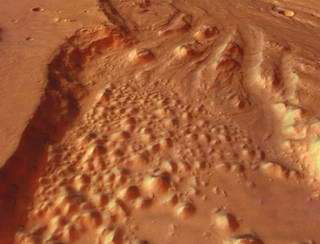
These images, taken by the High Resolution Stereo Camera (HRSC) aboard ESA’s Mars Express spacecraft, show a large depression called Iani Chaos and the upper reaches of a large outflow channel called Ares Vallis.
Image strips were taken in October 2004, during three orbits from a 350-kilometre altitude, with a resolution of 15 metres per pixel. The strips have then been matched to a mosaic that covers an area from 17.5º western longitude to 3º North. The Iani Chaos depression – 180 kilometres long and 200 kilometres wide – is connected to the beginning of Ares Vallis by a 100-kilometre wide transition zone.

Image: Disrupted pattern of rock blocks between Iani Chaos and Ares Vallis

From here, Ares Vallis continues its course for about 1400 kilometres through the ancient Xanthe Terra highlands, bordered by valley flanks up to 2000 metres high. Eventually Ares Vallis empties into Chryse Planitia.

These images help illuminate the complex geological history of Mars. Ares Vallis is one of several big outflow channels on Mars in this region that formed billions of years ago. Many surface features suggest that erosion of large water flows had carved Ares Vallis in the Martian landscape.

Overview of Iani Chaos and Ares Vallis

Overview of Iani Chaos and Ares Vallis. Credits: ESA/DLR/FU Berlin (G. Neukum)

Most likely gigantic floods ran downhill, carving a deep canyon into Xanthe Terra. Rocks eroded from the valley flanks were milled into smaller fractions and transported in the running water.

Finally this sedimentary load was deposited far north at the mouth of Ares Vallis in the Chryse plains, where NASA’s Mars Pathfinder landed in 1997 to search for traces of water with its small Sojourner rover.

The scenes displayed in the images show the transition zone between Iani Chaos and Ares Vallis. A chaotic distribution of individual blocks of rock and hills forms a disrupted pattern. These ‘knobs’ are several hundred metres high. Scientists suggest that they are remnants of a preexisting landscape that collapsed after cavities had formed beneath the surface.

The elongated curvature of features extending from south to north along with terraces, streamlined 'islands' and the smooth, flat surface in the valley centre are strong hints that it was running water that carved the valley.

Ice stored in possible cavities in the Martian highland might have been melted by volcanic heat. Pouring out, the melting water would have followed the pre-existing topography to the northern lowlands.

Cliffs and possible lava layers in Xanthe Terra

Cliffs and possible lava layers in Xanthe Terra. Credits: ESA/DLR/FU Berlin (G. Neukum)

A hundred kilometres further, a ten-kilometre-wide valley arm merges into Ares Vallis from the west. Large amounts of water originating from Aram Chaos (outside the image) joined the stream of Ares Vallis. Fan-shaped deposits on the valley floor are the remnants of landslides at the northern flanks.

At the freshly eroded cliffs possible lava layers are visible: such layers are found almost everywhere in Xanthe Terra. Further downstream, another valley branch enters Ares Vallis from the east after passing through an eroded impact crater in Xanthe Terra. West of Ares Vallis, a subtler riverbed is running parallel to the main valley.

Link: This flyover video is based on the digital terrain model from the stereo channels and the colour data.

Source: ESA


print this article email this article download pdf blog this article bookmark this article     Stumble it Digg this share on Facebook retweet share on Reddit add to delicious
Rate this story - not rated yet


June 1, 2005 all stories

Comments: 0

not rated yet
  • Stumble this up

  • Digg this

  • share this

  • hide
  • Related Stories

  • Phoenix probe lands on Mars (Update 4)
    created May 25, 2008 | popularity not rated yet | comments 0
  • Pulselike and Cracklike Ruptures in Earthquake Experiments
    created Dec 03, 2007 | popularity not rated yet | comments 0
  • The mysterious ridges at the mouth of Tiu Valles
    created Sep 12, 2007 | popularity not rated yet | comments 0
  • The first hiking maps of Mars
    created Feb 12, 2007 | popularity not rated yet | comments 0
  • Scientists develop DNA origami nanoscale breadboards for carbon nanotube circuits
    created Nov 10, 2009 | popularity not rated yet | comments 0


Other News

Fermi Telescope Peers Deep into Microquasar

Fermi Telescope Peers Deep into Microquasar (w/ Video)

Space & Earth / Astronomy

created 17 hours ago | popularity 4.7 / 5 (10) | comments 0

(PhysOrg.com) -- NASA's Fermi Gamma-ray Space Telescope has made the first unambiguous detection of high-energy gamma-rays from an enigmatic binary system known as Cygnus X-3. The system pairs a hot, massive ...


The Energy Sources of Ultraluminous Galaxies

The Energy Sources of Ultraluminous Galaxies

Space & Earth / Astronomy

created 18 hours ago | popularity 4.5 / 5 (13) | comments 1

(PhysOrg.com) -- Ultraluminous infrared galaxies ((ULIRGs) are galaxies whose luminosity exceeds that of a trillion suns; for comparison, the Milky Way galaxy has a typical (and much more modest) luminosity ...


New climate targets may not change daily life much (AP)

New climate targets may not change daily life much

Space & Earth / Environment

created 22 hours ago | popularity 3.8 / 5 (13) | comments 9

(AP) -- Americans' day-to-day lives won't change noticeably if President Barack Obama achieves his newly announced goal of slashing carbon dioxide pollution by one-sixth in the next decade, experts say.


Space shuttle Atlantis, 7 astronauts back on Earth (AP)

Space shuttle Atlantis, 7 astronauts back on Earth

Space & Earth / Space Exploration

created 19 hours ago | popularity not rated yet | comments 0

(AP) -- Space shuttle Atlantis and its seven astronauts returned to Earth with a smooth touchdown Friday to end an 11-day flight that resupplied the International Space Station.


China is set to launch its second moon orbiter next October, state media have reported

China to launch second lunar probe: state media

Space & Earth / Space Exploration

created 23 hours ago | popularity 5 / 5 (5) | comments 0

China will launch its second moon orbiter next October, state media reported Friday, as it powers ahead with a space programme that has sparked concerns abroad.