European funding for research on Biomolecular Nanomachines
Scientists from the Max Planck Institute of Colloids and Interfaces, Potsdam, and from eight other scientific institutions in Germany, France, the Netherlands, and Italy have received 2 Million Euro from the European Union for research on "Active Biomimetic Systems". These systems involve two types of biomolecular nanomachines, growing filaments and stepping motors, which are able to generate force in the nanodomain. The research network, which is coordinated by Prof. Reinhard Lipowsky, will elucidate the molecular mechanism underlying this force generation and will explore new possibilities for the integration of these molecular machines into nano- and microsystems. The network was launched on May 1, 2005.
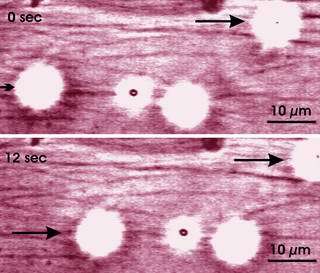
Image: Two snapshots of micrometer beads (bright spots) which are transported along essentially parallel microtubules (dark lines). The microtubules are immobilized on a glass substrate in an oriented manner with all their plus ends pointing to the right. The beads are pulled by stepping motors that are too small to be visible. The lower and the upper snapshot are 12 seconds apart. During this time interval, the beads have been displaced by about 10 micrometers. Image: Max Planck Institute of Colloids and Interfaces
Biomimetic systems mimic or imitate certain aspects of biological systems. One astounding aspect of biological cells is their ability to undergo dramatic morphological transformations: they can adapt their shape in order to squeeze themselves through very narrow pores, they can extend long `feet’ in order to crawl along surfaces, and they can divide themselves up into two daughter cells. All of these transformation processes are based on two types of biomolecular nanomachines: growing filaments and stepping motors.
Both types of nanomachines are constructed from proteins but use distinct mechanisms for force generation. Filaments are rod-like structures with a thickness of about 10 nanometers but a length of many micrometers. One end of the filament grows by the addition of nanometer-sized building blocks and, in this way, generates a pushing force. Stepping motors are proteins with two identical `legs’, which are about 10 nanometers in size. When in contact with a filament, such a motor undergoes a certain conformational transformation, a so-called "power stroke", which enables the motor to generate a pulling force.
Because of its small size, a single nanomachine generates a rather small force in the order of a few piconewtons (10-12 newtons). In addition, a single nanomachine is rather sensitive to its environment and is easily perturbed by thermal collisions with the surrounding molecules. It is quite remarkable, however, that all forces generated by living cells and organisms arise from the combined action of groups of such nanomachines. In this way, single cells can exert forces in the nanonewton range, and animals can generate forces of hundreds of newtons. Thus, biological systems are able to cover a very wide range of forces between a few piconewtons and several hundred newtons. In order to mimic this amazing ability, one must integrate bundles of filaments and groups of motors into larger and more complex systems. This provides a fundamental challenge for the bionano sciences.
The newly established European Research Network on "Active Biomimetic Systems", which is coordinated by Prof. Reinhard Lipowsky at the Max Planck Institute of Colloids and Interfaces, has several goals. First, to obtain a deeper understanding of the molecular processes that are responsible for the generation of the pushing and pulling forces. Second, to elucidate the cooperative behavior of filaments and motors in bundles, random meshworks, and more complex spatial arrangements. One example is provided by the nano-highways shown in Figure 1. Third, to control and vary the properties of these active biomimetic systems in a systematic and reliable manner and, thus, to optimize their architecture and to improve their design.
The research performed in this network is highly interdisciplinary and combines (bio)chemical preparation, (bio)physical characterization, and theoretical modelling. It therefore represents a concerted effort of scientists from biophysics, biochemistry, physical chemistry, and bioengineering. The participating institutions are: Max Planck Institute of Colloids and Interfaces, Potsdam; AMOLF Institute, Amsterdam; BASF, Ludwigshafen; Curie Institute, Paris; European Molecular Biology Laboratory, Heidelberg; Institute of Molecular Biotechnology, Jena; CNRS Laboratory on enzymology and structural biochemistry, Gif-sur-Yvette; Politecnico of Milan; and University of Leipzig.
Active biomimetic systems as pursued in the new research network have many possible applications as drug delivery systems, molecular sorting devices, diagnostic tools for cell screening, or scaffolds for tissue engineering. One long term vision is the construction of nanorobots, which can perform work and other useful tasks in the nano-domain. These tiny robots would have a large impact on many aspects of human life. In medicine, for example, nanorobots could be used for diagnostics on the level of single cells, for drug delivery to specific target cells, and for noninvasive surgery of very small regions of the human body. Likewise, such robots would represent important components for the development of nano-scale manufacturing. This type of manufacturing seems rather appealing in order to assemble distinct molecular components into integrated nanosystems with a complex supramolecular architecture.
Source: Max Planck Institute of Colloids and Interfaces


