Green diesel: New process makes fuel from plants
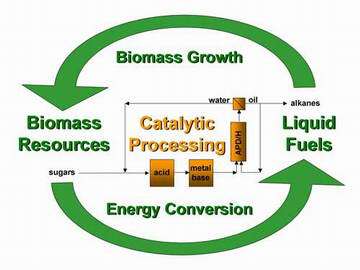
College of Engineering researchers have discovered a new way to make a diesel-like liquid fuel from carbohydrates commonly found in plants.
Reporting in the June 3 issue of the Journal Science, Steenbock Professor James Dumesic and colleagues detail a four-phase catalytic reactor in which corn and other biomass-derived carbohydrates can be converted to sulfur-free liquid alkanes resulting in an ideal additive for diesel transportation fuel. Co-researchers include chemical and biological engineering graduate students George Huber, Juben Chheda and Chris Barrett.
Image: Catalytic processing
"It's a very efficient process," says Huber. "The fuel produced contains 90 percent of the energy found in the carbohydrate and hydrogen feed. If you look at a carbohydrate source such as corn, our new process has the potential to create twice the energy as is created in using corn to make ethanol."
About 67 percent of the energy required to make ethanol is consumed in fermenting and distilling corn. As a result, ethanol production creates 1.1 units of energy for every unit of energy consumed. In the UW-Madison process, the desired alkanes spontaneously separate from water. No additional heating or distillation is required. The result is the creation of 2.2 units of energy for every unit of energy consumed in energy production.
"The fuel we're making stores a considerable amount of hydrogen," says Dumesic. "Each molecule of hydrogen is used to convert each carbon atom in the carbohydrate reactant to an alkane. It's a very high yield. We don't lose a lot of carbon. The carbon acts as an effective energy carrier for transportation vehicles. It's not unlike the way our own bodies use carbohydrates to store energy."
About 75 percent of the dry weight of herbaceous and woody biomass is comprised of carbohydrates. Because the UW-Madison process works with a range of carbohydrates, a wide range of plants, and more parts of the plant, can be consumed to make fuel.
"The current delivered cost of biomass is comparable or even cheaper than petroleum-based feedstock on an energy basis," Huber says. "This is one step in figuring out how to efficiently use our biomass resources."
Source: University of Wisconsin


