3D Magnetic Sensor for Rapid-Reaction Gas Pedal
June 5, 2005 3D Magnetic Sensor for Rapid-Reaction Gas Pedal

Gas and brake pedals have to react quickly and reliably if the occupants of the vehicle are not to be unnecessarily endangered. Engineers have developed a 3D magnetic sensor which digitally registers the pedal deflection by its angle. BMW is currently testing the system.

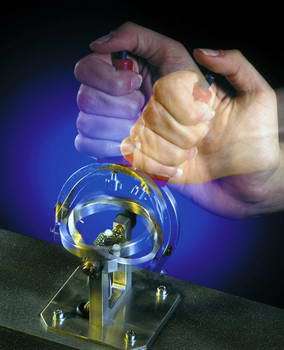
Image: In a joystick, the sensor measures the spatial position of a small magnet. From it, the evaluation electronics determines the position of the lever. © Fraunhofer IIS/Kurt Fuchs

When a driver has to slam on the brakes in an emergency, or when making a miscalculated overtaking maneuver, fractions of a second can often decide between life and death. The brake and gas pedals therefore have to react very quickly. By depressing the gas pedal, the driver sets off an elaborate mechanical system that causes a disk to swivel. Several magnetic-field sensors close to the disk register the angular speed. A linear movement is thus converted into a circular one, and this in turn is converted into the electrical signal used to control the engine and the brake. The conversion takes time, is technically complex and makes the entire system expensive.

Research engineers at the Fraunhofer Institute for Integrated Circuits IIS have developed a new process which instantly translates the deflection of the gas pedal into an electrical signal. “This renders the chain of signals through to the computer control system completely digital - eliminating the need for error-prone transmission mechanisms,” explains marketing director Klaus Taschka. “Our sensor is located under the gas pedal and measures the magnetic field in all three spatial directions simultaneously, to an accuracy of 0.1 degrees. This is unique worldwide.”

Like its one-dimensional predecessors the sensor measures on the basis of the Hall effect: When a conductor carries current across a magnetic field the electrons are deflected to the side, producing a transverse voltage which is proportional to the strength of the magnetic field. The sensor is produced using inexpensive standard CMOS techniques. It is inserted in a microchip on which the research engineers have also integrated most of the evaluation electronics. In order to identify errors quickly, the sensor monitors itself: A small coil surrounding it is switched on periodically, and the sensor measures the additional magnetic field. If the sensor is defective, no extra signal is received by the vehicle’s control system and the driver is informed of the fault.

Development engineers at BMW have already subjected the magnetic sensor to precision testing in the laboratory. Further tests are planned on gas, brake and clutch pedals. However, the sensor’s 3D measurement principle makes it equally good at registering the position of car headlights, joysticks and other moving machine components.

Source: Fraunhofer-Institut für Integrierte Schaltungen


print this article email this article download pdf blog this article bookmark this article     Stumble it Digg this share on Facebook retweet share on Reddit add to delicious
Rate this story - 1 /5 (1 vote)


June 5, 2005 all stories

Comments: 0

1 /5 (1 vote)
  • Stumble this up

  • Digg this

  • share this

  • hide
  • Related Stories

  • SMOS, Proba-2: Two new ESA satellites successfully lofted into orbit (w/ Video)
    created Nov 02, 2009 | popularity not rated yet | comments 0
  • Hyper-SAGE boosts remote MRI sensitivity
    created Oct 09, 2009 | popularity not rated yet | comments 0
  • Quantum cat's 'whiskers' offer advanced sensors
    created Apr 24, 2009 | popularity not rated yet | comments 0
  • The Day the Sun Brought Darkness (w/Video)
    created Mar 13, 2009 | popularity not rated yet | comments 0
  • 'NMR on a chip' features magnetic mini-sensor
    created Feb 19, 2008 | popularity not rated yet | comments 0


Other News

Intel logo A

Intel wants a chip implant in your brain

Technology / Hi Tech

created 22 hours ago | popularity 4.1 / 5 (16) | comments 28

(PhysOrg.com) -- Computer chip maker Intel wants to implant a brain-sensing chip directly into the brains of its customers to allow them to operate computers and other devices without moving a muscle.


Just in time for Black Friday: students turn iPhone into barcode scanner

Just in time for Black Friday: students turn iPhone into barcode scanner

Technology / Software

created 10 hours ago | popularity 4.7 / 5 (3) | comments 0

(PhysOrg.com) -- Comparing prices over the Internet has become a common practice for consumers. Now, just in time for Black Friday, a group of Missouri University of Science and Technology students is putting ...


IBM Researchers Lower Language Barrier With Text Translator

Technology / Computer Sciences

created 12 hours ago | popularity 4.5 / 5 (4) | comments 0

IBM Researchers are helping to break the language barrier with the advent of technology dubbed "n.Fluent" -- smart software that translates text between English and 11 other languages. IBM employees use it to instantaneously ...


The KLM airplane which runs on biokerosene is seen at Schiphol airport, near Amsterdam

KLM flies world's first 'passenger flight on biofuel'

Technology / Energy

created 11 hours ago | popularity 5 / 5 (1) | comments 0

A Boeing 747, one of four engines powered by a 50-percent biokerosene mix, circled the Netherlands for an hour on Monday for what airline KLM called the world's first passenger flight using biofuel.


Microsoft has held talks with Rupert Murdoch's News Corp over removing its news websites from Google, a report said

News Corp, Microsoft hold talks on Google: report

Technology / Internet

created 23 hours ago | popularity 1.8 / 5 (6) | comments 4

Microsoft has held talks with Rupert Murdoch's News Corp over a possible plan for the software giant to pay the media company to remove its news websites from Google, a report said Monday.