Exploding Star Left No Visible Core
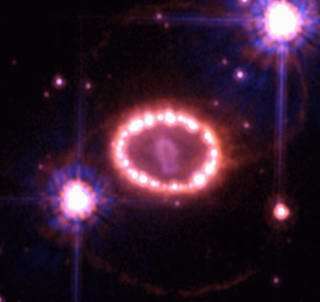
In 1987, earthbound observers saw a star explode in the nearby dwarf galaxy called the Large Magellanic Cloud. Astronomers eagerly studied this supernova-the closest seen in the past 300 years-and have continued to examine its remains. Although its blast wave has lit up surrounding clouds of gas and dust, the supernova appears to have left no core behind. Astronomers now report that even the sharp eyes of the Hubble Space Telescope failed to locate the black hole or ultracompact neutron star they believe was created by the star's death 18 years ago.
Image: The remnant of supernova 1987A shows no sign of the neutron star scientists believe is lurking at its heart. The Hubble Space Telescope took this image in December 2004. Credit: P. Challis & R. Kirshner (Harvard-Smithsonian Center for Astrophysics)
"We think a neutron star was formed. The question is: Why don't we see it?" said astronomer Genevieve Graves of UC Santa Cruz, first author on the paper announcing these results.
"Therein lies the mystery-where is that missing neutron star?" mused co-author Robert Kirshner of the Harvard-Smithsonian Center for Astrophysics (CfA).
When a massive star explodes, it leaves behind some sort of compact object, either a city-sized ball of subatomic particles called a neutron star, or a black hole. The outcome depends on the mass of the progenitor star. Smaller stars form neutron stars while larger stars form black holes.
The progenitor of supernova (SN) 1987A weighed 20 times as much as the sun, placing it right on the dividing line and leaving astronomers uncertain about what type of compact object it produced. All observations to date have failed to detect a light source in the center of the supernova remnant, leaving the question of the outcome unanswered.
Detecting a black hole or neutron star is challenging. A black hole can be detected only when it swallows matter, because the matter heats up and emits light as it falls into the black hole. A neutron star at the distance of the Large Magellanic Cloud can be detected only when it emits beams of radiation as a pulsar, or when it accretes hot matter like a black hole.
"A neutron star could just be sitting there inside SN 1987A, not accreting matter and not emitting enough light for us to see," said astronomer Peter Challis (CfA), second author on the study.
Observations have ruled out the possibility of a pulsar within SN 1987A. Even if the pulsar's beams were not aimed at the earth, they would light the surrounding gas clouds. However, theories predict that it can take anywhere from 100 to 100,000 years for a pulsar to form following a supernova, because the neutron star must gain a sufficiently strong magnetic field to power the pulsar beam. SN 1987A may be too young to hold a pulsar.
As a result, the only way astronomers might detect the central object is to search for evidence of matter accreting onto either a neutron star or a black hole. That accretion could happen in one of two ways: spherical accretion in which matter falls in from all directions, or disk accretion in which matter spirals inward from a disk onto the compact object.
The Hubble data rule out spherical accretion because light from that process would be bright enough to detect. If disk accretion is taking place, the light it generates is very faint, meaning that the disk itself must be quite small in both mass and radial extent. Also, the lack of detectable radiation indicates that the disk accretion rate must be extremely low-less than about one-fifth the mass of the Moon per year.
In the absence of a definitive detection, astronomers hope to learn more about the central object by studying the dust clouds surrounding it. That dust absorbs visible and ultraviolet light and re-radiates the energy at infrared wavelengths.
"By studying that reprocessed light, we hope to find out what's powering the supernova remnant and lighting the dust," said Graves. Future observations by NASA's Spitzer Space Telescope should provide new clues to the nature of the hidden object.
Additional observations by Hubble also could help solve the mystery. "Hubble is the only existing facility with the resolution and sensitivity needed to study this problem," said Kirshner.
Links:
The paper describing these findings is online at arxiv.org/abs/astro-ph?0505066
Harvard-Smithsonian Center for Astrophysics


