Quantum dots detect viral infections
In what may be one of the first medical uses of nanotechnology, a chemist and a doctor who specializes in infectious childhood diseases have joined forces to create an early detection method for a respiratory virus that is the most common cause of hospitalization among children under five.
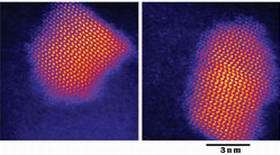
Image: Scanning electron microscope view of individual quantum dots shows individual atoms. Courtesy of Sandra Rosenthal and James McBride
Respiratory syncytial virus (RSV) sends about 120,000 children to the hospital in the United States each year. Although it is only life-threatening in one case out of every 100, it infects virtually all children by the time they are five. Few children in the U.S. die from RSV, but it also attacks the elderly, causing some 17,000 to 18,000 deaths annually. Individuals with impaired immune systems are another highly susceptible group. Vanderbilt researchers report that not only can a quantum dot system detect the presence of RSV particles in a matter of hours, rather than the two to five days required by current tests, but it is also more sensitive, allowing it to detect the virus earlier in the course of an infection
Current methods of detecting the virus can take from two to six days, postponing effective treatment. The new, high-tech method uses multi-colored, microscopic fluorescent beads, called quantum dots, which bind to molecular structures that are unique to the virus’s coat and the cells that it infects. In a paper appearing in the June issue of the journal Nanoletters, the Vanderbilt researchers report that not only can a quantum dot system detect the presence of particles of the respiratory syncytial virus (RSV) in a matter of hours, rather than the two to five days required by current tests, but it is also more sensitive, allowing it to detect the virus earlier in the course of an infection.
“The problem with current detection technologies is that they take too long,” says Professor of Pediatrics James E. Crowe, Jr. who collaborated with Associate Professor of Chemistry David W. Wright in the development. “When a patient with a respiratory illness comes in to the doctor, emergency room or clinic, some times their symptoms are caused by bacteria and some times they are caused by viruses. There are specific medicines to treat some viral infections and there are definitely antibiotics to treat bacteria. Yet current detection tests take up to five days to tell you if a virus is present and another day or so to tell you which virus it is.”
Crowe lists three potential benefits for such an early detection system. It can:
-- Increase the proper use of antiviral medicines. Although such medicines have been developed for some respiratory viruses, they are not used often as therapy because they are only effective if given early in the course of infection. By the time current tests identify the virus, it is generally too late for them to work.
-- Reduce the inappropriate use of antibiotics: Currently, doctors often prescribe antibiotics for respiratory illnesses. However, antibiotics combat respiratory illness caused by bacteria and are ineffective on viral infections. An early virus detection method would reduce the frequency with which doctors prescribe antibiotics for viral infections inappropriately, thereby reducing unnecessary antibiotic side-effects and cutting down on the development of antibiotic-resistance in bacteria.
-- Allow hospital personnel to isolate RSV patients: RSV is extremely infectious so early detection would allow hospital personnel to keep the RSV patients separate from other patients who are especially susceptible to infection, such as those undergoing bone-marrow transplants.
It is much easier to get approval for a new diagnostic test than a new drug. So the researchers estimate that it will take only two to three years to develop and validate the new test. “All the components are off-the-shelf,” Wright adds, “so any one can put together one of these detection system if they want to.”
The system should also be relatively inexpensive. The most costly ingredient is the quantum dots: A small bottle that contains enough of the material for about 200 tests costs $300.
As a result, this could be one of the earliest medical applications of nanotechnology, Wright and Crowe say.
The researchers’ next step will be to develop a quantum dot cocktail capable of simultaneously detecting the presence of at least five major respiratory viruses: influenza A and B, parainfluenza and metapneumovirus, in addition to RSV. This should be fairly straightforward, Wright says. In the current paper, Wright and Crowe demonstrate that they can use two different colors of quantum dots simultaneously. The colored quantum dots are attached to different “linker” molecules that bind to different RSV surface structures.
“It’s not much of a jump from two to five,” Wright says. Quantum dots are available in a dozen different colors, and antibodies specific to the other four respiratory viruses have been identified and can be used as linker molecules. Such a test would be able to diagnose more than 90 percent of all the cases of viral respiratory infection, he says.
The existence of such a test could encourage the development of improved therapies for respiratory viruses, Crowe says. Without a good diagnostic for a specific viral infection, drug companies don’t have much motivation to develop effective treatments because doctors are unlikely to prescribe them very often.
Currently, there are three diagnostic tests available for identifying respiratory viruses like RSV. The “gold standard” involves incubating an infected sample in a tissue culture for five days and then using a fluorescent dye to test for the presence of the virus. The main problem with this technique is that the virus is multiplying in the patient at the same time as it is growing in the culture.
This has caused many hospitals to switch to a technique called real time PCR, which is extremely sensitive but still takes 36 to 48 hours because of the need for a highly trained molecular biologist to conduct the test in a reference laboratory. There is also a third method, called the antigen test, which only takes 30 minutes. However, it is not sensitive enough to detect the presence of the virus at the early stages of an infection.
By comparison, the new quantum dot method takes one to two hours and is even more sensitive than real time PCR. “It can detect the presence of RSV within an hour after the virus is added to a culture,” says Wright.
“There is a tremendous amount of hype about nanotechnology,” says Crowe, “but this is a real-world, practical application that’s here now.”
The participation of the Wright lab was made possible by funding from the National Science Foundation and Vanderbilt University. That of the Crowe lab was supported by grants from the National Institutes of Health and the March of Dimes.
Source: Vanderbilt University (By David F. Salisbury)


