Bridges and buildings 'sense' cracks, damage with wireless devices
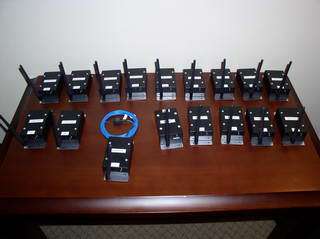
Imagine a bridge that's able to self-diagnose cracks or a building able to assess its own health after an earthquake, without any help from humans.
Networks of wireless sensors embedded in buildings, roads, bridges and other infrastructure hold that promise. In the first large-scale field test of the technology, University of Michigan researchers in conjunction with Stanford University and the Korean Advanced Institute of Science and Technology found that a wireless network of 14 sensors performed as well as traditional cabled-based monitoring systems.
To come to this conclusion, two structural monitoring systems (tethered and wireless) were tested simultaneously on the Geumdang Bridge in Icheon, South Korea, said Jerome Lynch, U-M assistant professor with appointments in civil and environmental engineering and electrical engineering and computer science. The results will be presented later this month at the International Conference on Structural Safety and Reliability in Rome.
There are several reasons scientists are trying to develop wireless networks to replace traditional cable-based monitoring methods used to assess the health or safety conditions of infrastructure, Lynch said. Wireless sensors are potentially much less expensive, more functional, and take less time to install and upkeep.
For instance, the wireless network on the Geumdang Bridge took just one hour to install, compared to an entire day for its cable-based counterpart, Lynch said. The battery-powered sensors are about as big as a deck of cards and cost about $100 each—$1,400 for the entire system—compared to $10,000 to $15,000 for the cable-based system.
Eventually, wireless monitoring systems could render obsolete the practice of sending engineers inside possibly unsafe building to assess damage after earthquakes, Lynch said.
"You will be able to have untrained maintenance people install the sensors in all types of infrastructure systems," Lynch said.
The sensors can also ferret out damage that isn't clearly visible. For example, special sensors that emit electricity into structures can detect interior damage if say, an internal crack invisible to the naked eye disrupts the electrical current, Lynch said.
In the Geumdang experiment in late December, researchers took measurements for three days, recording the vibrations made by different sized trucks driving over the bridge. Each sensor processes data locally and the unit communicates a few key data points to a central computer. That cuts down on data glut, and also saves battery power in the unit, Lynch said.
"If you want the system to determine its health, you want it to be self-sufficient computatively," Lynch said.
The Michigan Department of Transportation will use the same set of wireless sensors this summer to measure potential crack patterns in a slab of Engineered Cement Composite, a new civil engineering material designed at U-M College of Engineering. MDOT will use the ECC to retrofit a section of the Grove Street bridge deck over I-94 in Ypsilanti.
For more information on civil engineering, visit: www.engin.umich.edu/dept/cee/
Source: University of Michigan


