Astronomers to Look to Distant Galaxies with Balloon-Borne Telescope
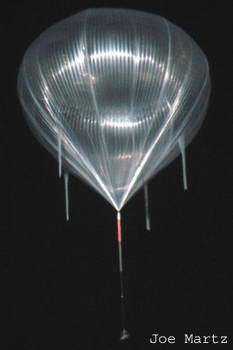
An international team of researchers, led by astronomers at the University of Pennsylvania, has launched the most highly sensitive telescope of its kind to be carried by balloon. The Balloon-borne Large Aperture Sub-millimeter Telescope or BLAST will take a five to nine-day journey along the upper reaches of Earth's atmosphere. BLAST will collect images of objects in our solar system as well as the distant light that details the formation of stars and the evolution of whole galaxies.
The balloon launched on June 11th from the Swedish Space Corporation facility in Kiruna, Sweden and follow the atmospheric currents toward Canada where it will be recovered.
Suspended by a massive (37 million cubic foot) unmanned helium balloon, the BLAST will float 126,000 feet up, to the edge of space -- past the pollution and atmospheric conditions that hamper the abilities of even the best Earthbound telescopes. When fully inflated, the balloon would fill a football stadium.
"While BLAST won't become a permanent fixture in the sky, balloon-based astronomy offers many of the perks of space-based telescopes at a fraction of the cost of actually putting a telescope in orbit and maintaining it," said Mark Devlin, principle investigator for the BLAST project and associate professor in Penn's Department of Physics and Astronomy.
The telescope's mirror measures two meters (6.5 feet) in diameter and will be capable of surveying a patch of sky about four times the size of the moon to look for faint stellar objects. The entire telescope weighs 2000 kilograms (about 4400 pounds).
On board, 260 detectors, about 20 times as many ever used on a balloon telescope flight, will convert photons from the observed objects into heat. A rise in temperature would thereby measure the number of photons from galaxies formed 5 to 12 billion years ago, when the universe was one-tenth its current age. The detectors will capture light at three separate wavelengths. By measuring the number of photons at each wavelength of light from an object, the astronomers could determine how far away the object is as well as its luminosity.
The goal of the project is to conduct a series of experiments to help accurately theories of the formation of stars within our own galaxy as well as the formation of other galaxies. Chief among those is a series of extra-galactic surveys to identify the distant galaxies responsible for producing the background levels of light and radiation that we see throughout the Universe. In addition, BLAST will survey the molecular clouds associated with the earliest stages of star formation. Closer to home, BLAST will observe features of our own Solar System including planets, and large asteroids.
"Not only are we collecting some unique and interesting information about the universe, but we are also pioneering technologies that will pave the way for other planned balloon projects," Devlin said. "Of course, once we have our data, the real hard part comes in figuring out what all this information means.
Along with Devlin, the Penn BLAST contingent is comprised of Ed Chapin, Simon Dicker, Jeff Klein, Marie Rex and Chris Semisch. In its entirety, the BLAST project is a collaboration between Penn researchers and colleagues at Brown University, the University of Toronto, the University of British Columbia, the University of Miami, the Jet Propulsion Laboratory, Cardiff University and the Instituto Nacional de Astrofisica of Mexico.
Support for the research was provided by NASA, the Canadian Space Agency and the United Kingdoms Particle Physics and Astronomy Research Council (PPARC).
Links:
Technical details about BLAST can be found online at: chile1.physics.upenn.edu/blastpublic/index.shtml
Ongoing details about the launch can be found at the blog of University of British Colombia graduate student Gaelen Marsden (www.physics.ubc.ca/~gmarsden/kiruna_2005/) and the blog of University of Toronto graduate student Don Weibe (gimli.physics.utoronto.ca/Kiruna_2005/).
Global positioning system tracking of BLAST can be found at NASA's National Scientific Balloon Facility's website: www.nsbf.nasa.gov/sweden/sweden05.htm


