SMA Confirms Proto-Planetary Systems are Common in the Galaxy
Meeting this week in Cambridge, Mass., astronomers using the Submillimeter Array (SMA) on Mauna Kea, Hawaii, confirmed, for the first time, that many of the objects termed "proplyds" found in the Orion Nebula do have sufficient material to form new planetary systems like our own.
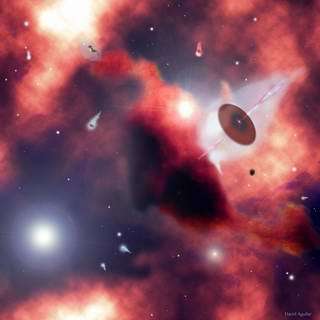
Image: In this artist rendering, the proplyds appear as rapidly spinning stars surrounded by a dust disk around the middle and two stellar jets extending from the poles. Nestled inside a cocoon of gas, these jets slow down the angular momentum of the spinning star so that eventually, planets may form. Artwork Credit: David Aguilar, CfA
"The SMA is the only telescope that can measure the dust within the Orion proplyds, and thereby assess their true potential for forming planets. This is critical in our understanding of how solar systems form in hostile regions of space," said Jonathan Williams of the University of Hawaii Institute for Astronomy, lead author on a paper submitted to The Astrophysical Journal.
Surviving in the chaotic regions within the Orion Nebula where stellar winds can reach a staggering two million miles per hour and temperatures exceed a searing 18,000 degrees Fahrenheit, the question remained - would enough material endure to form a new solar system or would it be eroded away into space like wind and sand eroding away desert cliffs? It now appears that these protoplanetary disks are quite tenacious, bringing new grounds for optimism in the search for planetary systems.
Imaged by the Hubble Space Telescope back in the early 1990s as misshapen silhouettes against the nebular background, the most spectacular proplyds appear bright. Their surrounding ionized cocoons glow due to their close proximity to a nearby hot star formation called the Trapezium. The Trapezium is a star cluster consisting of more than 1,000 young, hot stars that are only 1 million years old. They condensed out of the original cold, dark cloud of gas that now glows from their ionizing light. They are crowded into a space about 4 light-years in diameter, the same as the distance between the Sun and Proxima Centauri, the next closest star in space.
Blasted by the solar winds of the Trapezium, the proplyds are the next generation of smaller stars to arise in Orion, this time with visible discs that may be forming planets. It has remained unclear, however, whether they contained enough material to form stable planetary systems. Using the SMA, astronomers now have been able to probe deep inside these disks to measure their mass and to unravel the formation process presented by these potential infant solar systems.
"While the Hubble pictures were spectacular, they revealed only disk-like shapes that did not tell us the amount of material present," said David Wilner, of the Harvard-Smithsonian Center for Astrophysics (CfA). Since some of the discs appear to be comparable in size and mass to our own solar system, this strengthens the connection between the Orion proplyds and our origins.
Since most Sun-like stars in the Galaxy eventually form in environments like the Orion Nebula, the SMA results suggest that the formation of solar systems like our own is common and a continuing event in the Galaxy.
"The same cycle of birth, life and death we experience here on Earth is repeated in the stars overhead. Now, the SMA provides us with a front-row seat in unraveling the wonder of these cosmic events," reflected Wilner.
Headquartered in Cambridge, Mass., the Harvard-Smithsonian Center for Astrophysics (CfA) is a joint collaboration between the Smithsonian Astrophysical Observatory and the Harvard College Observatory. CfA scientists, organized into six research divisions, study the origin, evolution and ultimate fate of the universe.
Source: Harvard-Smithsonian Center for Astrophysics


