Atmospheric Omens: Scientists Gain New Insights into Spring Onset; Better Forecasting Expected
Forget about the groundhog and his shadow. Scientists have discovered that the interplay between two layers of the atmosphere plays a major role in the arrival of spring -- a finding that could lead to improved weather and climate forecasting.
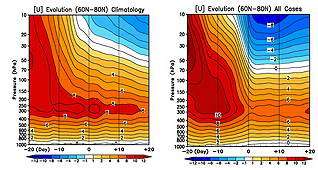
These figures represent the longitudinally averaged windfield at high latitudes. The figure on the left shows a sequence of long-term daily averages with Day 0 corresponding to April 13. The figure on the right represents a 40-year composite time evolution created by aligning seasonal final warming (SFW) events, which are indicated as Day 0. Areas in red indicate westerly winds, and the areas in blue depict easterly winds.
“Our research indicates that the onset of spring is more rapid than suggested by the annual cycle of long-term daily averages and is linked to an event known as the stratospheric final warming,” said Robert Black, an associate professor at the Georgia Institute of Technology’s School of Earth and Atmospheric Sciences (EAS).
Black will give a presentation, “Spring onset in the Northern Hemisphere: A role for the stratosphere?” on June 16 at the American Meteorological Society’s 17th Conference on Climate Variability and Change in Cambridge, Mass. There, he will discuss a study begun last summer with co-researchers Walter Robinson, a professor of atmospheric sciences at the University of Illinois at Urbana-Champaign, and Brent A. McDaniel, a post-doctoral scholar at Georgia Tech.
Results from this study, part of an ongoing project sponsored by the National Science Foundation (NSF), are expanding scientists’ understanding of atmospheric interaction.
For many years, scientists believed that the troposphere (the lowest region of atmosphere where weather occurs) drove changes in the stratosphere (atmospheric layer directly above the troposphere) without any feedback. Yet in the late 1990s, new studies found that the stratosphere can affect the tropospheric circulation.
These studies, however, focused on individual seasons. “Because the arrival of spring has a pronounced influence on the hydrological cycle, vegetative growing season and ecosystem productivity, we wanted to study the transition between seasons,” Black said. To that end, his team gathered observational data derived from a variety of sources and constructed a composite picture of spring’s arrival over a 40-year period.
As winter draws to a close, the westerly jet stream in the troposphere begins to weaken. At the same time, the westerly jet stream in the stratosphere above not only weakens, but eventually reverses direction to become easterly. Black and his colleagues discovered that this event, known as the stratospheric final warming, accelerates the weakening of the tropospheric winds.
“Instead of a gradual weakening over several weeks, it’s as if someone flipped a switch,” Black explained. “The transition from a winter to spring wind pattern occurs in about one week.”
Stratospheric final warming events are caused by large-scale Rossby waves, planetary waves that are produced when winds in the troposphere blow over different surfaces on the earth, such as major mountain ranges. These waves can extend into the stratosphere, where if their amplitude is great enough, they create a drag on the stratosphere’s westerly jet stream that can trigger a stratospheric final warming.
“These final warmings don’t happen at the same time every year,” Black said, noting that stratospheric final warmings occur as early as mid-March or as late as mid-May. The researchers also found that these events vary in their intensity, and final warmings that take place earlier in the year are typically more abrupt.
Granted, other factors also influence spring’s arrival, such as solar heating of the earth’s surface. “Still, stratospheric final warmings explain a significant part of the seasonal transition, especially in the Arctic,” Black said.
The next step is being able to accurately predict when a stratospheric final warming will occur. In the NSF-sponsored study, Black and his colleagues will attack the underlying physics of stratospheric final warming events that relate to spring onset.
“The ultimate goal is to provide concrete information for improving weather prediction models,” Black said. “Our study shows the extent to which the stratosphere is influencing the troposphere. So if we want to accurately predict spring onset in the troposphere, we need to be concerned about the stratosphere.”
There could also be implications for climate forecasting since global warming may impact how long the stratospheric jet stream persists every year. If spring arrives earlier or later, it can affect how efficiently the ecosystem functions. “Plants and animals may be able to adapt to a gradual change,” Black said, “but a dramatic change might wreak havoc.”
Source: Georgia Institute of Technology


