Long-Lost Da Vinci Masterpiece Found Behind Palazzo Walls
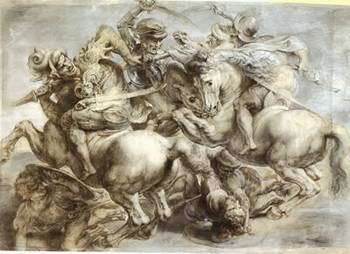
It could be a scene from the "Da Vinci Code:" A high-tech art sleuth finds a hollow space behind an Italian palazzo’s murals, and believes he may have discovered a Da Vinci masterpiece not seen since 1563.
In a case of life imitating art, Maurizio Seracini, an internationally recognized expert in high-technology art analysis, has done just that – and, in an odd twist, he does indeed appear, as himself, in Dan Brown’s popular bestseller about secrets hidden in Leonardo’s work – the book’s only non-fictional character.
Image: Detail from a copy of Leonardo da Vinci's long-lost "Battle of Anghiari," based on preliminary sketches and copies of the work during the artist's life. Maurizio Seracini, a noted art conservation and authentication expert, believes the fresco is hidden behind an existing fresco by the artist Giorgio Vasari in Florence's Palazzo Vecchio. Credit: The Louvre, Paris.
(In the “Da Vinci Code”, Seracini uses his investigational skills to show that Leonardo’s “Adoration of the Magi” has been painted over by other artists and can no longer be considered a true Da Vinci.)
Seracini, 55, an alumnus of the University of California, San Diego and a native Florentine, thinks he may be close to finding the lost fresco “Battle of Anghiari” behind murals by Giorgio Vasari in Florence’s Palazzo Vecchio. Using radar, x-rays and other devices, he discovered a narrow cavity behind the Vasari fresco “Battle of Marciano,” and believes that the latter artist, an admirer of the great Leonardo, intentionally created the space to preserve the master’s work.
“Leonardo’s ‘Battle of Anghiari’ was considered the highest work of art of the Renaissance at that time,” Seracini said. “For over 50 years afterwards, documents spoke of the wonderful horses of Leonardo with the highest admiration.”
If he and other researchers can prove that the Vasari murals conceal a greater treasure, “it may be possible,” Seracini believes, “to remove the Vasari fresco and the wall behind, extract Leonardo’s mural, and finally put the Vasari back in place.”
Seracini, who heads Editech -- a Florence-based company he founded in 1977 focused on the “diagnostics of cultural heritage” -- estimates that he’s worked on some 2,000 paintings, including 31 works by Raphael and three others by Da Vinci. Most of his equipment, he says, has been adapted from medical devices. Infrared, thermographic, ultraviolet and other kinds of scanners allow him to see images behind a painting’s visible layers.
Now those high-tech tools have peered behind a mural, into a palazzo’s walls, to find another mural, long thought destroyed or lost to the ages.
Art historians have known that “Battle of Anghiari” existed from early sketches, from the copies made by Da Vinci contemporaries, and from the writings of those who saw it – one of whom described it as “miraculous.”
Seracini received his bachelor’s degree from UCSD’s Revelle College in 1973; he majored in applied mathematics and bioengineering, and spoke at his alma mater in April, as a Bioengineering Distinguished Lecturer, on “The Role of Science in Conservation of Cultural Heritage.” In 1975, he received a degree in electronic engineering from the University of Padua in Italy.
He credits his UCSD teachers – who had him experiment with lasers on fragments of blackened marble from Venice and Florence – with the spark that “ignited a long-lasting desire to blend art and science.”
During his time as a student in San Diego, he also traveled to UCLA to study under Carlo Pedretti, a scholar of Renaissance art and a specialist in Da Vinci.
It was his mentor Pedretti, seeking a non-invasive way to search for Leonardo’s masterpiece, who steered Seracini to the murals in the Palazzo Vecchio.
The long-lost fresco Seracini may have found is also known by its Anglicized title “Battle of Angiers.” Begun in 1505, the painting is considered by many art historians to be Leonardo’s most important – and largest – masterpiece. Vasari, commissioned by the Medici family in 1593 to remodel the palazzo’s hall, might have covered the unfinished work with a wall.
Most art historians believe, says Seracini, that even if the incomplete Da Vinci fresco is behind the wall, it may have deteriorated beyond salvation. Like the doctor he studied to be, he takes a physician’s detached approach to the prospect. “We’ll investigate,” he says, “and see.” It’s the code Da Vinci himself might have followed.
Source: University of California, San Diego


