Cosmos 1 - First Solar Sail Spacecraft to be Launched on Tuesday
On June 21, Cosmos 1 - the world's first solar sail spacecraft - is set to launch atop a converted ICBM from a submerged Russian submarine in the Barents Sea.
The data obtained during the flight of Cosmos 1 will assist the world community in analyzing and developing future solar sail technologies. The mission will be controlled from the Lavochkin Association in Moscow. A Project Operations Center will be located at The Planetary Society in Pasadena, California.
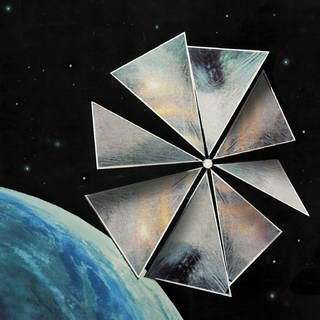
Image: The Solar Sail in Orbit. Credit: NPO Lavochkin, The Planetary Society (c)
Cosmos 1 will be the first mission to test the concept of sailing on light, using the pressure of photons to propel it through space. Reflected light pressure will push against eight giant reflective blades, designed to adjust to the continuously changing orbital energy and spacecraft velocity.
When Cosmos 1, the first solar sail spacecraft, launches on June 21, 2005, it will carry into Earth orbit a CD containing the names of over 75,000 members of The Planetary Society and the Japan Planetary Society, along with the works of early visionaries who inspired solar sailing.
Cosmos 1 is a project of The Planetary Society and Cosmos Studios. Built in Russia, it will launch atop a converted ICBM from a submerged Russian submarine in the Barents Sea. Data obtained during the flight of Cosmos 1 will assist the world space community in analyzing and developing future solar sail technologies, such as those presaged on the CD in an historic essay by F.A. Tsander and a science fiction story by Arthur C. Clarke. See the full CD contents at www.planetary.org/solarsailcd/
Ann Druyan, CEO of Cosmos Studios and Cosmos 1 Project Manager, and Louis Friedman, Executive Director of The Planetary Society and Cosmos 1 Project Director, both have messages on the CD.
Druyan's message says in part, "Our ancestors devised a means to ride the winds across the high seas…The names of these ancient explorers are lost to us. Today we honor their courage and genius with this first flight of Cosmos 1."
The spacecraft was built by the Lavochkin Association and the Space Research Institute of the Russian Academy of Sciences in Russia. These space organizations are also investing in mission infrastructure to advance their own space-sailing ambitions. The Russians have built a new, lightweight spacecraft and utilized a low-cost launch system in a bid to develop a new series of scientific spacecraft.
"Solar sailing is the pathway to the stars - the only technology known today leading to interstellar flight," said Friedman on the CD.
Solar Sail Watch, a program designed for the general public, will invite people around the world to lend their help in tracking Cosmos 1 and photographing its progress across the night sky. Once its sails unfurl, Cosmos 1 will be bright enough to be easily visible to the naked eye. The Planetary Society and Cosmos Studios urge everyone to witness this historic mission first hand. Visit planetary.org/solarsail/watch for more details.
WEB LINKS:
The Planetary Society planetary.org
Solar Sail CD www.planetary.org/solarsailcd
Solar Sail Watch planetary.org/solarsail/watch
Solar Sail planetary.org/solarsail/
Cosmos Studios solarsail.org and carlsagan.com
Lavochkin Association www.laspace.ru/ ( in Russian )


