Concept Antarctic vehicle unveiled
June 20, 2005
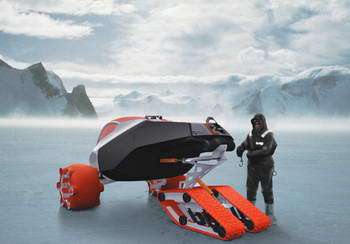
An innovative concept for an Antarctic vehicle is unveiled this week at the Royal College of Art’s final year show. Working closely with experts from the British Antarctic Survey (BAS), award-winning designer James Moon has come up with a lightweight, compact eco-friendly vehicle for use in one of the Earth’s most extreme environments.
Image: "Ninety Degrees South", (c) James Moon.
The vehicle, called "Ninety Degrees South", uses novel technology to keep drivers safe, warm and protected from the high levels UV exposure that occur under the Antarctic ozone hole. Designed to fit into the small Twin Otter aircraft that BAS use for working in remote deep field locations, Moon’s two-person vehicle has a combination of tracks and wheels allow it to operate anywhere on the continent over hard ground, snow or ice surfaces. The designer believes the versatility of his concept vehicle has commercial potential.
He says, “The challenge was to design an environmentally-friendly vehicle specifically for Antarctica that could be used also in other cold regions. I’m particularly interested in overcoming the dangers of travelling across crevassed areas of ice. Unknown terrain limits the speed of any journey over the ice - the faster you can detect crevasses the quicker you can travel. I’m using unmanned pathfinder technology which travels on a GPS controlled route ahead of the main unit. The pathfinder is secured by a 30m umbilical cord, and uses ground-penetrating radar to assess risk. I believe this technology serves as a prototype for future, entirely automated, expeditions in the Antarctic and on other planets.”
David Blake, British Antarctic Survey Head of Technology & Engineering says, “The large tracked vehicles (Snocats) and snowmobiles we use have been developed over several years and work reliably in the extreme Antarctic environment, supporting our field and base operations. James Moon’s concept is very novel and a vehicle built to his design could enable new areas of activity to be undertaken in Antarctica, including ground based deep field surveys. I am sure that should the vehicle be developed, it could also be used as a personnel carrier in Arctic regions. James's vehicle is innovative and challenging and I am delighted at his enthusiasm and drive in developing his concept vehicle.”
Source: British Antarctic Survey (BAS)
-
Crossing the icy unknown, hunting climate clues
Mar 21, 2009 |
4.3 / 5 (29) |
0
-
ESA prepares for a human mission to Mars
Apr 02, 2007 |
4.3 / 5 (7) |
0
-
Better than a needle in the eye: New medical device offers hope and relief for patients
Feb 02, 2012 |
4.5 / 5 (2) |
0
-
Driving the green: New study suggests that electric-powered trucks will save money for businesses
Feb 01, 2012 |
4.3 / 5 (6) |
9
-
Wireless power could revolutionize highway transportation, researchers say
Feb 01, 2012 |
4.3 / 5 (27) |
66
-
Engineers build first sub-10-nm carbon nanotube transistor
Feb 01, 2012 |
4.9 / 5 (31) |
30
-
Something old, something new: Evolution and the structural divergence of duplicate genes
Jan 31, 2012 |
4.6 / 5 (7) |
1
-
The hidden nanoworld of ice crystals: Revealing the dynamic behavior of quasi-liquid layers
Jan 30, 2012 |
5 / 5 (3) |
1
-
Stock market network reveals investor clustering
Jan 27, 2012 |
3.9 / 5 (23) |
8
-
Of microchemistry and molecules: Electronic microfluidic device synthesizes biocompatible probes
Jan 26, 2012 |
5 / 5 (1) |
0
More news stories
A frank discussion of the power law and linking correlation to causation
(PhysOrg.com) -- Michael Stumpf a mathematics professor at Imperial College in London, and Mason Porter a lecturer at Oxford have teamed together to write and publish a perspective piece in Science regarding the in ...
Employers feel no love for unscrupulous practice of 'service sweethearting'
A new study led by two Florida State University marketing professors finds that some frontline service employees who are rewarded for hikes in customer loyalty and satisfaction also may engage in "service ...
Other Sciences / Economics & Business
10 hours ago |
4 / 5 (1) |
4
The question of life in the ancient world
Theres a general feeling that we dont get the Greeks ancient or modern. Many, including heads of state like Angela Merkel, visibly shake their head in exasperation, rightly or wrongly, at ...
Other Sciences / Archaeology & Fossils
15 hours ago |
1.3 / 5 (3) |
4
Sonic Cradle lands spot in TED exhibition
A Simon Fraser University graduate student project that melds music, meditation and modern technology has landed a rare spot as an exhibit at TEDActive 2012 in Palm Springs, California this month.
12 hours ago |
not rated yet |
0
Chilean miners' rescue capsule on show in London
The capsule used to rescue Chilean miners trapped underground for two months goes on display Saturday at the Science Museum in London -- the first time it has been seen in Europe.
14 hours ago |
not rated yet |
0
Google users warned of threat to smartphone wallets
Users of Google smartphone wallets were being warned on Friday that there is a way to crack pass codes intended to thwart thieves from going on illicit shopping sprees.
Anonymous knocks CIA website offline (Update)
The website of the Central Intelligence Agency was inaccessible on Friday after the hacker group Anonymous claimed to have knocked it offline.
New error-correcting codes guarantee the fastest possible rate of data transmission
Error-correcting codes are one of the triumphs of the digital age. Theyre a way of encoding information so that it can be transmitted across a communication channel such as an optical fiber o ...
Complex wiring of the nervous system may rely on a just a handful of genes and proteins
Researchers at the Salk Institute have discovered a startling feature of early brain development that helps to explain how complex neuron wiring patterns are programmed using just a handful of critical genes. ...
Humans may have helped the decline of African rainforests 3000 years ago
(PhysOrg.com) -- Large areas of rainforests in Central Africa mysteriously disappeared over three thousand years ago, to be replaced by savannas. The prevailing theory has been that the cause was a change ...
New power source discovered
(PhysOrg.com) -- Researchers at the Massachusetts Institute of Technology (MIT) and RMIT University have made a breakthrough in energy storage and power generation.