When it comes to sensation, our brain seems tuned to the unexpected
June 20, 2005 When it comes to sensation, our brain seems tuned to the unexpected

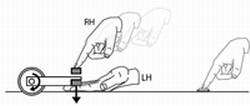
On the basis of observations of how we interpret the sensation of a simple finger-tap, researchers have advanced our understanding of how the brain sorts important, externally-derived sensations, such as those created by an insect crawling on the skin, from unimportant, internally-derived sensations, such as the brush of one's own hand. The new study is reported in the June 21 issue of Current Biology by researchers Paul Bays and Daniel Wolpert of University College London and Randy Flanagan of Queen's University, Canada.

Image credit: Bays et al./Current Biology 2005.

Our senses are constantly inundated with information from which the brain must select the most important in order to guide our behavior. Because the brain is interested in novel information, it tends to discount sensations that result directly from our own actions, such as when we touch one part of our body with another. It has been suggested that a brain mechanism predicts these sensory signals in advance and attenuates them before they reach awareness. This may explain, for example, why the sensation of tickling yourself feels so much weaker than that of someone else tickling you.

The research study reported this week supports this theory. Participants in the study were asked to use a finger on their right hand to tap a finger on their left hand. A computer-controlled device between the fingers could delay or advance the transmission of the tap to the left finger. The sensation of touch in the left finger was found to be reduced during a time window centered on the time at which the fingers would normally make contact. This phenomenon, whereby the brain seems to anticipate when a self-derived action should be perceived, may have the effect of making a touch from an external source easier to detect. The findings suggest that an element of prediction is involved in the attenuation of internally-derived sensation and that the attenuation is not merely associated with the body's movement per se.

Source: Cell Press


print this article email this article download pdf blog this article bookmark this article     Stumble it Digg this share on Facebook retweet share on Reddit add to delicious
Rate this story - 3 /5 (1 vote)


June 20, 2005 all stories

Comments: 0

3 /5 (1 vote)
  • Stumble this up

  • Digg this

  • share this

  • hide
  • Related Stories

  • Irritating smells alert special cells, study finds
    created Mar 04, 2008 | popularity not rated yet | comments 0
  • Probing Question: How does anesthesia work?
    created Oct 25, 2007 | popularity not rated yet | comments 0
  • Old memory traces in brain may trigger chronic pain
    created Jun 04, 2007 | popularity not rated yet | comments 0
  • The science of tickling
    created Jan 19, 2006 | popularity not rated yet | comments 0
  • Words, gestures are translated by same brain regions, says new research
    created Nov 09, 2009 | popularity not rated yet | comments 0


Other News

Research shows avatars can negatively affect users

Other Sciences / Social Sciences

created 7 hours ago | popularity 5 / 5 (1) | comments 0

(PhysOrg.com) -- Although often seen as an inconsequential feature of digital technologies, one's self-representation, or avatar, in a virtual environment can affect the user's thoughts, according to research by a University ...


New fossil plant discovery links Patagonia to New Guinea in a warmer past

New fossil plant discovery links Patagonia to New Guinea in a warmer past

Other Sciences / Archaeology & Fossils

created 8 hours ago | popularity not rated yet | comments 0

Fossil plants are windows to the past, providing us with clues as to what our planet looked like millions of years ago. Not only do fossils tell us which species were present before human-recorded history, ...


Golden State: Yes, No or Maybe?

Golden State: Yes, No or Maybe?

Other Sciences / Other

created 6 hours ago | popularity 3 / 5 (1) | comments 0

(PhysOrg.com) -- Dan Schnur, director of the College's Jesse M. Unruh Institute of Politics, analyzes the findings from the first of six USC College of Letters, Arts & Sciences/Los Angeles Times statewide ...


School textbooks have political purpose, finds study

School textbooks have political purpose, finds study

Other Sciences / Social Sciences

created 7 hours ago | popularity 2 / 5 (2) | comments 0

(PhysOrg.com) -- The simple school textbook is used by states to mould loyal citizens, according to a new study.


Gender-based pay gaps among US faculty

Other Sciences / Social Sciences

created 13 hours ago | popularity 1 / 5 (1) | comments 0

Before the Equal Pay Act of 1963 was signed into law by President Kennedy, women earned about fifty percent less than men. Nationally, women still earn an average of thirty percent less than men regardless of education, choice ...