Haier and Freescale unveil world’s first consumer TV with Ultra-Wideband
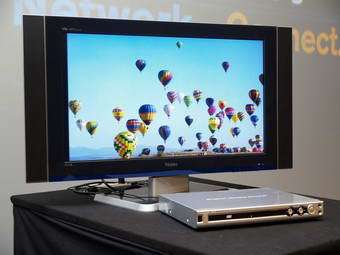
Haier Corporation and Freescale Semiconductor achieved a critical milestone for wireless home entertainment systems and showcased the first Ultra-Wideband (UWB)-enabled LCD, high definition television (HDTV) and digital media server at the Freescale Technology Forum.
Leveraging UWB, Freescale Chairman and Chief Executive Officer Michel Mayer and Haier Executive Vice President Shariff Kan broadcasted high definition video and audio streams wirelessly from a digital media server to Haier’s 37-inch HDTV located across the stage.
“Freescale’s Ultra-Wideband solution provides the wireless experience our customers desire,” said Yu Zi Da, vice president of Haier. “UWB gives consumers the freedom to place the television anywhere they would like in the room, without requiring a physical connection to a set-top box, digital video recorder or media server. We have worked closely with Freescale over the past two years on integrating UWB and look forward to continuing this collaboration with a variety of consumer products.”
Haier, one of the largest Chinese consumer electronics manufacturers, will package the digital media server and HDTV in a complete wireless solution and make it available to Chinese consumers later this year and to U.S. consumers by 2006.
“This first UWB-enabled consumer product marks the beginning of great wireless experiences for consumers,” said Franz Fink, senior vice president and general manager for Freescale’s Wireless and Mobile Systems Group. “UWB is now a proven technology designed to enhance user experiences by providing a wireless connection with the speed and quality they demand.”
Freescale’s UWB technology is capable of transferring multiple high definition (HD) or MPEG2 movie streams – up to 110 megabits per second (Mbps) – at distances up to 20 meters, enabling significant freedom in the placement of home theater equipment. Current wireless video solutions do not have the bandwidth to accommodate HD or MPEG2 streams, which require a minimum of 20Mbps each. Indeed, current WiFi solutions are only capable of broadcasting standard definition (SD) video streams at 5-7Mbps.
HDTV and Digital Media Server Availability
The television and digital media server are expected to be available in retail outlets in Q4 2005 throughout China. Although approved for use in the United States, Haier is initially targeting this product for the Chinese market, leveraging a regulatory license granted by the Chinese government. Haier is currently developing UWB-enabled products for distribution in other regions, including the US, in 2006.
The Haier television is a 37-inch, liquid crystal display (LCD) HDTV with 1080i resolution. It supports both SD and HD video and uses a component/DVI interface. The Freescale UWB antenna is embedded inside the television and is not visible to the user. No additional equipment is required and consumers need only a power source for the actual television.
The digital media server is the size of a standard digital video device (DVD) player but includes personal video player (PVR) functionality, a DVD playback capability and a tuner, as well as the Freescale UWB solution to wirelessly stream media to the HDTV. The digital media server can be placed as far away as 20 meters from the actual HDTV, providing considerable freedom in home theater configuration.
About Ultra-Wideband Technology
Ultra-Wideband is a wireless technology that transmits an extremely low power signal over a wide swath of radio spectrum. Unlike conventional radio systems that operate within a relatively narrow bandwidth, Ultra-Wideband operates across a wide range of frequency spectrum by transmitting a series of very narrow and low power pulses. The combination of broader spectrum, lower power and pulsed data means that Ultra-Wideband causes less interference than conventional narrowband radio solutions, and is engineered to deliver wire-like performance in an indoor wireless environment. This makes Ultra-Wideband technology ideal for consumer electronics applications that are increasingly multimedia-rich in content.


