Dust belt around nearby star clear sign of exoplanet
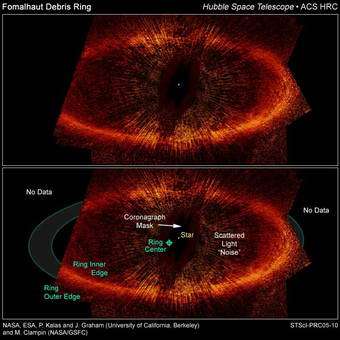
Astronomers zooming in on a nearby star with NASA's Hubble Space Telescope have discovered unmistakable evidence of a planetary system: a perturbed dusty belt around the star that's analogous to the vast Kuiper Belt of icy rocks encircling the sun.
While the discovery is expected to send astronomers scurrying to their telescopes to obtain direct images of a planet around the star, called Fomalhaut, it also provides a Rosetta stone for debris disks - the pancakes of rock and ice that form around new stars and coalesce into planets.
Image: The top view, taken by NASA's Hubble Space Telescope, is the first visible-light image of a dust ring around the nearby, bright young star Fomalhaut. The view at bottom points out important features in the image, such as the ring's inner and outer edges. In order to image the faint ring, a coronagraph on Hubble's Advanced Camera for Surveys was used to eclipse the bright star, the position of which is indicated by a dot near the ring's center. The center of the ring is about 1.4 billion miles away from the star. Astronomers believe that an unseen planet moving in an elliptical orbit is reshaping the ring. Credit: NASA, ESA, P. Kalas and J. Graham (University of California, Berkeley), and M. Clampin (NASA's Goddard Space Flight Center)
"Theoretical simulations already hinted at a planetary perturbation around the star, but these direct images with Hubble are really bringing Fomalhaut out into the spotlight," said Paul Kalas, a research astronomer at the University of California, Berkeley. "This is an exciting system to look at for finding planets and understanding how planets interact with debris disks."
Fomalhaut, a star only 25 light years distant and about twice the mass of the sun, is a mere 200 million years old - one-twentieth the age of the sun. In our solar system, that age was the epoch of bombardment, when asteroids and comets rained down on the planets and moons.
"When our solar system was 200 million years old, it was an exciting time, a period of transition between the birth of planets and their final state," he said. "The planets had formed, but they were still clearing a large reservoir of minor bodies - the small comets and asteroids left over from the time of formation. The moon was being bombarded with objects that produced the craters we see today. And Mars was being bombarded by comets, depositing water, and all the planets were having their atmospheres modified as objects rained down on them. Our Kuiper Belt is material left over from that era."
We can't study that long-ago era directly, he said, but we can learn about it from young debris disks around other stars.
Kalas and collaborators James R. Graham, professor of astronomy at UC Berkeley, and Mark Clampin of the NASA Goddard Space Flight Center in Greenbelt, Md., will publish their findings in the June 23, 2005, issue of the journal Nature.
Infrared astronomers first detected heat from a dusty debris disk around the star Fomalhaut more than 20 years ago, but could only speculate about any planets that may have condensed out of the dust. Now, however, the team of astronomers was able to take advantage of the Hubble's new Advanced Camera for Surveys to obtain clear enough images to discern the disk's sharp edges, the hallmark of a planet. As a near neighbor of Earth and the brightest star in the southern constellation Piscis Austrinus (the Southern Fish), Fomalhaut was a perfect target for the camera.
"The edge of the belt is very sharp, consistent with a knife edge - it's basically sliced," said Kalas. "That is similar to Saturn's rings, where we see very sharp edges shaped by little moons that shepherd the ring and keep the material from spreading." Perhaps more telling, the narrow ring is not centered on the star but on a spot 1.4 billion miles from the star. Kepler's laws of planetary motion state that objects in elliptical orbits around one another are centered on the focus of the ellipse, which is always offset from the geometric center of the ellipse. The observed offset of the belt implies a planet in a highly eccentric orbit that sweeps up the dust in the disk, in the same way Neptune and the larger planets of our solar system have vacuumed out a hole in the debris disk around the sun, leaving a distant ring of rocky debris called the Kuiper Belt.
"We are saying that this offset and the sharp edge together are strong evidence for a planetary system," Kalas said.
Fomalhaut (HD 216956) is one of several nearby stars with debris disks that the Hubble telescope has focused on in a search for signs of planets. Two of these, beta-Pictoris and AU Microscopii, are difficult to map because they are edge-on, Kalas said. The edge-on orientation obscures most detail of disk structure. Other stars, such as Vega and Fomalhaut, are not edge-on, but they are so bright that the starshine hides details of the disk structure.
One of three new cameras on the Hubble, however, has a coronagraph that can eclipse stars in order to image the surrounding area with high sensitivity and resolution. For Fomalhaut, the Hubble images have a resolution of about 0.5 AU, or 47 million miles. An AU or astronomical unit is the average distance between the Earth and sun, about 93 million miles.
"The Advanced Camera for Survey's coronagraph offers high contrast, allowing us to see the ring's structure against the extremely bright glare from Fomalhaut," Clampin said. "This observation is currently impossible to do at visible wavelengths without the Hubble Space Telescope. The fact that we were able to detect it with Hubble was unexpected, but impressive."
Kalas and his collaborators used Hubble over a five-month period in 2004 - May 17, Aug. 2, and Oct. 27 - to map the ring's structure. The Hubble image clearly shows a narrow ring with a width of only 25 AU (2.3 billion miles), starting at a distance of 133 AU (12 billion miles) from the star and extending out to 159 AU. Earth's Kuiper Belt, by comparison, extends from 30 AU - Neptune's orbit - to 50 AU, far beyond Pluto.
"While Fomalhaut's ring is analogous to the Kuiper Belt, its diameter is four times greater than that of the Kuiper Belt," Kalas said. "The size of Fomalhaut's dust ring suggests that not all planetary systems form and evolve in the same way - planetary architectures can be quite different from star to star."
The belt probably is produced by a planet or planets in distant orbits, perhaps between 50 to 70 AU (4.7 billion to 6.5 billion miles), based on models, Kalas said. The observing team would have seen the planet directly if it had been more than five times Jupiter's mass, and further observations should be able to image a Jupiter-size planet. The system also is a compelling target for future telescopes such as NASA's James Webb Space Telescope and the Terrestrial Planet Finder, he said.
One side of the ring was not imaged because it extended beyond the Advanced Camera for Survey's field of view. The astronomers will use Hubble again this summer to map the entire ring. They expect that the additional data will reveal whether or not the ring has any gaps that could have been carved out by the gravitational influence of an unseen body. The longer, deeper exposures also may show whether the ring has an even wider diameter than currently seen. In addition, the astronomers will measure the ring's colors to determine its physical properties, including its composition.
Source: University of California - Berkeley


