Spectacular Planetary Conjunction Appearing Now At Sunset
Stick up your thumb and hold it at arm's length. It doesn't seem very big, does it? But it is, big enough to hide three planets.
This weekend Mercury, Venus and Saturn are going to crowd together in a patch of sky no bigger than your thumb. Astronomers call it a "conjunction" and it's going to be spectacular.
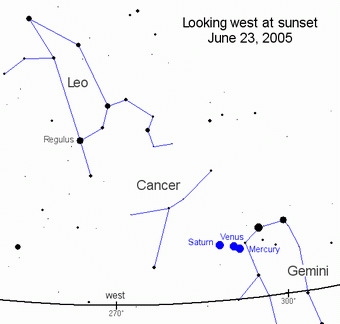
Image: The western sky at sunset on Saturday, June 23th.
The show begins on Saturday evening, June 25th. Step outside and look west toward the glow of the setting sun. Venus appears first, a bright point of light not far above the horizon. As the sky darkens, Saturn and Mercury pop into view. The three planets form a eye-catching triangle about 1.5o long, easily hidden by your thumb.
It gets better on Sunday evening, June 26th. The triangle shrinks with Venus and Mercury only 0.5o apart. Now they fit behind your pinky!
Monday evening, June 27th, is best of all. With Saturn nearby, Venus and Mercury converge. At closest approach, the two planets will be less than one-tenth of a degree apart. Such pairings of bright planets are literally spellbinding.
If you go outside to see the show, take someone along. Here are some fun facts you can share:
The closest planet to the sun, Mercury, is not the hottest. Venus is. The surface temperature of Venus is 870 F (740 K), hot enough to melt lead. The planet's thick carbon dioxide atmosphere traps solar heat, leading to a runaway greenhouse effect. On Venus, global warming has run amok.
Venus is so bright because the planet's clouds are wonderful reflectors of sunlight. Unlike clouds on Earth, which are made of water, clouds on Venus are made of sulfuric acid. They float atop an atmosphere where the pressure reaches 90 times the air pressure on Earth. If you went to Venus, you'd be crushed, smothered, dissolved and melted--not necessarily in that order. Don't go.
Mercury is only a little better. At noontime, the surface temperature reaches 800 F (700 K). If you turn your kitchen's oven to that setting, the pizza will burn to a smoking crisp.
Radars on Earth have pinged Mercury and found icy reflections near the planet's poles. How can ice exist in such heat? NASA's MESSENGER spacecraft is en route to Mercury now to investigate.
Here's one way to trick an astronomer: Show them a picture of Mercury and ask what it is. Many will answer "the Moon," because the Moon and Mercury look so much alike. But Mercury has something that the Moon does not: long sinuous cliffs called "lobate scarps." Some researchers think Mercury's scarps are like wrinkles in a raisin, a sign of shrinkage. A shrinking planet? Weird.
If you look at Venus or Mercury through a telescope, you won't be impressed. Both are featureless, Venus because of its bland clouds, Mercury because it is small and far away. Saturn is different. Even a small telescope will show you Saturn's breathtaking rings.
Galileo Galilei discovered Saturn's rings almost 400 years ago, but he didn't understand what he saw. A planet with rings was too much even for Galileo. Scientists today are still reeling.
Saturn's rings are improbably thin. If you made a 1-meter-wide scale model of Saturn, the rings would be 10,000 times thinner than a razor blade. They're full of strange waves and spokes and grooves. And no one knows where they came from.
One school of thought holds that Saturn's rings are debris from the breakup of a tiny moon or asteroid only a few hundred million years ago.
As recently as the Age of Dinosaurs on Earth, Saturn might have been a naked planet - no rings! Tiny moons orbiting among the rings today appear to be stealing angular momentum, which, given time, could cause the rings to collapse. Is Saturn like a flower, temporarily in bloom?
That's one of many questions being investigated by NASA's Cassini spacecraft, which has been orbiting Saturn since 2004. Cassini is on a 4-year mission to study Saturn's moons (all 34 of them), rings and weather. Every day the craft beams stunning images to Earth: click here to see them.
A lot can happen behind your thumb. This weekend is a good time to look.
Copyright 2005 by Space Daily, Distributed by United Press International


