Hubble captures outburst from Tempel 1 comet
June 27, 2005
The images are a reminder that Tempel 1's icy nucleus, roughly the size of central Paris, is dynamic and volatile. Astronomers hope the eruption of dust seen in these observations is a preview of the fireworks that may come 4 July, when a probe from the Deep Impact spacecraft will slam into the comet, possibly blasting off material and giving rise to a similar dust plume.
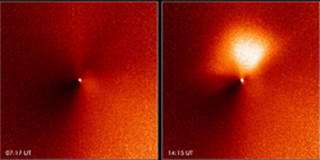
Image: Comet 9P/Temple June 14, 2005. NASA, ESA, P.Feldman (Johns Hopkins University) and H.Weaver (Johns Hopkins University Applied Physics Laboratory
Comet 9P/Tempel 1 was discovered on April 3, 1867 by Ernst Wilhelm Leberecht Tempel of Marseilles France while visually searching for comets. The comet was first recognized as periodic in May of 1867 when C. Bruhns of Leipzig determined the orbital period to be 5.74 years. In 1881, comet Tempel 1 passed 0.55 AU from Jupiter. Due to gravitational interactions, the comet's orbital period was increased to 6.5 years and the perihelion distance was increased from 1.8 AU to 2.1 AU, making the comet an even fainter object. Currently, Tempel 1 has an orbital period of 5.5 years and a perihelion distance of roughly 1.5 AUs. With an orbital eccentricity of 0.5, Tempel 1's orbit lies between the orbits of Mars and Jupiter.
These observations demonstrate that Hubble's sharp "eye" can see exquisite details of the comet's temperamental activities. The Earth-orbiting observatory was 120 million kilometres away from the comet when these images were taken by the Advanced Camera for Surveys' High Resolution Camera. The telescope's views complement close-up images being taken by cameras aboard Deep Impact, which is speeding toward the comet.
The two images, taken seven hours apart on 14 June, show Tempel 1 and its new jet. The image at left, taken at 7:17 a.m. (UT), is a view of the comet before the outburst. The bright dot is light reflecting from the comet's nucleus, which appears star-like in these images because it is too small even for Hubble to resolve. The nucleus, a potato-shaped object, is 7 kilometres across and 2 kilometres long. Hubble's viewing the nucleus is as difficult as someone trying to spot a potato in Stockholm from Madrid.
The photo at right, snapped at 14:15 a.m. (UT), reveals the jet [the bright fan-shaped area]. The jet extends about 2,200 kilometers, which is roughly the distance from Copenhagen to Athens. It is pointing in the direction of the Sun. Comets frequently show outbursts in activity, but astronomers still don't know exactly why they occur. Tempel 1 has been moving closer to the Sun, and perhaps the increasing heat opened up a crack in the comet's dark, crusty surface. Dust and gas trapped beneath the surface could then spew out of the crack, forming a jet. Or, perhaps a portion of the crust itself was lifted off the nucleus by the pressure of heated gases beneath the surface. This porous crust might then crumble into small dust particles shortly after leaving the nucleus, producing a fan-shaped coma on the sunward side. Whatever the cause, the new feature may not last for long.
Astronomers hope that the July 4 collision will unleash more primordial material trapped inside the comet, which formed billions of years ago. Comets are thought to be 'dirty snowballs', porous agglomerates of ice and rock that dwell in the frigid outer boundaries of our solar system. Periodically, they make their journey into the inner solar system as they loop around the Sun.
The contrast in these images has been enhanced to highlight the brightness of the new jet.
In Europe, the European Southern Observatory will conduct a massive ground-based observing campaign before and in the week after the impact.
Source: ESA/Hubble Information Centre
-
Latest EPOXI findings on Comet Hartley 2 published
Jun 16, 2011 |
5 / 5 (4) |
0
-
Swift and Hubble probe an asteroid crash (w/ video)
Apr 28, 2011 |
5 / 5 (6) |
10
-
Sounds of Comet Tempel 1 smashing into Stardust-NExT
Feb 24, 2011 |
5 / 5 (2) |
0
-
Stardust flyby '1,000 percent successful'
Feb 21, 2011 |
4.5 / 5 (2) |
6
-
NASA releases images of man-made crater on comet
Feb 16, 2011 |
4.6 / 5 (15) |
2
-
Engineers build first sub-10-nm carbon nanotube transistor
Feb 01, 2012 |
4.9 / 5 (30) |
30
-
Something old, something new: Evolution and the structural divergence of duplicate genes
Jan 31, 2012 |
4.6 / 5 (7) |
1
-
The hidden nanoworld of ice crystals: Revealing the dynamic behavior of quasi-liquid layers
Jan 30, 2012 |
5 / 5 (3) |
1
-
Stock market network reveals investor clustering
Jan 27, 2012 |
3.9 / 5 (23) |
8
-
Of microchemistry and molecules: Electronic microfluidic device synthesizes biocompatible probes
Jan 26, 2012 |
5 / 5 (1) |
0
More news stories
New views show old NASA Mars landers
(PhysOrg.com) -- The High Resolution Imaging Science Experiment (HiRISE) camera on NASA's Mars Reconnaissance Orbiter recorded a scene on Jan. 29, 2012, that includes the first color image from orbit showing ...
Space & Earth / Space Exploration
20 hours ago |
4.9 / 5 (7) |
8
|
Deconstructing a mystery: What caused Snowmaggedon?
In the quiet after the storms, streets and cars had all but disappeared under piles of snow. The U.S. Postal Service suspended service for the first time in 30 years. Snow plows struggled to push the evidence ...
Space & Earth / Earth Sciences
12 hours ago |
4.7 / 5 (3) |
1
|
Black holes and star formation
(PhysOrg.com) -- It has long been recognized that galaxy mergers or even close interactions can play a vital role in shaping the morphology of galaxies. One way they can do so, it is thought, is by triggering ...
19 hours ago |
4.1 / 5 (7) |
5
|
Ocean microbe communities changing, but long-term environmental impact is unclear
As oceans warm due to climate change, water layers will mix less and affect the microbes and plankton that pump carbon out of the atmosphere but researchers say it's still unclear whether these processes ...
Space & Earth / Earth Sciences
14 hours ago |
5 / 5 (2) |
2
|
Researchers create 3-D laser maps that show how earthquake changes landscape
Geologists have a new tool to study how earthquakes change the landscape down to a few inches, and it's giving them insight into how earthquake faults behave. In the Feb. 10 issue of the journal Science, a team ...
Space & Earth / Earth Sciences
14 hours ago |
5 / 5 (4) |
0
|
'Dark plasmons' transmit energy
Microscopic channels of gold nanoparticles have the ability to transmit electromagnetic energy that starts as light and propagates via "dark plasmons," according to researchers at Rice University.
FDA-approved drug rapidly clears amyloid from the brain, reverses Alzheimer's symptoms in mice
Neuroscientists at Case Western Reserve University School of Medicine have made a dramatic breakthrough in their efforts to find a cure for Alzheimer's disease. The researchers' findings, published in the journal Science, show t ...
Hydrogen from acidic water: Researchers develop potential low cost alternative to platinum for splitting water
A technique for creating a new molecule that structurally and chemically replicates the active part of the widely used industrial catalyst molybdenite has been developed by researchers with the Lawrence Berkeley ...
Ultraviolet protection molecule in plants yields its secrets
Lying around in the sun all day is hazardous not just for humans but also for plants, which have no means of escape. Ultraviolet (UV) radiation from the sun can damage proteins and DNA inside cells, leading ...
Soraa LED light may dim 50-watt halogen rivals
(PhysOrg.com) -- Soraa, a Fremont, California company founded in 2008, this week launched its first product, a light that uses LEDS (light emitting diodes). The "Soraa LED MR16 lamp" is the "perfect" replacement ...
Anyone can learn to be more inventive, cognitive researcher says
There will always be a wild and unpredictable quality to creativity and invention, says Anthony McCaffrey, a cognitive psychology researcher at the University of Massachusetts Amherst, because an "Aha moment" is rare and ...