Guide: How To See NASA's Comet Crash In The Sky on July 4th
When NASA's Deep Impact slams an 800-pound projectile into Comet Tempel 1 at 23,000 miles per hour, the collision should create quite a splash.
Cameras and other instruments on the main spacecraft will watch this first-ever comet excavation from a safe distance, and astronomers on Earth will be looking on with powerful mountaintop telescopes.
Countless amateur stargazers will be watching too.
If you have a telescope or binoculars, you can watch to see if the comet brightens after the probe's kamikaze plunge. Contrary to optimistic predictions, you're unlikely to see anything of this event with your unaided eye.
But you can at least see the place in the sky where it's happening.
Your location will be important. The crash is set to happen at 10:52 p.m. Pacific Daylight Time on July 3rd (1:52 a.m. Eastern Daylight Time on the morning of July 4th).
At that moment, the comet will be well placed in a dark sky from the western United States, especially the Southwest. But for much of the eastern United States and Canada the comet will have already slipped below the horizon.
"Anyone west of the Mississippi River has a chance of seeing the comet when Deep Impact slams into it," says Kelly Beatty, executive editor of Sky & Telescope magazine.
"People in southwestern Canada, Mexico, and Central America will have good seats too."
Here's where to look. After dark, find Jupiter shining high in the southwest. It's the brightest "star" in that part of the sky (brighter Venus sets in the west-northwest during dusk).
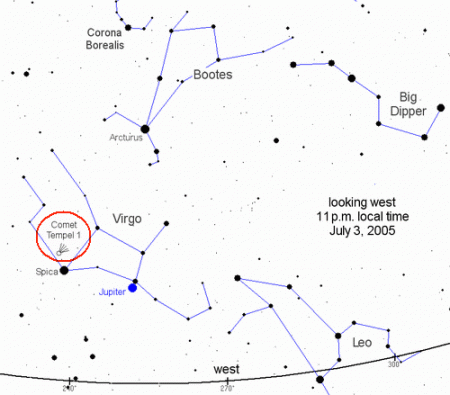
Image: Look for Comet Tempel 1 near the bright star Spica on July 3rd and 4th.
Off to Jupiter's left, by somewhat more than the width of your fist seen at arm's length, is the fainter star Spica. The impact with the comet will happen a couple of finger-widths above Spica.
Even during and after impact the comet is expected to remain faint, and telescope users will need to use the detailed star chart that accompanies this release.
Suitable charts also appear in the June 2005 issue of Sky & Telescope, the July-August 2005 issue of Night Sky, and online at SkyandTelescope.com.
Anyone who's not already familiar with how to use star charts with a telescope will need to follow the beginner's instructions in the online article.
Some scientists speculate that Comet Tempel 1 will stay bright long after it gets hit, so you may be able to spot it for several nights after July 3rd.
If your evening sky is clear on July 6th or 7th, there's an easy way to find Comet Tempel 1 with your telescope. Just center Spica in your lowest-power eyepiece, then let the sky drift by (turn off the scope's tracking motor if it has one). Wait exactly 20 minutes, and Comet Tempel 1 should be in the field of view.
Copyright 2005 by Space Daily, Distributed by United Press International


