Einstein Ring in Distant Universe
Astronomers Using the VLT Discover Bright Cosmic Mirage Far Away
Using ESO's Very Large Telescope, Rémi Cabanac and his European colleagues have discovered an amazing cosmic mirage, known to scientists as an Einstein Ring. This cosmic mirage, dubbed FOR J0332-3557, is seen towards the southern constellation Fornax (the Furnace), and is remarkable on at least two counts. First, it is a bright, almost complete Einstein ring. Second, it is the farthest ever found.
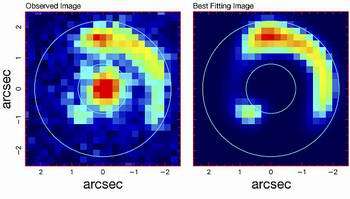
The left image is magnified and centred on the newly discovered Einstein ring. The image quality ("seeing") of the R-band image is exceptional (0.5") and the image reveals the lensing system in stunning details. The central dot is the lens, a quiescent massive galaxy that distort the light emitted by background sources. The large arc surrounding the central lens is a part of the Einstein-ring created by a background source finely aligned with the lens. The reddish colour indicates that the redshift of the system is very large. FORS2 spectroscopy of the lensing system yield a redshift close to 1 for the lens (we see the lens as it was when the universe was half its present size), and a record-breaking redshift z=3.8 for a background source of such brightness, hence we see the object (a star forming galaxy) as it was when the universe was only 12% of its present age. The lensing model indicates that the light of the source is magnified at least 13 times. The right panel shows the reconstructed image based on the model of the lens and the source, showing the ring to extend over 3/4 of a circle. ((FORS/VLT))
"There are only a very few optical rings or arcs known, and even less so in which the lens and the source are at large distance, i.e. more than about 7,000 million light-years away (or half the present age of the Universe)", says Rémi Cabanac, former ESO Fellow and now working at the Canada-France-Hawaii Telescope. "Moreover, very few are nearly complete", he adds.
But in the case of this newly found cosmic ring, the images show it to extend to almost 3/4 of a circle. The lensing galaxy is located at a distance of about 8,000 million light-years from us, while the source galaxy whose light is distorted, is much farther away, at 12,000 million light-years. Thus, we see this galaxy as it was when the universe was only 12% of its present age. The lens magnifies the source almost 13 times.
The observations reveal the galaxy acting as a lens to be a rather quiet galaxy, 40,000 light-years wide, with an old stellar population. The far away lensed galaxy, however, is extremely active, having recently experienced bursts of star formation. It is a compact galaxy, 7,000 light-years across.
"Because the gravitational pull of matter bends the path of light rays, astronomical objects - stars, galaxies and galaxy clusters - can act like lenses, which magnify and severely distort the images of galaxies behind them, producing weird pictures as in a hall of mirrors", explains Chris Lidman (ESO), co-discover of the new cosmic mirage.
In the most extreme case, where the foreground lensing galaxy and the background galaxy are perfectly lined up, the image of the background galaxy is stretched into a ring. Such an image is known as an Einstein ring, because the formula for the bending of light, first described in the early twentieth century by Chwolson and Link, uses Albert Einstein's theory of General Relativity.
Gravitational lensing provides a very useful tool with which to study the Universe. As "weighing scales", it provides a measure of the mass within the lensing body, and as a "magnifying glass", it allows us to see details in objects which would otherwise be beyond the reach of current telescopes.
From the image, co-worker David Valls-Gabaud (CFHT), using state-of-the-art modelling algorithms, could deduce the mass of the galaxy acting as a lens - it is almost one million million suns.
The paper describing this research has been published as a Letter to the Editor in Astronomy and Astrophysics, volume 436, L21-L25 ("Discovery of a high-redshift Einstein ring", by R.A. Cabanac, D. Valls-Gabaud, A.O. Jaunsen, C. Lidman, and H. Jerjen). The paper is available for download in PDF format from the A&A web site.
Source: European Southern Observatory (ESO)


