Fusion technology: from ANU to the world
June 30, 2005 Fusion technology

Technology pioneered at ANU that could see the future of power generation become clean and green has come a step closer today with the announcement of an international development to harness fusion technology.
Australian scientist Sir Mark Oliphant is regarded as the discoverer of the process of fusion in 1932. He founded fusion plasma research at ANU in the early 1950s, which continues today.

Fusion uses plasma physics — the process which powers the sun — to generate power with minimal greenhouse gas emissions. Fusion occurs when the hydrogen isotopes deuterium and tritium are placed under great pressure.

A major project to begin large-scale investigation into the potential of fusion technology was announced overnight, with the $10 billion International Thermonuclear Experimental Reactor (ITER) to be built in Cadarache, in southern France.

ITER will be owned and funded by the United States, Russia, China, Japan, South Korea and the European Union.

Dr Matthew Hole from the ANU Research School of Physical Sciences and Engineering says it is a major move towards truly ‘green’ power.

“Unlike traditional fossil fuel and nuclear power plants, fusion reactors produce minimal greenhouse gas emissions with short-lived radioactive waste, by comparison to fission. They’re also inherently safe, with no possibility of the reaction itself running out of control.

“What’s exciting about it is that it has near-zero greenhouse gas emissions and there’s a virtually limitless quantity of fuel. It’s green energy that will hopefully power civilization in the future.”

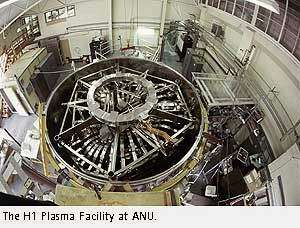
Today, the H1 Major National Research Facility at ANU is considered to be at the forefront of fundamental fusion research in Australia.

The H1 experiment, which confines the hot plasma in flexible magnetic fields, is designed to provide a test bed for fundamental plasma research.

Dr Hole says it will be at least another 30 years before the commercial development of fusion energy becomes a possibility, but in the meantime ANU researchers are continuing their work to better understand the fusion process.

Dr Hole leads an Australian group of scientists and engineers from universities around the country, the Australian ITER Forum, which aims to advance fusion science in Australia and promote an Australian role in the ITER project in France.

Source: Australian National University


Rate this story - 4.7 /5 (3 votes)


June 30, 2005 all stories

Comments: 0

4.7 /5 (3 votes)

  • hide
  • Related Stories

  • Taming 900 vortices gives plasma energy insight
    created Jan 05, 2007 | popularity not rated yet | comments 0
  • Gene by gene, scientists dig for the triggers
    created Jan 02, 2009 | popularity not rated yet | comments 0
  • Mystery of missing hydrogen
    created Nov 24, 2008 | popularity not rated yet | comments 0
  • Discovery could be key to bioterrorism defense
    created Jul 30, 2005 | popularity not rated yet | comments 0
  • New Details About Antarctic Iceberg Detachment
    created Jun 14, 2005 | popularity not rated yet | comments 0


Other News

Extra large carbon

Extra large carbon

Physics / General Physics

created 6 hours ago | popularity 4.7 / 5 (9) | comments 5 | with audio podcast

An exotic form of carbon has been found to have an extra large nucleus, dwarfing even the nuclei of much heavier elements like copper and zinc, in experiments performed in a particle accelerator in Japan. ...


Scientist explore future of high-energy physics

Scientist explore future of high-energy physics

Physics / General Physics

created 12 hours ago | popularity 4.9 / 5 (10) | comments 4 | with audio podcast

In a 1954 speech to the American Physical Society, the University of Chicago's Enrico Fermi fancifully envisioned a particle accelerator that encircled the globe. Such would be the ultimate theoretical outcome, ...


Leaf veins inspire a new model for distribution networks (w/ Video)

Physics / General Physics

created 9 hours ago | popularity 5 / 5 (2) | comments 0 | with audio podcast

(PhysOrg.com) -- Following the straight and narrow may be good moral advice, but it’s not a great design principle for a distribution network. In new research, a team of biophysicists describe a complex netting of interconnected ...


New magnetic tuning method enhances data storage

New magnetic tuning method enhances data storage

Physics / General Physics

created 12 hours ago | popularity 4.3 / 5 (3) | comments 0 | with audio podcast

Researchers in Chicago and London have developed a method for controlling the properties of magnets that could be used to improve the storage capacity of next-generation computer hard drives.


New method for measuring fluid flow in algae could herald revolution for fluid mechanics

Physics / General Physics

created 14 hours ago | popularity 5 / 5 (2) | comments 0 | with audio podcast

In the words of Todd Squires, of the University of California, Santa Barbara "Nature has long inspired researchers in fluid mechanics to explore the mechanical strategies used by living creatures. Where better to look for ...