Deep Impact's Impactor Meets Tempel 1 Comet (first picture)
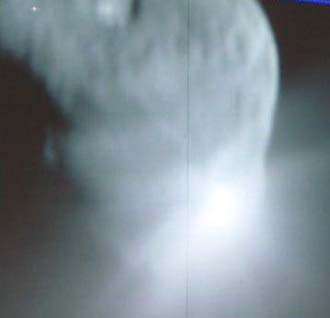
July 4th, 2005 Deep Impact's Impactor Meets Tempel 1 Comet

The above image from NASA TV is a view from Deep Impact's flyby showing the impactor colliding with comet Tempel 1.

A US space projectile crashed head-on into a comet hurtling through the solar system Monday in an unprecedented feat of technology that scientists hope will help reveal the secrets of the Universe.

The probe rammed the heart of the Tempel 1 comet exactly as planned at 0552 GMT, 133 million kilometers (83 million miles) from Earth.

"That's awesome! That's awesome!" US flight control officials shouted after the impact was confirmed. "We hit just exactly where we wanted to."

A picture sent to Earth by a fly-by probe showed a bright flash of light as the projectile collided with the comet, which is traveling through the solar system at approximately 37,100 kilometers (23,000 miles) per hour and is equal in size to half of Manhattan Island.

The copper-laden impactor was beaming back high-resolution pictures of the comet until just a few seconds before the collision.

They showed craters, ridges and presumed glaciers on the potato-shaped comet that was discovered in 1867 and named Tempel 1.

"We have put a new trail for other people to follow," said Charles Elachi, director of the Jet Propulsion Laboratory, a division of the National Aeronautics and Space Administration that was a key partner in the experiment.

The reason scientists are so excited is that comets circling the Sun, which are numbered in billions, are seen as leftovers from a massive cloud of gas and dust that condensed to form the Sun and planets about 4.6 billion years ago.

Their geological and chemical structures could thus contain important clues to the nature of the Universe and how it was formed, including Earth.

The projectile was fired from a mothership spacecraft, "Deep Impact," that was itself launched from the Kennedy Space Center in Florida in January.
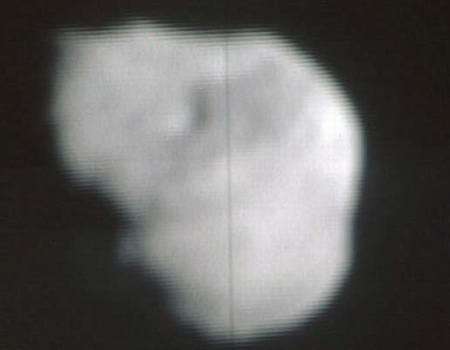
Nucleus of comet Tempel 1 before impact

This image from NASA TV shows the nucleus of comet Tempel 1 before impact from Deep Impact´s flyby´s high-resolution imager. Image credit: NASA/JPL-Caltech/UMD

It undertook a 173-day, 431-million-kilometer journey to get close to Tempel 1. After launching the projectile, it then recorded data from the impact.

"It's just absolutely stunning," NASA Associate Administrator Al Diaz told reporters.

"To be in a situation where we are here tracking a comet for this period of time and then precisely positioning a spacecraft in a way that creates that environment that is so bright... I am speechless!"

He said the success was thanks to broad cooperation between scientists and researchers inside and outside the United States.

Although incoming imagery is still to be analyzed, the impact was expected to gouge a large crater on the surface of the comet, sending up a cloud of ice, dust and debris that researchers hope will offer valuable information.

A separate fly-by probe took images of the resulting cloud, which scientists believe could contain particles from the comet nucleus.

"We're just basically starting our work now," said Michael A'Hearn, "Deep Impact" principal investigator, "Interpreting will take a bit of a time".

On Saturday, Tempel 1 belched out more ice and dust, expanding the size of the cloud around it.

The outburst, the fourth in the past three weeks, was not of particular concern to National Aeronautics and Space Administration scientists, said project manager Rick Grammier.

"The comet is definitely full of surprises so far and probably has a few more in store for us," he commented.

Scientists insisted that although the experiment was reminiscent of the 1998 movie "Deep Impact," in which a US spaceship attacks a monster comet with nuclear weapons to ward off its collision with Earth, the real-life strike on Tempel 1 was in pursuit of exclusively scientific goals.

"Comet Tempel 1 poses no threat to the Earth now or in the foreseeable future," said Don Yeomans, a mission scientist with NASA's Jet Propulsion Laboratory.

In Moscow, meanwhile, a Russian astrologist said she was filing a lawsuit against NASA on the grounds that the bombardment of Tempel 1 would both upset her horoscope and violate her spiritual rights.

Marina Bai said she was demanding 8.7 billion rubles (302 million dollars) compensation from NASA via the agency's representative office in Russia.

Story: (c) 2005 AFP
Image credit: NASA


print this article email this article download pdf blog this article bookmark this article     Digg this Stumble it share on Facebook share on Reddit add to delicious save to Yahoo! bookmarks
not rated yet


July 4th, 2005 all stories
Space & Earth /

Comments: 0
Rank: not rated yet

  • Stumble this up

  • Digg this

  • Share it:
  • share on Facebook
  • share on MySpace
  • share on Slashdot
  • rss-newsfeed
  • share on Google
  • share on Reddit
  • add to delicious
  • save to Yahoo! bookmarks
  • share on Windows Live
  • Add to Mixx!
Rating: not rated yet

  • Related Stories

  • Scientists Develop New Method to Find Alien Oceans, Earth-like Planets (w/Videos)
    created May 26, 2009 | popularity not rated yet | comments 0
  • Stardust Logs A Decade Under The Stars
    created Feb 09, 2009 | popularity not rated yet | comments 0
  • Deep Impact Films Earth as an Alien World
    created Jul 18, 2008 | popularity not rated yet | comments 0
  • Probing Question: What are Shooting Stars?
    created Apr 09, 2008 | popularity not rated yet | comments 0
  • Deep Impact Begins Hunt for Alien Worlds
    created Feb 08, 2008 | popularity not rated yet | comments 0

Tags


  • Physicists Demonstrate Quantum Memory with Matter Qubits
    Physicists Demonstrate Quantum Memory with Matter Qubits
    Physics / General Physics
    created Jul 03, 2009 | popularity 4.4 / 5 (17) | comments 1
  • 'Holey' Nanosheets for Wastewater Dye Removal
    Nanotechnology / Nanomaterials
    created Jul 01, 2009 | popularity 5 / 5 (5) | comments 1
  • Jellyfish Robot Swims Like its Biological Counterpart
    Jellyfish Robot Swims Like its Biological Counterpart
    Electronics / Robotics
    created Jun 26, 2009 | popularity 4.4 / 5 (8) | comments 1
  • Could Maxwell's Demon Exist in Nanoscale Systems?
    Could Maxwell's Demon Exist in Nanoscale Systems?
    Physics / General Physics
    created Jun 24, 2009 | popularity 4.4 / 5 (18) | comments 29
  • Living Safely with Robots, Beyond Asimov's Laws
    Living Safely with Robots, Beyond Asimov's Laws
    Electronics / Robotics
    created Jun 22, 2009 | popularity 4.6 / 5 (52) | comments 40
  • Other News

    Forty years ago man first walked on the moon

    Space & Earth / Space Exploration

    created 15 hours ago | popularity 5 / 5 (2) | comments 1

    Forty years ago on July 20, 1969, American astronaut Neil Armstrong realized the oldest dream of human civilizations when he became the first man to walk on the moon.


    The least sea ice in 800 years

    The least sea ice in 800 years

    Space & Earth / Earth Sciences

    created Jul 01, 2009 | popularity 4.2 / 5 (62) | comments 56

    New research, which reconstructs the extent of ice in the sea between Greenland and Svalbard from the 13th century to the present indicates that there has never been so little sea ice as there is now. The ...


    Gas around young galaxy

    Intense heat killed the Universe's would-be galaxies, researchers say

    Space & Earth / Astronomy

    created Jul 01, 2009 | popularity 3.4 / 5 (21) | comments 27

    (PhysOrg.com) -- Our Milky Way galaxy only survived because it was already immersed in a large clump of dark matter which trapped gases inside it, scientists led by Durham University's Institute for Computational ...


    Scientists' Drill Hits Magma: Only Third Time on Record

    Scientists' Drill Hits Magma: Only Third Time on Record

    Space & Earth / Earth Sciences

    created Jun 29, 2009 | popularity 4.7 / 5 (22) | comments 19

    (PhysOrg.com) -- Scientists drilling a borehole deep into Iceland’s rocky crust to explore new methods of using geothermal energy hit a major roadblock on Thursday: Their drill ran into molten rock at a depth ...


    NASA manager pitches a cheaper return-to-moon plan

    Space & Earth / Space Exploration

    created Jun 30, 2009 | popularity 4 / 5 (7) | comments 18

    (AP) -- Like a car salesman pushing a luxury vehicle that the customer no longer can afford, NASA has pulled out of its back pocket a deal for a cheaper ride to the moon.