Hubble captures Deep Impact's collision
July 4, 2005 Hubble captures Deep Impact's collision

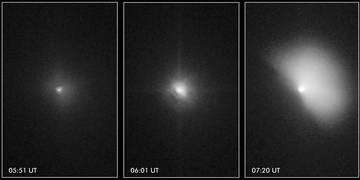
The NASA/ESA Hubble Space Telescope captured the dramatic effects of the collision early July 4 between a 370-kilogram projectile released by the Deep Impact spacecraft and comet 9P/Tempel 1.

This sequence of images shows the comet before and after the impact. The image at left shows the comet about a minute before the impact. The encounter occurred at 7:52 a.m. CEST.

In the middle image, captured 15 minutes after the collision, Tempel 1 appears four times brighter than in the pre-impact photo. Astronomers noticed that the inner cloud of dust and gas surrounding the comet's nucleus increased by about 200 kilometres in size. The impact caused a brilliant flash of light and a constant increase in the brightness of the inner cloud of dust and gas.

The Hubble telescope continued to monitor the comet, snapping another image [at right] 62 minutes after the encounter. In this photo, the gas and dust ejected during the impact are expanding outward in the shape of a fan. The fan-shaped debris is travelling at about 1,800 kilometres an hour, or twice as fast as the speed of a commercial jet. The debris extends about 1,800 kilometres from the nucleus.

The potato-shaped comet is 14 kilometres wide and 4 kilometres long. Tempel 1's nucleus is too small even for the Hubble telescope to resolve.

The visible-light images were taken by the Advanced Camera for Surveys' High Resolution Camera.

Source: ESA
Image Credit: NASA, ESA, P. Feldman (Johns Hopkins University) and H. Weaver (Johns Hopkins University Applied Physics Laboratory)


print this article email this article download pdf blog this article bookmark this article     Stumble it Digg this share on Facebook retweet share on Reddit add to delicious
Rate this story - not rated yet


July 4, 2005 all stories

Comments: 0

not rated yet
  • Stumble this up

  • Digg this

  • share this

  • hide
  • Related Stories

  • Hubble captures rare Jupiter collision
    created Jul 25, 2009 | popularity not rated yet | comments 0
  • Comet impact theory disproved
    created Jan 26, 2009 | popularity not rated yet | comments 0
  • Tunguska catastrophe: Evidence of acid rain supports meteorite theory
    created Jul 15, 2008 | popularity not rated yet | comments 0
  • SMART-1 impacts Moon (Update 2)
    created Sep 03, 2006 | popularity not rated yet | comments 0
  • SMART-1 towards final impact
    created Aug 04, 2006 | popularity not rated yet | comments 0


Other News

Glider robot a sleek ocean explorer

Space & Earth / Earth Sciences

created 5 hours ago | popularity 4.4 / 5 (7) | comments 0

The sea was heaving, the skies gray. The captain of the research ship was worried about the weather. About 120 miles off the coast of Spain, three Rutgers University scientists had a narrow window of opportunity to find and ...


Voyager makes an interstellar discovery

Voyager makes an interstellar discovery

Space & Earth / Space Exploration

created Dec 26, 2009 | popularity 4.8 / 5 (33) | comments 8

The solar system is passing through an interstellar cloud that physics says should not exist. In the Dec. 24th issue of Nature, a team of scientists reveal how NASA's Voyager spacecraft have solved the mystery.


Climate change puts ecosystems on the run, researchers say

Climate change puts ecosystems on the run, researchers say

Space & Earth / Environment

created 6 hours ago | popularity not rated yet | comments 3

(PhysOrg.com) -- Global warming is causing habitats to move across the landscape. Can the creatures living there keep up? If they can't, some species may die out, researchers say.


China defends role at Copenhagen

Space & Earth / Environment

created Dec 25, 2009 | popularity 2 / 5 (4) | comments 2

China has defended its role at this month's climate change talks in Copenhagen, saying Premier Wen Jiabao played a key part in sealing an accord, after critics blamed Beijing for blocking negotiations.


As shuttle's career nears an end, NASA turns focus to satellites

Space & Earth / Space Exploration

created Dec 26, 2009 | popularity 4.3 / 5 (7) | comments 0

NASA heads into 2010 with the bittersweet assignment of retiring the space shuttle after nearly three decades. But that's not all the agency has planned: There are also launches of three new satellites aimed at better understanding ...