Fundamental limitation to quantum computers
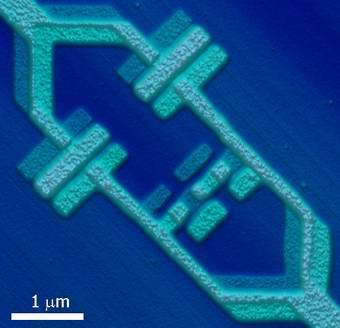
July 7th, 2005 Electron microscope image of a qubit from Hans Mooij's research group at Delft University of Technology

Quantum computers that store information in so-called quantum bits (or qubits) will be confronted with a fundamental limitation. This is the claim made by Dutch theoretical physicists from the Foundation for Fundamental Research on Matter (FOM) and Leiden University in an article recently published in the journal Physical Review Letters.

Image: Electron microscope image of a qubit from Hans Mooij's research group at Delft University of Technology.

A quantum computer can only function if the information exists for long enough to be processed. The so-called coherence of the qubit ensures that the quantum information remains intact. The researchers have now discovered that the coherence spontaneously disappears over the course of time and with this the stored information as well. This could pose a considerable problem for the development of a quantum computer.

A quantum computer makes use of the fact that a quantum mechanical system -an electron, an atom or even a larger system such as a superconducting quantum bit - can simultaneously exist in two states. Normally one of the two states disappears as soon as the system comes into contact with the outside world. The coherence then disappears as a result of the decoherence process and the information in a quantum bit is lost.

A quantum bit typically consists of a large number of particles, with an unavoidably large number of possibilities to be influenced by the environment and thus be subjected to decoherence. Jasper van Wezel, Jeroen van den Brink (FOM) and Jan Zaanen, all attached to the Lorentz Institute of Leiden University have now investigated whether it is possible to maintain the coherence in an isolated qubit.

Much to their surprise they discovered that the coherence tends to spontaneously disappear, even without external influences. The degredation process is linked to the occurrence of quantum mechanical spontaneous symmetry breaking. In classical physics an equivalent example of this process is spontaneous crystallisation in a solution. At a certain position a crystal is spontaneously formed, as a result of which the fluid structure is broken.

According to the researchers' predictions, the coherence in some highly promising concepts for qubits will disappear after about a second. Moreover, the smaller the qubits the faster that process occurs. All of this would seem to pose a fundamental limitation on the development of qubits. Experimental research will now have to demonstrate whether this phenomenon actually occurs.

The article "An Intrinsic Limit to Quantum Coherence due to Spontaneous Symmetry Breaking" was published in Physical Review Letters, in the week ending 17 June 2005.

Source: Netherlands Organization for Scientific Research


print this article email this article download pdf blog this article bookmark this article     Digg this Stumble it share on Facebook share on Reddit add to delicious save to Yahoo! bookmarks
3/5 after 2 votes


July 7th, 2005 all stories
Nanotechnology /

Comments: 0
Rank: 3/5 after 2 votes

  • Stumble this up

  • Digg this

  • Share it:
  • share on Facebook
  • share on MySpace
  • share on Slashdot
  • rss-newsfeed
  • share on Google
  • share on Reddit
  • add to delicious
  • save to Yahoo! bookmarks
  • share on Windows Live
  • Add to Mixx!
Rating: 3/5 after 2 votes


Tags


  • Transform a ball into a rock -- or make it invisible -- using transformation optics
    Transform a ball into a rock -- or make it invisible -- using transformation optics
    Physics / General Physics
    created 10 hours ago | popularity 3.7 / 5 (3) | comments 0
  • Could a quantum motor do work?
    Physics / General Physics
    created Jul 07, 2009 | popularity 4 / 5 (12) | comments 0
  • Physicists Demonstrate Quantum Memory with Matter Qubits
    Physicists Demonstrate Quantum Memory with Matter Qubits
    Physics / General Physics
    created Jul 03, 2009 | popularity 4.5 / 5 (20) | comments 1
  • 'Holey' Nanosheets for Wastewater Dye Removal
    Nanotechnology / Nanomaterials
    created Jul 01, 2009 | popularity 5 / 5 (5) | comments 1
  • Jellyfish Robot Swims Like its Biological Counterpart
    Jellyfish Robot Swims Like its Biological Counterpart
    Electronics / Robotics
    created Jun 26, 2009 | popularity 4.4 / 5 (9) | comments 1
  • Other News

    Nanopillars promise cheap, efficient, flexible solar cells

    Nanopillars Promise Cheap, Efficient, Flexible Solar Cells

    Nanotechnology / Nanomaterials

    created 3 hours ago | popularity 4 / 5 (4) | comments 1

    (PhysOrg.com) -- Researchers at the U.S. Department of Energy's Lawrence Berkeley National Laboratory and the University of California at Berkeley have demonstrated a way to fabricate efficient solar cells ...


    Material world: Graphene's versatility promises new applications

    Graphene's versatility promises new applications

    Nanotechnology / Nanomaterials

    created 8 hours ago | popularity 5 / 5 (2) | comments 1

    Since its discovery just a few years ago, graphene has climbed to the top of the heap of new super-materials poised to transform the electronics and nanotechnology landscape. As N.J. Tao, a researcher at the ...


    Light-absorbing nanowires may make better solar panels

    Light-absorbing nanowires may make better solar panels

    Nanotechnology / Nanomaterials

    created Jul 07, 2009 | popularity 4.1 / 5 (9) | comments 5

    (PhysOrg.com) -- A century after German physicist Gustav Mie derived the math to explain why the colors in some stained glass windows look especially resplendent in the sunlight, a team of Stanford engineers ...


    Researchers enlist DNA to bring carbon nanotubes' promise closer to reality

    Nanotechnology / Bio & Medicine

    created Jul 08, 2009 | popularity 5 / 5 (1) | comments 1

    A team of researchers from DuPont and Lehigh University has reported a breakthrough in the quest to produce carbon nanotubes (CNTs) that are suitable for use in electronics, medicine and other applications.


    'Flexible camera' replaces lens with fiber web

    'Flexible camera' replaces lens with fiber web

    Nanotechnology / Nanomaterials

    created Jul 07, 2009 | popularity 4.6 / 5 (10) | comments 0

    (PhysOrg.com) -- Imagine a soldier's uniform made of a special fabric that allows him to look in all directions and identify threats that are to his side or even behind him. In work that could turn such science ...