Research on Deep-Sea Sponge Yields Substantial Mechanical Engineering Insights
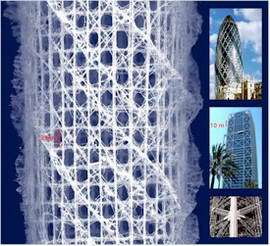
Scientists discover that marine sponge has unique structural properties, lending mechanical rigidity and stability to inherently fragile material
In a paper to be published July 8 in Science, a Lucent Technologies Bell Labs researcher suggests that a tropical deep-sea sponge can teach engineers and architects a lot about building remarkably strong structures from extremely fragile materials.
Image: Bell Labs researchers have discovered that the structural details of an Euplectella sea sponge correspond to fundamental mechanical engineering principles used in buildings such as (from top) the Swiss Re Tower in London, hotel De Las Artes in Barcelona, Spain and the Eiffel Tower in Paris. (Photo Credit: Lucent Technologies/Bell Labs)
“Nature has found a way to perfect inherently fragile materials by employing standard engineering principles from the nano to the macro scale,” said Bell Labs materials scientist Joanna Aizenberg, the lead researcher on the team. “This creature’s skeleton is a textbook lesson in mechanical engineering, offering valuable knowledge that could lead to new concepts in materials science and engineering design.”
Aizenberg’s team studied Euplectella, commonly called a Venus’s Flower Basket, a cylindrical sponge made of a natural glass called biosilica that generally grows to about six inches in length. It lives in the depths of Pacific Ocean and is usually home to a pair of mating shrimp, which are protected from predators by the sponge’s strong skeleton.
Tufts of glass fibers about the thickness of a human hair grow at the base of the sponge. In August 2003, Aizenberg led a research team in studying the optical properties of those fibers, discovering that the sponge uses multiple layers of glass held together by an organic glue to cover this natural “optical fiber,” making it extremely resistant to cracking and breaking. This discovery led to unique insights in the production of commercial fiber optic strands.
In their latest studies of Euplectella, Aizenberg and her team at Bell Labs, working with collaborators at the Institute for Collaborative Biotechnologies and Materials Research Laboratory at the University of California, Santa Barbara, and the Max Planck Institute of Colloids and Interfaces in Potsdam, Germany, identified seven different levels of structural hierarchy in the sponge. Each of the structural levels corresponds to a fundamental construction principle commonly used in civil engineering and sometimes product design, but on a scale 1,000 times smaller than a building.
For example, the fibers that comprise the sponge’s skeleton are arranged in a lattice, or open criss-cross pattern, reinforced by fibers that run diagonally in both directions inside alternate squares in the lattice. This construction technique is often found in high-rise buildings and free-standing bookshelves to counteract shear stress, which can easily collapse a non-reinforced square structure.
The team also discovered that when the diameter of the sponge’s skeleton increases beyond a certain point the outer structure is reinforced by ridges in a spiral pattern. The ridges counteract an effect known as “ovalization,” which makes cylindrical structures more prone to collapse, as demonstrated by the fact that it’s fairly easy to twist or flatten an empty aluminum can. By stabilizing its skeleton with external ridges, the sponge makes itself difficult to crush. Other hierarchical levels include highly stable laminated glass beams, fiber-reinforced cements, and bundled structural elements, to name a few.
“These discoveries illustrate that Nature often demonstrates simple solutions to complex scientific problems,” said Elsa Reichmanis, director of Materials Research, Bell Labs. “These sponges are formed perfectly, with exactly the right amount of material needed to optimize the design. Understanding how these structures evolve could help improve the synthetic materials and design processes we use today and in the future.”
The discovery furthers Bell Labs’ contributions in the field of biomimetics, a study of engineering principles in the natural world for application in synthetic materials and technologies. Aizenberg previously led research teams that created the world’s first micro-patterned crystals inspired by bioengineering, and discovered optical fibers in Euplectella sponges and unique biological optical receptors in brittlestars.
Source: Bell Labs


