Sharp Develops New Technology to Blend Plant-Based Plastic with Waste Plastic

July 11th, 2005

Sharp Corporation has developed a new technology to blend plant-based plastic that uses corn as the raw material, and waste plastic recovered from scrapped consumer electronics.
Using a mix of plant-based plastic and waste plastic blended by means of this technology in consumer electronics can significantly reduce environmental impact compared to using common plastics derived from petroleum-based feedstocks.

In the future, Sharp will be conducting tests to assess commercial potential, with the goal of using blended plastic in Sharp products within fiscal 2006. In the future, when the price of plant-based plastics is reduced to a level on a par with general plastics, it is estimated that the percentage of renewable resources (plant-based plastic and waste plastic) used in all products will increase to 30% by fiscal 2010.

At present, raw materials used in consumer electronics rely almost entirely on fossil materials such as petroleum, but efforts to shift as much as possible to renewable resources (plant-based and recycled materials) are moving forward from the perspective of limiting emissions of greenhouse gases, with the aim of building a sustainable recycling-oriented society.

At the same time, plant-based plastics have the potential to reduce the impact on the environment given that incinerating these materials does not cause the concentration of carbon dioxide gas in the atmosphere to rise. However, problems remain in terms of impact/shock resistance, thermal resistance, cost and other factors, and their adoption in the area of consumer durable goods, particularly electronic products, remains limited.

Against this background, Sharp has been conducting research since 1999 on technologies to recycle waste plastic from consumer electronics, and in May 2003, put such a recycling technology into practical use to enable repeated re-use of polypropylene (PP) and polystyrene (PS) recovered from four categories of discarded household electrical appliances falling under the Home Appliance Recycling Law (air conditioners, TVs, refrigerators and washing machines) in components in new manufactured products in these four categories without loss of physical properties such as material strength.

Major Features of Technology to Blend Plant-Based Plastics and Waste Plastic

1) Development of technology to compatibilize*1 plant-based plastic with waste plastic.
2) Improved impact resistance, thermal resistance, etc., to a practical level, previously a problem with plant-based plastic.
3) Three patent applications pending.

*1 Technology to cause microdispersion (increase compatibility at the molecular level) by uniformly blending non-homogeneous plastic materials.

Technology to Compatibilize Plant-Based Plastic with Waste Plastic

In blending plant-based plastic (polylactic acid [PLA]) and waste plastic (polypropylene [PP]), the two materials tend not to be mutually compatible, causing a gap to form at the boundary surfaces of the PLA and PP and leading to a significant loss of physical properties (such as impact resistance and thermal resistance) (see Figure 1).

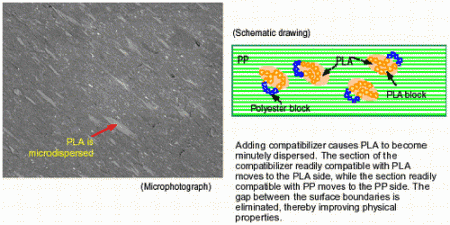
But blending in an appropriate amount of a newly developed compatibilizer (Figure 2) and mixing the PLA and PP in an optimal proportion, the PLA forms an ultrafine dispersion and facilitates compatibility between the two materials, thereby dramatically improving the physical properties of the blended material. (Figure 3).
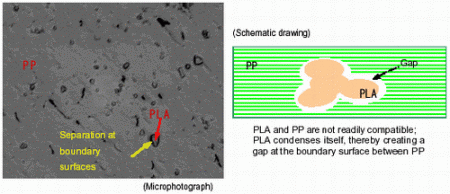

Figure 1   When PLA and PP are mixed using typical methods
Enlarge

Figure 1 When PLA and PP are mixed using typical methods


Figure 2   Schematic diagram of compatibilizer at work

Figure 2 Schematic diagram of compatibilizer at work


Figure 3.   PLA is microdispersed as a result of blending with a compatibilizer
Enlarge

Figure 3. PLA is microdispersed as a result of blending with a compatibilizer


print this article email this article download pdf blog this article bookmark this article     Digg this Stumble it share on Facebook share on Reddit add to delicious save to Yahoo! bookmarks
3.5/5 after 8 votes


July 11th, 2005 all stories
Technology /

Comments: 0
Rank: 3.5/5 after 8 votes

  • Stumble this up

  • Digg this

  • Share it:
  • share on Facebook
  • share on MySpace
  • share on Slashdot
  • rss-newsfeed
  • share on Google
  • share on Reddit
  • add to delicious
  • save to Yahoo! bookmarks
  • share on Windows Live
  • Add to Mixx!
Rating: 3.5/5 after 8 votes

  • Related Stories

  • Critics: Burial site for Hudson PCBs is inadequate
    created Jun 22, 2009 | popularity not rated yet | comments 0
  • Scientists set 2020 goal for improving Pacific Ocean's health
    created Jun 01, 2009 | popularity not rated yet | comments 0
  • Voyage to the centre of the 'Plastic Vortex'
    created May 25, 2009 | popularity not rated yet | comments 0
  • Study Finds that Styrofoam Increases Biodiesel Power Output
    created May 04, 2009 | popularity not rated yet | comments 0
  • It's safer to recycle, not dump, toxic electronics
    created Apr 27, 2009 | popularity not rated yet | comments 0

Tags


  • Physicists Demonstrate Quantum Memory with Matter Qubits
    Physicists Demonstrate Quantum Memory with Matter Qubits
    Physics / General Physics
    created 19 hours ago | popularity 4.5 / 5 (11) | comments 1
  • 'Holey' Nanosheets for Wastewater Dye Removal
    Nanotechnology / Nanomaterials
    created Jul 01, 2009 | popularity 5 / 5 (5) | comments 1
  • Jellyfish Robot Swims Like its Biological Counterpart
    Jellyfish Robot Swims Like its Biological Counterpart
    Electronics / Robotics
    created Jun 26, 2009 | popularity 4.4 / 5 (7) | comments 1
  • Could Maxwell's Demon Exist in Nanoscale Systems?
    Could Maxwell's Demon Exist in Nanoscale Systems?
    Physics / General Physics
    created Jun 24, 2009 | popularity 4.4 / 5 (18) | comments 29
  • Living Safely with Robots, Beyond Asimov's Laws
    Living Safely with Robots, Beyond Asimov's Laws
    Electronics / Robotics
    created Jun 22, 2009 | popularity 4.6 / 5 (51) | comments 39
  • Other News

    Homeland Security Secretary Janet Napolitano

    US government Internet traffic to be screened: report (Update)

    Technology / Internet

    created 18 hours ago | popularity 5 / 5 (1) | comments 2

    The Obama administration is planning to use the National Security Agency to screen Internet traffic between government agencies and the private sector, the Washington Post reported Friday.


    Volkswagen hopes to turn out its first all-electric car in 2013

    Volkswagen plans electric car in 2013: head

    Technology / Energy

    created 12 hours ago | popularity 1 / 5 (1) | comments 0

    German auto maker Volkswagen hopes to turn out its first all-electric car in 2013, VW head Martin Winterkorn said Friday.


    Japanese veterans in Imperial Army uniforms march in Tokyo

    Japanese imperial army maps to go online

    Technology / Internet

    created 10 hours ago | popularity 1 / 5 (1) | comments 0

    Old Asia-Pacific maps from Japanese Imperial Army archives are going online for modern use, such as studying changes in forest cover or the growth of cities, a Japanese researcher said Friday.


    US wants privacy in new cyber security system (AP)

    US wants privacy in new cyber security system

    Technology / Internet

    created 22 hours ago | popularity 4 / 5 (1) | comments 0

    (AP) -- The Obama administration is moving cautiously on a new pilot program that would both detect and stop cyber attacks against government computers, while trying to ensure citizen privacy protections.


    Racing car powered by chocolate and steered by carrots takes to the track at Goodwood

    Technology / Engineering

    created 16 hours ago | popularity 1 / 5 (3) | comments 0

    A racing car created from potatoes and carrots and powered by chocolate will be put through its paces this weekend at the world’s largest celebration of motorsport.