Mystery compact object producing high energy radiation
In a recent issue of Science Magazine, the High Energy Stereoscopic System (H.E.S.S.) team of international astrophysicists reports the discovery of another new type of very high energy (VHE) gamma ray source.
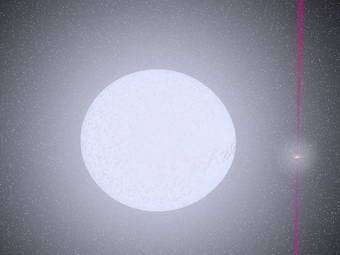
Image: A computer simulation of the microquasar LS5039. The companion star to the compact object is a massive star that is losing material from its surface. This matter is then captured by the compact object's strong gravitational field and spirals down towards the surface. Some of this material is then ejected in two jets travelling at 20% of the speed of light. This image was created using software developed by Dr. Rob Hynes of LSU.
Gamma-rays are produced in extreme cosmic particle accelerators such as supernova explosions and provide a unique view of the high energy processes at work in the Milky Way. VHE gamma-ray astronomy is still a young field and H.E.S.S. is conducting the first sensitive survey at this energy range, finding previously unknown sources.
The object that is producing the high energy radiation is thought to be a 'microquasar'. These objects consist of two stars in orbit around each other. One star is an ordinary star, but the other has used up all its nuclear fuel, leaving behind a compact corpse. Depending on the mass of the star that produced it, this compact object is either a neutron star or a black hole, but either way its strong gravitational pull draws in matter from its companion star. This matter spirals down towards the neutron star or the black hole, in a similar way to water spiraling down a plughole.
However, sometimes the compact object receives more matter than it can cope with. The material is then squirted away from the system in a jet of matter moving at speeds close to that of light, resulting in a microquasar. Only a few such objects are known to exist in our galaxy and one of them, an object called LS5039, has now been detected by the H.E.S.S. team.
In fact, the real nature LS5039 is something of a mystery. It is not clear what the compact object is. Some of the characteristics suggest it is a neutron star, some that it is a black hole. Not only that, but the jet isn't much of a jet; although it is moving at about 20% of the speed of light, which might seem a lot, in the context of these objects it's actually quite slow.
Nor is it clear how the gamma rays are being produced. As Dr. Guillaume Dubus of the Ecole Polytechnique points out "We really shouldn't have detected this object. Very high energy gamma rays emitted close to the companion star are more likely to be absorbed, creating a matter/antimatter cascade, than escape from the system."
Dr Paula Chadwick of the University of Durham adds "It's very exciting to have added another class of object to the growing catalogue of gamma ray sources. It's an intriguing object - it will take more observations to work out what is going on in there."
The H.E.S.S. array is ideal for finding new VHE gamma ray objects; because it's wide field of view (ten times the diameter of the Moon) means that it can survey the sky and discover previously unknown sources.
The results were obtained using the High Energy Stereoscopic System (H.E.S.S.) telescopes in Namibia, in South-West Africa. This system of four 13 m diameter telescopes is currently the most sensitive detector of VHE gamma-rays - radiation that is a million, million times more energetic than the visible light. These high energy gamma rays are quite rare even for relatively strong sources; only about one gamma ray per month hits a square metre at the top of the Earth's atmosphere. Also, since they are absorbed in the atmosphere, a direct detection of a significant number of the rare gamma rays would require a satellite of huge size. The H.E.S.S. telescopes employ a trick - they use the atmosphere as detector medium. When gamma rays are absorbed in the air, they emit short flashes of blue light, named Cherenkov light, lasting a few billionths of a second. This light is collected by the H.E.S.S. telescopes with large mirrors and extremely sensitive cameras and can be used to create images of astronomical objects as they appear in gamma-rays.
The H.E.S.S. telescopes represent several years of construction effort by an international team of more than 100 scientists and engineers from Germany, France, the UK, Ireland, the Czech Republic, Armenia, South Africa and the host country Namibia. The instrument was inaugurated in September 2004 by the Namibian Prime Minister, Theo-Ben Guirrab, and its first data have already resulted in a number of important discoveries, including the first astronomical image of a supernova shock wave at the highest gamma-ray energies.
Source: PPARC


