Purdue findings support earlier nuclear fusion experiments
Researchers at Purdue University have new evidence supporting earlier findings by other scientists who designed an inexpensive "tabletop" device that uses sound waves to produce nuclear fusion reactions.
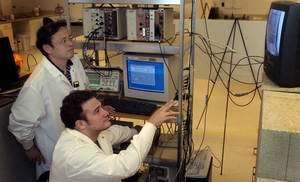
Image: Purdue University researchers Yiban Xu, standing, and Adam Butt, in the foreground, look at a monitor connected to a camera trained on a nearby experiment. The research has yielded evidence supporting earlier findings by other scientists who designed an inexpensive "tabletop" device that uses sound waves to produce nuclear fusion reactions. (Purdue News Service photo/David Umberger)
The technology, in theory, could lead to a new source of clean energy and a host of portable detectors and other applications.
The new findings were detailed in a peer-reviewed paper appearing in the May issue of the journal Nuclear Engineering and Design. The paper was written by Yiban Xu, a post-doctoral research associate in the School of Nuclear Engineering, and Adam Butt, a graduate research assistant in both nuclear engineering and the School of Aeronautics and Astronautics.
A key component of the experiment was a glass test chamber about the size of two coffee mugs filled with a liquid called deuterated acetone, which contains a form of hydrogen known as deuterium, or heavy hydrogen. The researchers exposed the test chamber to subatomic particles called neutrons and then bombarded the liquid with a specific frequency of ultrasound, which caused cavities to form into tiny bubbles. The bubbles then expanded to a much larger size before imploding, apparently with enough force to cause thermonuclear fusion reactions.
Fusion reactions emit neutrons that fall within a specific energy range of 2.5 mega-electron volts, which was the level of energy seen in neutrons produced in the experiment. The experiments also yielded a radioactive material called tritium, which is another product of fusion, Xu and Butt said.
The Purdue research began two years ago, and the findings represent the first confirmation of findings reported earlier by Rusi Taleyarkhan. Now at Purdue, Taleyarkhan, the Arden L. Bement Jr. Professor of Nuclear Engineering, discovered the fusion phenomenon while he was a scientist working at the Oak Ridge National Laboratory.
"The two key signatures for a fusion reaction are emission of neutrons in the range of 2.5 MeV and production of tritium, both of which were seen in these experiments," Xu said.
The same results were not seen when the researchers ran control experiments with normal acetone, providing statistically significant evidence for the existence of fusion reactions.
"The control experiments didn't show anything," Xu said. "We changed just one parameter, substituting the deuterated acetone with normal acetone."
Deuterium contains one proton and one neutron in its nucleus. Normal hydrogen contains only one proton in its nucleus.
Taleyarkhan led a research team that first reported the phenomenon in a 2002 paper published in the journal Science. Those researchers later conducted additional research at the Oak Ridge National Laboratory, Rensselaer Polytechnic Institute and the Russian Academy of Sciences and wrote a follow-up paper that appeared in the journal Physical Review E in 2004, just after Taleyarkhan had come to Purdue.
Scientists have long known that high-frequency sound waves cause the formation of cavities and bubbles in liquid, a process known as "acoustic cavitation," and that those cavities then implode, producing high temperatures and light in a phenomenon called "sonoluminescence."
In the Purdue research, however, the liquid was "seeded" with neutrons before it was bombarded with sound waves. Some of the bubbles created in the process were perfectly spherical, and they imploded with greater force than irregular bubbles. The research yielded evidence that only spherical bubbles implode with a force great enough to cause deuterium atoms to fuse together, similar to the way in which hydrogen atoms fuse in stars to create the thermonuclear furnaces that make stars shine.
Nuclear fusion reactors have historically required large, expensive machines, but acoustic cavitation devices might be built for a fraction of the cost. Researchers have estimated that temperatures inside the imploding bubbles reach 10 million degrees Celsius and pressures comparable to 1,000 million earth atmospheres at sea level.
Xu and Butt now work in Taleyarkhan's lab, but all of the research on which the new paper is based was conducted before they joined the lab, and the research began at Purdue before Taleyarkhan had become a Purdue faculty member. The two researchers used an identical "carbon copy" of the original test chamber designed by Taleyarkhan, and they worked under the sponsorship and direction of Lefteri Tsoukalas, head of the School of Nuclear Engineering.
Although the test chamber was identical to Taleyarkhan's original experiment, and the Purdue researchers were careful to use deuterated acetone, they derived the neutrons from a less-expensive source than the Oak Ridge researchers. The scientists working at Oak Ridge seeded the cavities with a "pulse neutron generator," an apparatus that emits rapid pulses of neutrons. Xu and Butt derived neutrons from a radioactive material that constantly emits neutrons, and they simply exposed the test chamber to the material.
Development of a low-cost thermonuclear fusion generator would offer the potential for a new, relatively safe and low-polluting energy source. Whereas conventional nuclear fission reactors make waste products that take thousands of years to decay, the waste products from fusion plants would be short-lived, decaying to non-dangerous levels in a decade or two. For the same unit mass of fuel, a fusion power plant would produce 10 times more energy than a fission reactor, and because deuterium is contained in seawater, a fusion reactor's fuel supply would be virtually infinite. A cubic kilometer of seawater would contain enough heavy hydrogen to provide a thousand years' worth of power for the United States.
Such a technology also could result in a new class of low-cost, compact detectors for security applications that use neutrons to probe the contents of suitcases; devices for research that use neutrons to analyze the molecular structures of materials; machines that cheaply manufacture new synthetic materials and efficiently produce tritium, which is used for numerous applications ranging from medical imaging to watch dials; and a new technique to study various phenomena in cosmology, including the workings of neutron stars and black holes.
The desktop experiment is safe because, although the reactions generate extremely high pressures and temperatures, those extreme conditions exist only in small regions of the liquid in the container – within the collapsing bubbles, Xu said.
Purdue researchers plan to release additional data from related experiments in October during the Nuclear Reactor Thermal Hydraulics conference in Avignon, France.
The 2004 paper was written by Taleyarkhan while a distinguished scientist at Oak Ridge National Laboratory, postdoctoral fellow J.S Cho at Oak Ridge Associated Universities; Colin West, a retired scientist from Oak Ridge; Richard T. Lahey Jr., the Edward E. Hood Professor of Engineering at Rensselaer Polytechnic Institute (RPI); R.C. Nigmatulin, a visiting scholar at RPI and president of the Russian Academy of Sciences' Bashkortonstan branch; and Robert C. Block, active professor emeritus in the School of Engineering at RPI and director of RPI's Gaerttner Linear Accelerator Laboratory.
ABSTRACT
Confirmatory experiments for nuclear emissions during acoustic cavitation
Yiban Xua,*, Adam Butta,b
a School of Nuclear Engineering
b School of Aeronautics and Astronautics
Purdue University
Confirmatory experiments were conducted to assess the potential for nuclear fusion related emissions of neutrons and tritium during neutron-seeded acoustic cavitation of deuterated acetone. Corresponding control experiments were conducted with normal acetone. Statistically significant (5-11 S.D. increased) emissions of 2.45 MeV neutrons and tritium were measured during cavitation experiments with chilled deuterated acetone. Control experiments with normal acetone and irradiation alone did not result in tritium activity or neutron emissions. Insights from imaging studies of bubble clusters and shock trace signals relating to bubble nuclear fusion are discussed.
Source: Purdue University


