New Infrared Tool Measures Silicon Wafer Thickness
July 13, 2005
New Infrared Tool Measures Silicon Wafer Thickness

In the last few years, semiconductor circuit features have shrunk to sub-100 nanometer dimensions, while the size of the thin silicon wafers that these circuits are constructed on has grown from 200 millimeters (mm) to 300 mm (about 12 inches). The payoff is a higher yield of finished devices from fewer wafers.

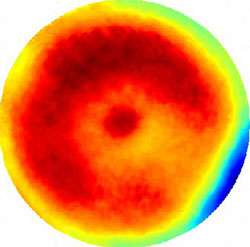
Image: A new NIST calibration system under development used infrared laser light to precisely measure the thickness of 300 millimeter silicon wafers. Changes in color within the spatial map above represent changes in wafer thickness. Green represents the average wafer thickness, while red, orange and yellow areas are thicker, and turquoise and blue areas are thinner. Credit: Q. Wang, U. Griesmann/NIST

The tough part, however, is to make wafers substantially larger while simultaneously meeting higher quality control specifications. The optics and materials for “printing” nanoscale circuit lines require that the wafers used are perfectly flat and of uniform thickness. To help the semiconductor industry meet its 2010 quality control roadmap goals, researchers at the National Institute of Standards and Technology (NIST) recently developed a new instrument that accurately measures differences in thickness across a 300 mm wafer with an excellent repeatability of 5 nm. The researchers hope the tool, with further refinements, will allow them to establish a new calibration service for “master wafers” used in the industry to measure wafer thickness.

The NIST researchers will describe the instrument, the Improved Infrared Interferometer, or IR3 for short, at a technical conference* in late July. Like all interferometers, the IR3 uses intersecting waves of light to create interference patterns, which in turn can be used as a ruler to measure nanoscale dimensions. While most interferometers use red laser light, the IR3 uses infrared laser light. And unlike visible light, these much longer wavelengths pass right through a silicon wafer. This means that IR3 can illuminate the top and bottom on a 300 mm wafer and produce a detailed spatial map of differences in thickness in one pass. Conventional tools require spinning the wafer and measuring at multiple locations.

The NIST researchers make precision measurements of the wafer’s index of refraction—the amount that light is “bent” as it passes through the silicon—as a critical step in correctly interpreting the interference patterns. Increased precision in the refractive index measurement will be necessary before “absolute” measurements of thickness rather than relative differences will be possible with the new instrument.

*Q. Wang, U. Griesmann and R. Polvani. Interferometric thickness calibration of 300 mm silicon wafers. ASPE Summer Topical Meeting on Precision Interferometric Metrology (July 20-22, 2005).

Source: NIST

4.5 /5 (2 votes)  

Rank 4.5 /5 (2 votes)
Tags

Relevant PhysicsForums posts

More news stories

Putting the squeeze on planets outside our solar system

(PhysOrg.com) -- Using high-powered lasers, scientists at Lawrence Livermore National Laboratory and collaborators discovered that molten magnesium silicate undergoes a phase change in the liquid state, abruptly ...

Physics / Condensed Matter

created 18 hours ago | popularity 4.3 / 5 (7) | comments 0 | with audio podcast

Hovering not hard if you're top-heavy, researchers find

Top-heavy structures are more likely to maintain their balance while hovering in the air than are those that bear a lower center of gravity, researchers at New York University's Courant Institute of Mathematical Sciences ...

Physics / General Physics

created 19 hours ago | popularity 5 / 5 (2) | comments 1 | with audio podcast

SLAC, Stanford team focuses on high-energy electrons to treat cancer

Accelerator physicists at SLAC and cancer specialists from Stanford are working on a new technology that could dramatically reduce the time needed for cancer radiation treatments. The team ran an initial experiment ...

Physics / General Physics

created 22 hours ago | popularity 5 / 5 (2) | comments 0

Measurements from high-energy collisions lead to better understanding of why meson particles disappear

For several years, physicists at the Relativistic Heavy Ion Collider (RHIC) at Brookhaven National Laboratory (BNL), USA, have studied an unusual state of matter called the quark–gluon plasma, which they ...

Physics / General Physics

created 22 hours ago | popularity 4.5 / 5 (4) | comments 0

Explained: Sigma

It's a question that arises with virtually every major new finding in science or medicine: What makes a result reliable enough to be taken seriously? The answer has to do with statistical significance -- but ...

Physics / General Physics

created Feb 09, 2012 | popularity 5 / 5 (16) | comments 53


Anonymous knocks CIA website offline (Update)

The website of the Central Intelligence Agency was inaccessible on Friday after the hacker group Anonymous claimed to have knocked it offline.

New error-correcting codes guarantee the fastest possible rate of data transmission

Error-correcting codes are one of the triumphs of the digital age. They’re a way of encoding information so that it can be transmitted across a communication channel — such as an optical fiber o ...

Small modular reactor design could be a 'SUPERSTAR'

(PhysOrg.com) -- Though most of today's nuclear reactors are cooled by water, we've long known that there are alternatives; in fact, the world's first nuclear-powered electricity in 1951 came from a reactor ...

New power source discovered

(PhysOrg.com) -- Researchers at the Massachusetts Institute of Technology (MIT) and RMIT University have made a breakthrough in energy storage and power generation.

The power of estrogen -- male snakes attract other males

A new study has shown that boosting the estrogen levels of male garter snakes causes them to secrete the same pheromones that females use to attract suitors, and turned the males into just about the sexiest ...

Advanced power-grid model finds low-cost, low-carbon future in West

(PhysOrg.com) -- The least expensive way for the Western U.S. to reduce greenhouse gas emissions enough to help prevent the worst consequences of global warming is to replace coal with renewable and other ...