Findings bolster link between birds and T. rex
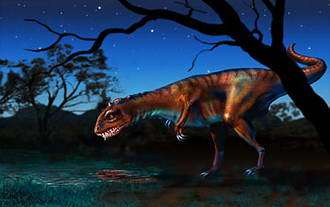
A recent analysis showing the presence of a very bird-like pulmonary, or lung, system in predatory dinosaurs provides more evidence of an evolutionary link between dinosaurs and birds. First proposed in the late 19th century, theories about the animals' relatedness enjoyed brief support but soon fell out of favor. Evidence gathered over the past 30 years, though, has breathed new life into the hypothesis.
New evidence shows the predatory dinosaur, Majungatholus atopus, had a very bird-like pulmonary system. Credit: Nicolle Rager Fuller, National Science Foundation
Ohio University's Patrick O'Connor and Harvard University's Leon Claessens publish their results in the July 14 issue of the journal, Nature. The work makes clear the unique pulmonary system of birds, which has fixed lungs and air sacs that penetrate the skeleton, has an older history than previously realized. It also dispels the theory that predatory dinosaurs had lungs similar to living reptiles, like crocodiles.
The avian pulmonary system uses "flow-through ventilation," relying on a set of nine flexible air sacs that act like bellows to move air through the almost completely rigid lungs. Air sacs do not take part in the actual oxygen exchange, but do greatly enhance its efficiency and allow for the high metabolic rates found in birds. This system also keeps the volume of air in the lung nearly constant, a prerequisite for maintaining a level flight path.
O'Connor says the presence of an extensive pulmonary air sac system with flow-through ventilation of the lung suggests this group of dinosaurs could have maintained a stable and high metabolism, putting them much closer to a warm-blooded existence.
"More and more characteristics that once defined birds--feathers, for example--are now known to have been present in dinosaurs, so, many avian features may really be dinosaurian," said O'Connor.
A portion of the air sac actually integrates with the skeleton, forming air pockets in otherwise dense bone. The exact function of this skeletal modification is not completely understood, but one explanation theorizes the skeletal air pockets evolved to lighten the bone structure, allowing dinosaurs to walk upright and birds to fly.
In addition to prehistoric dinosaur bones preserved in museums in the United States and abroad, O'Connor and Claessens used an exquisitely preserved specimen of the Tyrannosaurus rex relative, Majungatholus atopus that O'Connor helped discovery in 1996. He and Claessens are currently examining the pulmonary structure of the pterosaur--a flying dinosaur.
The National Science Foundation provided support for this research through its biology directorate and a graduate research fellowship. For more on this story, see the University of Ohio and Harvard press releases.
Source: NSF


