Superwind discovered spreading Star Dust across the Universe
A team of astronomers, led by the University of Durham, has discovered the aftermath of a spectacular explosion in a galaxy 11.5 billion light years away. Their observations, reported today (14th July 2005) in the journal Nature provide the most direct evidence yet of a galaxy being almost torn apart by explosions that produce a stream of high-speed material known as "Superwinds". The observations were made using the 4.2 metre William Herschel Telescope on La Palma in which the UK is a major stakeholder.
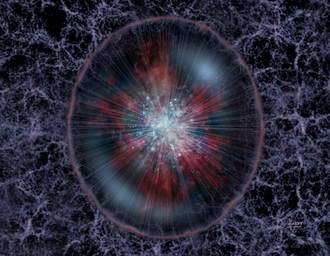
Image: An artist's impression of a Superwind in a young massive galaxy over 10 billion light years from Earth. This conveys the impression of an exploding shell plowing into the surrounding gas at high speed, and partly absorbing the light from gas and young stars in the galaxy. Image Credit: PPARC/David Hardy
Through Superwinds, galaxies are thought to blast a significant part of their gas into intergalactic space at speeds of up to several hundred miles per second. The driving force behind them is the explosion of many massive stars during an intense burst of star formation early in the galaxy's life, possibly assisted by energy from a super massive black hole growing at its heart.
Superwinds are vital to the theory of galaxy formation for several reasons: firstly, they limit the sizes of galaxies by preventing further star formation - without them theoretical models indicate far more very bright galaxies than are actually seen in the Universe today. Secondly, they carry heavy elements - Star dust - far from their production sites in stars out into intergalactic space, providing raw material for planets and life across the Universe. Whilst the theories predicted Superwinds of this kind existed, previously observed examples were much smaller phenomena in nearby galaxies. These observations provide some of the most direct evidence yet for the existence of large-scale, galaxy-wide superwinds so far back in the history of the Universe.
The discovery of the Superwind was made by observing the gas in the halo of a galaxy (known as "LAB-2"), which at over 300,000 light years across is about three times larger than the disk of our own Milky Way galaxy. The astronomers discovered that light from hot glowing hydrogen gas is dimmed in a very specific way across the entire galaxy.
"We believe that the dimming is caused by a shell of cooled material which has been swept-up from the surroundings by a galaxy-wide Superwind explosion," said Dr. Richard Wilman of the University of Durham. "Based on the uniformity of the absorption across the galaxy, it appears that the explosion was triggered several hundred million years earlier. This allows time for the gas to cool and to slow down from its high ejection speed, and thus to produce the absorption. As we see it, the shell is probably a few hundred thousand light years in front of its parent galaxy," added Dr. Wilman.
Astronomers have long been puzzled about why key elements for the formation of planets and ultimately life (such as carbon, oxygen and iron) are so widely distributed throughout the Universe; only 2 billion years after the Big Bang, the remotest regions of intergalactic space have been enriched with them. The Superwind observed in this galaxy shows how such blast waves can travel through space carrying the elements formed deep within galaxies.
Crucial to the discovery and its interpretation was the ability to obtain detailed information on the gas in two-dimensions across the whole galaxy. This was made possible by a technique known as integral field spectroscopy, which is only just reaching maturity on the world's largest telescopes.
Dr Joris Gerssen, a key member of the Durham team, explains, "Most astronomical spectroscopy is performed by placing a small aperture, or a narrow slit on the target, which for complex, extended sources such as this galaxy gives a rather incomplete picture".
To overcome this the astronomers used an integral field spectrograph called 'Sauron' for a large survey of nearby galaxies, built at the Observatoire de Lyon by a collaboration of French, Dutch and UK astronomers.
Dr Gerssen added," "Sauron is truly unique and its high efficiency means that it can more than hold its own against instruments on the world's largest telescopes, some twice the size of the William Herschel Telescope. Nevertheless, the sheer distance of our target galaxy meant that Sauron had to stare at it for over 15 hours in order to make this discovery".
"Sauron has provided us with the best evidence so far for an extensive outflow from a galaxy undergoing a huge starburst. These measurements are among the first steps towards understanding the physics of galaxy formation.," commented Prof. Roger Davies, University of Oxford, one of the institutes involved on Sauron," and we look forward to using similar two-dimensional spectrographs being built for 8m telescopes; these will probe the galaxy formation process to even earlier times."
To date, observational evidence for Superwinds in young galaxies in the distant Universe has been largely indirect and circumstantial; efforts have focussed on searching for their subtle statistical signatures in large surveys of galaxies and intergalactic gas.
According to Prof. Richard Bower, from the University of Durham's Institute of Computational Cosmology who initiated the research, "Astronomers have observed high-speed outflows in distant star-forming galaxies for several years, but never before have we been able to gauge their true scale from observations of a single galaxy. By taking advantage of the highly extended emission source of this galaxy, we can see the outflow as a kind of silhouette against the whole galaxy. This suggests that Superwinds are truly galaxy-wide in scale, and that they really are as important as our theories require."
Source: PPARC


