Scientists make landmark observations about weak force
Experimenters at the Stanford Linear Accelerator Center (SLAC) have made vital new observations that illuminate the nature of the weak force.
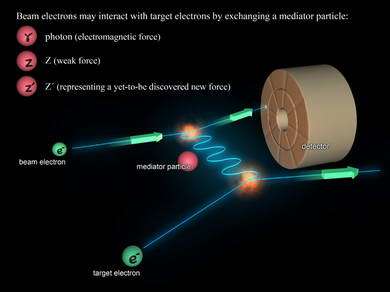
Image: E158's Rare Interactions. In studying scattering between electrons, the experiment looked for the one weak force interaction out of every one million electromagnetic force interactions. E158 was sensitive to (but did not find) indirect signals from Z' (Z prime) particles, hypothetical fat cousins of Z particles that would carry a yet-be-discovered new force. Illustration by Juna Kurihara, SLAC
The weak force is tremendously important. Without it, there would be no life on Earth. The weak force causes radioactive decays, which are essential in making sunlight. Radioactive decays also warm the inner Earth, enabling liquid magma to move continents and generate earthquakes. Radioactive decays can be used to measure the age of the Earth and archeological samples, and to diagnose and treat disease. The strength of the weak force affects how long the sun and stars last, and the mix of basic elements in our universe.
Using extraordinary precision, scientists working on SLAC's E158 experiment made the landmark observation that the strength of the weak force acting on two electrons lessens when the electrons are far apart. The results have been accepted for publication in the field's primary journal, Physical Review Letters.
"Physicists have long expected that the weak force interactions would be weaker at longer distances, but proving it wasn't easy," said experiment co-spokesman Krishna Kumar, professor of physics at the University of Massachusetts-Amherst. SLAC physicists made up one third of the 60-person collaboration and led experimental operations.
"The experiment could only be done at SLAC, using the highest beam power SLAC has seen in 30 years," Kumar said. "We measured this minute effect with a massive beam. It was a huge technical achievement—most people were skeptical about our chances for success."
The precision measurements required enormous numbers of electrons. The SLAC linear accelerator sent 500 billion electrons in a single bunch to a target, and repeated this 700 million times. In half of these electron bunches, the electrons were polarized to spin right-handed. The electrons in the remaining bunches were polarized to spin left-handed. Some electrons entering the target scattered off target electrons by exchanging a mediator particle. The mediator is almost always a photon, which transmits the electromagnetic force (think visible light, radio waves, X-rays). The collaboration's challenge was to find the rate of rare events: the electron-electron scatters that took place by exchanging a Z particle, which mediates the weak force. They found one weak force interaction out of every 1 million electromagnetic force interactions.
Because there is an asymmetry in how the weak force acts, there is a slight difference in how often left-handed electrons scatter using a Z particle compared to the rate for right-handed electrons. On average, a bunch of right-handed electrons generates 20 million scattering events, including several dozen Z scatters. Left-handed bunches yield about five more Z-mediated scatters.
E158 made the first observation of this slight left-right asymmetry, called parity violation, in electron-electron interactions in 2003. The asymmetry is so tiny—131 parts per billion—that if you did the experiment with clocks, a left-handed clock would be only one hour faster after 1,000 years (see animation).
The measured asymmetry for E158 is proportional to the electron's weak charge, which determines the strength of the weak force between two electrons. Previous experiments at SLAC and CERN, Europe's particle physics lab near Geneva, had measured the electron's weak charge at short distances, about 100 times smaller than the width of a proton. E158 has now demonstrated that, as predicted, at "long" distances, approximately 10 times the width of a proton, the electrons are far apart and their weak charge is only half the size of the charge at short distances.
The experiment established that the electron's weak charge varies with distance—a trait called running. This is the first demonstration of running in weak force interactions. The results confirm for the first time an important aspect of Standard Model theory, which describes the actions of the weak force, electromagnetism and the strong force.
The weak charge gets weaker because of quantum fluctuations. The vacuum surrounding every particle randomly spits out and reabsorbs virtual particles, making an ephemeral cloud that effectively forms a screen between distant interacting electrons.
"E158 is sensitive to this rich structure that exists in the microscopic world, the structure of nothing, of the vacuum," said Yury Kolomensky, leader of the analysis and assistant professor of physics at the University of California-Berkeley.
Precision measurements have a history of enabling scientific discovery, as in the case of inferring the existence of Neptune by observing Uranus' wayward orbit (see illustration).
"E158 has been a real tour de force by a talented group of experimentalists," said Bill Marciano, senior theoretical physicist at Brookhaven National Laboratory. Although not on the experiment, he has worked extensively on precision weak interaction calculations. "Their high precision measurement of a tiny parity-violating asymmetry provides one of the best tests of the Standard Model and confirms the expected running of the weak charge."
The collaboration involved physicists from SLAC, University of Massachusetts, UC-Berkeley, Syracuse University, California Institute of Technology, Jefferson Lab, Princeton University, Smith College, University of Virginia and the French laboratory Saclay. SLAC is funded by the Department of Energy's Office of Science and operated by Stanford University.
Source: Stanford Linear Accelerator Center


