Geologists Use Particles from Galaxy's Far Reaches to Understand Processes at Earth's Surface
Scientists at the U.S. National Science Foundation and the European Commission of the European Union have announced a new initiative - called CRONUS, for cosmic-ray produced nuclide systematics - to measure cosmic rays from far-distant supernovas to time the history of the Earth's surface.
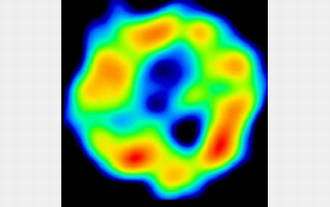
Image: Supernovae such as this one, named SN 1993J, give off blasts of cosmic rays that bombard the Earth and change the atomic make up of its surface rock. Researchers supported by the international CRONUS project will measure the effects of cosmic rays to determine the timing of ancient geologic events. The color scale represents the brightness of the radio emission detected by very large array radiotelescopes. Blue depicts the faintest emission; red depicts brightest. Credit: Image courtesy of NRAO/AUI and N. Bartel, M. Bietenholz, M. Rupen, et al.
Galactic explosions known as supernovas unleash torrents of fantastically energetic atomic particles. Billions of these cosmic rays impact Earth every year. The infinitesimal particles blast apart the atoms of Earth's atmosphere and rocks, changing them into new elements. Now, NSF has awarded $5.8 million over five years for geologists to measure the accumulated results of these atomic transmutations in rocks at Earth's surface.
Fred Phillips of the New Mexico Institute of Mining and Technology will coordinate the U.S. arm of the project, which includes 13 U.S. universities.
"The CRONUS initiative will benefit all disciplines in the Earth sciences," said Herman Zimmerman, director of NSF's division of earth sciences. Whether geomorphology, tectonics, volcanology, hydrology, geologic hazards, or paleoclimatology, he said, "Each needs an improved understanding of geochronology at the Earth's surface."
The European Union, through its Marie Curie Actions, has awarded 3.4 million Euro ($4.4 million) over four years for the project, a research-training network involving research teams in France, Germany, Netherlands, Slovakia, Switzerland the United Kingdom. Training of early stage and experienced researchers in the novel technique is an integral part of the European CRONUS effort to contribute to the mobility, exchange and training of high-quality European scientists.
Tibor Dunai, now at the Vrije Universiteit, Amsterdam, will coordinate the European arm. He will relocate to the University of Edinburgh in the fall of 2005.
"The ability to date changes in landscapes with cosmogenic nuclides has already revolutionized our understanding of Earth processes," said Dunai. "CRONUS will allow us to unlock the great potential this novel technique has, helping us to better understand the environment around us."
Powerful cosmic-ray particles penetrate only a few feet below the Earth's surface, so deeper rocks are shielded from the buildup of cosmic-ray transmutations. The number of new atoms produced by cosmic rays can thus show the amount of time passed since geological events such as earthquakes, landslides and glaciers. They can also reveal how fast Earth's surface changes from such forces as erosion by rivers.
"As scientists who use geochronology techniques in the course of their research," U.S. coordinator Phillips said. "We need to know exactly how cosmic rays are distributed on our planet's surface, taking into account variables like longitude, latitude, and elevation, as well as changes occurring over geologic time scales, such as periodic shifts in Earth's magnetic field."
Scientists affiliated with CRONUS will work to understand the fundamentals of cosmic-ray reactions so that they can routinely use them as methods for reconstructing and analyzing environment changes. When perfected, the new cosmic-ray methods will shed light on Earth's past climate cycles, changes in soil erosion, frequency of floods and landslides, and how weathering of rocks affects global warming and cooling.
Scientists from the United States and Europe will work together sampling rocks from key sites around the world, exposing elements to nuclear beams in high-energy accelerators, and counting cosmic-ray impacts with detectors aboard high-altitude aircraft. These results will all be synthesized in a broad-ranging effort to understand all aspects of the cosmic phenomenon.
"This is a way of bringing the projectiles of exploding stars down to very practical use on earth," said Phillips.
Source: NSF


