UCLA chemists create nano valve
UCLA chemists have created the first nano valve that can be opened and closed at will to trap and release molecules. The discovery, federally funded by the National Science Foundation, will be published July 19 in the Proceedings of the National Academy of Sciences.
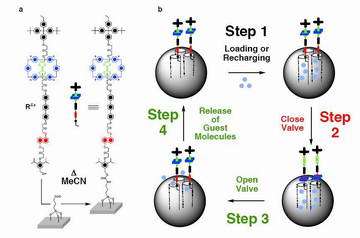
Image: "a" shows the structural formula of the rotaxane molecule and the procedure for tethering it to the surface of a tiny piece of glass; "b" shows how the nano valve opens and closes. Credit: J. Zink, T. Nguyen, F. Stoddart/UCLA Chemistry (Hi-res image)
"This paper demonstrates unequivocally that the machine works," said Jeffrey I. Zink, a UCLA professor of chemistry and biochemistry, a member of the California NanoSystems Institute at UCLA, and a member of the research team. "With the nano valve, we can trap and release molecules on demand. We are able to control molecules at the nano scale.
"A nano valve potentially could be used as a drug delivery system," Zink said.
"The valve is like a mechanical system that we can control like a water faucet," said UCLA graduate student Thoi Nguyen, lead author on the paper. "Trapping the molecule inside and shutting the valve tightly was a challenge. The first valves we produced leaked slightly."
"Thoi was a master nano plumber who plugged the leak with a tight valve," Zink said.
This nano valve consists of moving parts -- switchable rotaxane molecules that resemble linear motors designed by California NanoSystems Institute director Fraser Stoddart's team -- attached to a tiny piece of glass (porous silica), which measures about 500 nanometers, and which Nguyen is currently reducing in size. Tiny pores in the glass are only a few nanometers in size.
"It's big enough to let molecules in and out, but small enough so that the switchable rotaxane molecules can block the hole," Zink said.
The valve is uniquely designed so one end attaches to the opening of the hole that will be blocked and unblocked, and the other end has the switchable rotaxanes whose movable component blocks the hole in the down position and leaves it open in the up position. The researchers used chemical energy involving a single electron as the power supply to open and shut the valve, and a luminescent molecule that allows them to tell from emitted light whether a molecule is trapped or has been released.
Switchable rotaxanes are molecules composed of a dumbbell component with two stations between which a ring component can be made to move back and forth in a linear fashion. Stoddart, who holds UCLA's Fred Kavli Chair in nanosystems sciences, has already shown how these switchable rotaxanes can be used in molecular electronics. Stoddart's team is now adapting them for use in the construction of artificial molecular machinery.
"The fact that we can take a bistable molecule that behaves as a switch in a silicon-based electronic device at the nanoscale level and fabricate it differently to work as part of a nano valve on porous silica is something I find really satisfying about this piece of research," Stoddart, said. "It shows that these little pieces of molecular machinery are highly adaptable and resourceful, and means that we can move around in the nanoworld with the same molecular tool kit and adapt it to different needs on demand."
In future research, they will test how large a hole they can block, to see whether they can get larger molecules, like enzymes, inside the container; they are optimistic.
The research team also includes Hsian-Rong Tseng, a former postdoctoral scholar in chemistry who is now an assistant professor of molecular and medical pharmacology in UCLA's David Geffen School of Medicine; Paul Celestre, a former undergraduate student in Stoddart's laboratory; Amar Flood, a former UCLA researcher in Stoddart's supramolecular chemistry group who is now an assistant professor of chemistry at Indiana University; and Yi Liu, a former UCLA graduate student who is now a postdoctoral scholar at the Scripps Research Institute in La Jolla.
"Our team and Fraser's have very different areas of expertise," Zink said. "By combining them and working together we were able to make something new that really works."
Stoddart has noted that it is only in the past 100 years that humankind has learned how to fly. Prior to the first demonstration of manned flight, there were many great scientists and engineers who said it was impossible.
"Building artificial molecular machines and getting them to operate is where airplanes were a century ago," Stoddart said. "We have come a long way in the last decade, but we have a very, very long way to go yet to realize the full potential of artificial molecular machines."
The nano valve is much smaller than living cells. Could a cell ingest a nano valve combined with bio-molecules, and could light energy then be used to release a drug inside a cell? Stay tuned.
Source: University of California - Los Angeles


