Astronomers Debate Whether Oldest Known Dust Disk Will Ever Form Planets
July 19th, 2005 Astronomers Debate Whether Oldest Known Dust Disk Will Ever Form Planets

Every rule has an exception. One rule in astronomy, supported by considerable evidence, states that dust disks around newborn stars disappear in a few million years. Most likely, they vanish because the material has collected into full-sized planets. Astronomers have discovered the first exception to this rule - a 25-million-year-old dust disk that shows no evidence of planet formation.

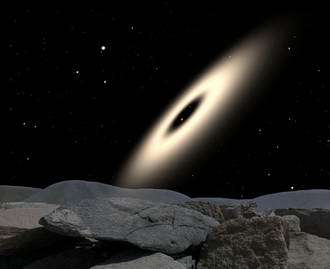
Image: Astronomers were surprised to discover a 25-million-year-old protoplanetary disk around a pair of red dwarf stars 350 light-years away. Gravitational stirring by the binary star system (shown in this artist's conception) may have prevented planet formation. Credit: David A. Aguilar (CfA)

"Finding this disk is as unexpected as locating a 200-year-old person," said astronomer Lee Hartmann of the Harvard-Smithsonian Center for Astrophysics (CfA), lead author on the paper announcing the find.

The discovery raises the puzzling question of why this disk has not formed planets despite its advanced age. Most protoplanetary disks last only a few million years, while the oldest previously known disks have ages of about 10 million years.

"We don't know why this disk has lasted so long, because we don't know what makes the planetary formation process start," said co-author Nuria Calvet of CfA.

The disk in question orbits a pair of red dwarf stars in the Stephenson 34 system, located approximately 350 light-years away in the constellation Taurus. Data from NASA's Spitzer Space Telescope shows that its inner edge is located about 65 million miles from the binary stars. The disk extends to a distance of at least 650 million miles. Additional material may orbit farther out where temperatures are too low for Spitzer to detect it.

Astronomers estimate the newfound disk to be about 25 million years old. They calculated the age by modeling the central stars within the system, since stars and disk share the same age. The appearance of the disk itself also supports an advanced age.

"The disk looks a lot different than most other disks we've seen. This disk looks a lot more evolved than those around younger stars," said Hartmann.

Hartmann and Calvet hold opposite opinions about the eventual fate of the disk around Stephenson 34.

"Most stars, by the age of 10 million years, have done whatever they're going to do," said Hartmann. "If it hasn't made planets by now, it probably never will."

Calvet disagreed. "This disk still has a lot of gas in it, so it may still form giant planets."

Both astronomers emphasize that such debates are a natural part of the scientific process.

"Some people expect scientists to have all the answers. But research is all about exploring the edge of what is known," said Hartmann. "That's what makes it so exciting!"

In the future, Hartmann and Calvet plan to search for more old disks in order to learn why some disks survive so much longer than most others.

"It's important to find more objects like this because they give us clues about the conditions that influence the formation of planets," said Calvet.

This research will be published in The Astrophysical Journal Letters.

Source: Harvard-Smithsonian Center for Astrophysics


print this article email this article download pdf blog this article bookmark this article     Digg this Stumble it share on Facebook share on Reddit add to delicious save to Yahoo! bookmarks
not rated yet


July 19th, 2005 all stories
Space & Earth /

Comments: 0
Rank: not rated yet

  • Stumble this up

  • Digg this

  • Share it:
  • share on Facebook
  • share on MySpace
  • share on Slashdot
  • rss-newsfeed
  • share on Google
  • share on Reddit
  • add to delicious
  • save to Yahoo! bookmarks
  • share on Windows Live
  • Add to Mixx!
Rating: not rated yet

  • Related Stories

  • Radio telescope images reveal planet-forming disk orbiting twin suns
    created Jun 10, 2009 | popularity not rated yet | comments 0
  • Ultracool stars take 'wild rides' around, outside the Milky Way
    created Jun 09, 2009 | popularity not rated yet | comments 0
  • Radio telescopes extend astronomy's best 'yardstick'
    created Jun 08, 2009 | popularity not rated yet | comments 0
  • Resolving a galactic mystery
    created Apr 29, 2009 | popularity not rated yet | comments 0
  • Galaxy Evolution Explorer Mission Celebrates Sixth Anniversary
    created Apr 28, 2009 | popularity not rated yet | comments 0

Tags


  • Physicists Demonstrate Quantum Memory with Matter Qubits
    Physicists Demonstrate Quantum Memory with Matter Qubits
    Physics / General Physics
    created Jul 03, 2009 | popularity 4.4 / 5 (17) | comments 1
  • 'Holey' Nanosheets for Wastewater Dye Removal
    Nanotechnology / Nanomaterials
    created Jul 01, 2009 | popularity 5 / 5 (5) | comments 1
  • Jellyfish Robot Swims Like its Biological Counterpart
    Jellyfish Robot Swims Like its Biological Counterpart
    Electronics / Robotics
    created Jun 26, 2009 | popularity 4.4 / 5 (8) | comments 1
  • Could Maxwell's Demon Exist in Nanoscale Systems?
    Could Maxwell's Demon Exist in Nanoscale Systems?
    Physics / General Physics
    created Jun 24, 2009 | popularity 4.4 / 5 (18) | comments 29
  • Living Safely with Robots, Beyond Asimov's Laws
    Living Safely with Robots, Beyond Asimov's Laws
    Electronics / Robotics
    created Jun 22, 2009 | popularity 4.6 / 5 (52) | comments 40
  • Other News

    Forty years ago man first walked on the moon

    Space & Earth / Space Exploration

    created 8 hours ago | popularity 5 / 5 (2) | comments 0

    Forty years ago on July 20, 1969, American astronaut Neil Armstrong realized the oldest dream of human civilizations when he became the first man to walk on the moon.


    The least sea ice in 800 years

    The least sea ice in 800 years

    Space & Earth / Earth Sciences

    created Jul 01, 2009 | popularity 4.3 / 5 (59) | comments 52

    New research, which reconstructs the extent of ice in the sea between Greenland and Svalbard from the 13th century to the present indicates that there has never been so little sea ice as there is now. The ...


    Gas around young galaxy

    Intense heat killed the Universe's would-be galaxies, researchers say

    Space & Earth / Astronomy

    created Jul 01, 2009 | popularity 3.2 / 5 (19) | comments 25

    (PhysOrg.com) -- Our Milky Way galaxy only survived because it was already immersed in a large clump of dark matter which trapped gases inside it, scientists led by Durham University's Institute for Computational ...


    Scientists' Drill Hits Magma: Only Third Time on Record

    Scientists' Drill Hits Magma: Only Third Time on Record

    Space & Earth / Earth Sciences

    created Jun 29, 2009 | popularity 4.7 / 5 (20) | comments 19

    (PhysOrg.com) -- Scientists drilling a borehole deep into Iceland’s rocky crust to explore new methods of using geothermal energy hit a major roadblock on Thursday: Their drill ran into molten rock at a depth ...


    NASA manager pitches a cheaper return-to-moon plan

    Space & Earth / Space Exploration

    created Jun 30, 2009 | popularity 4 / 5 (7) | comments 18

    (AP) -- Like a car salesman pushing a luxury vehicle that the customer no longer can afford, NASA has pulled out of its back pocket a deal for a cheaper ride to the moon.