Students Steer a Blimp to Test Near Space Military Technology
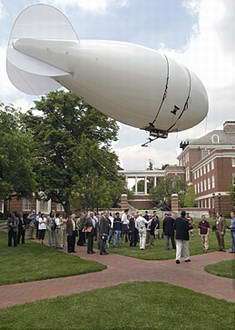
Helium-Filled Airship Allows Tryout for Guidance, Navigation and Control System
Using a 17-foot-long helium-filled blimp, four propellers and sophisticated electronics, three Johns Hopkins undergraduates have built a model airship that will aid professional engineers who are designing a military craft to conduct surveillance at the outer edge of the Earth's atmosphere.
The similar but much larger unmanned airship is being developed by engineers at Johns Hopkins University's Applied Physics Laboratory in Laurel, Md., to provide visual and communications support from an altitude of about 100,000 feet above sea level. To help test and refine the guidance, navigation and control system for such a craft, APL engineers asked students in the university's Engineering Design Project class to devise a smaller version of the airship.
During the two-semester course, offered by the Department of Mechanical Engineering, the student team built a model airship that can fly autonomously, following computer commands to move itself to a predetermined location. The craft can also be steered manually through a wireless remote controller. The onboard equipment includes a video camera that can transmit real-time images from about 50 feet above the ground.
"We're trying to see how these systems would work, using commercial off-the-shelf equipment," said Vincent F. Neradka, an APL engineer who worked with the undergraduates. "The model aircraft works very well. The students met almost all of our objectives. We're delighted with what they did."
One of the goals was to keep costs down because the full-size system is envisioned as a relatively inexpensive disposable airship that would hover high over a military location for two to four weeks, sending pictures of activity on the ground and relaying communications. Then the airship would either disintegrate or be destroyed. As envisioned by APL, the airship, dubbed High Altitude Reconnaissance Vehicle, or HARVe, would be stuffed inside a missile or reusable rocket, which would carry it to a near space altitude. After emerging from its carrier, a mammoth balloon would self-inflate and carry a gondola equipped with sensors and propellers. Unlike most conventional satellites, HARVe could be directed to stay in place above a single ground location for weeks at a time.
The smaller model, built by the students for about $12,500, will help APL determine whether existing low-cost technology might work in a full-size version. The student model utilizes a commercial blimp capable of carrying a 10- pound aluminum gondola. The gondola is equipped with two propellers facing forward and two reversible propellers facing up and down, a video camera and the electronic navigation, control and guidance system. Just before the end of the school year, the students conducted test flights with the model, then turned it over to APL engineers.
The student inventors were Ben Jackson, 22, a double-degree major in mechanical engineering and trumpet performance from Wilmette, Ill.; Nicholas Keim, 21, a mechanical engineering major from Ellicott City, Md.; and Michael K. Chin, 22, a mechanical engineering major from Brookline, Mass.
The undergraduates had to overcome several hurdles while completing the project. "Being mechanical engineers, a lot of the circuitry was beyond our training," Keim said. "We had to get some outside help."
In addition, the motors that the students' computers had predicted would be powerful enough to run the vertical propellers turned out to be not powerful enough — and had to be replaced. "One of the things we learned was that theory doesn't always work out," Keim said. "Sometimes, things break and you have to deal with it."
Added Jackson, "There were frustrating times when things didn't work, and we didn't know why. But overall, it was a great experience to be able to complete the design of something new and then see the whole invention come to fruition. That was very satisfying."
The model airship was one of nine Johns Hopkins projects completed this year by undergraduates in the engineering design course. The class is taught by Andrew F. Conn, a Johns Hopkins graduate with more than 30 years of experience in public and private research and development. Each team of three or four students, usually working within budgets of up to $10,000, had to design a device, purchase or fabricate the parts, and assemble the final product. Corporations, government agencies and nonprofit groups provided the assignments and funding. The course is traditionally a well-received, hands-on engineering experience for Johns Hopkins undergraduates.
Source: Johns Hopkins University (Photo by Will Kirk)


