Cassini spacecraft: Mystifying pictures
July 20, 2005 Cassini spacecraft: Mystifying pictures

The Cassini spacecraft has coasted to its closest encounter yet with Saturn's icy moon Enceladus -- but the pictures it took mystify NASA scientists.

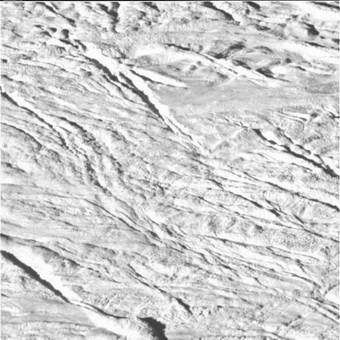
Image: This is the first raw image returned from the Cassini spacecraft after its closest flyby yet. Here the surface of Enceladus is about 320 kilometers (199 miles) away. The spacecraft completed its flyby on July 14. Credit: NASA

The spacecraft skimmed about 110 miles above the moon July 14, returning pictures of a boulder-strewn landscape currently beyond explanation. The "boulders" appear to range between 30 and 60 feet in diameter.

"That's a surface texture I have never seen anywhere else in the solar system," said David Rothery, a planetary geologist at England's Open University.

John Spencer, a Cassini team member at the Southwest Research Institute in Colorado, agrees the images are puzzling.

"You would expect to see small craters or a smooth, snow-covered landscape at this resolution," he told New Scientist magazine. "This is just strange. In fact, I have a really hard time understanding what I'm seeing."

Regardless of the outcome of ongoing analyses and discussions, National Aeronautics and Space Administration officials have already scheduled another flyby of the moon in 2008, when Cassini will skim to within about 60 miles of the moon's boulder-strewn surface.

Copyright 2005 by United Press International


print this article email this article download pdf blog this article bookmark this article     Stumble it Digg this share on Facebook retweet share on Reddit add to delicious
Rate this story - 5 /5 (1 vote)


July 20, 2005 all stories

Comments: 0

5 /5 (1 vote)
  • Stumble this up

  • Digg this

  • share this

  • hide
  • Related Stories


Other News

Close-up movie shows hidden details in the birth of super-suns

Close-up movie shows hidden details in the birth of super-suns (w/ Video)

Space & Earth / Astronomy

created 11 hours ago | popularity 4.8 / 5 (5) | comments 0

(PhysOrg.com) -- The constellation of Orion is a hotbed of massive star formation, most prominently in the Great Nebula that sits in Orion's sword. The glowing gas of the Nebula is powered by a group of young ...


Ghostly 'Spokes' Puff Out From Saturn's Ring's

Ghostly 'Spokes' Puff Out From Saturn's Ring's (w/ Video)

Space & Earth / Space Exploration

created 7 hours ago | popularity 5 / 5 (1) | comments 0

(PhysOrg.com) -- Massive, bright clouds of tiny ice particles hover above the darkened rings of Saturn in an image captured by the Cassini spacecraft on Sept. 22, 2009, around the time of Saturn's equinox. ...


NASA 'Drops' Next Generation Robotic Lander During Autonomous Tests

NASA 'Drops' Next Generation Robotic Lander During Autonomous Tests

Space & Earth / Space Exploration

created 7 hours ago | popularity 4.7 / 5 (3) | comments 1

(PhysOrg.com) -- NASA has successfully completed a series of autonomous "drop" tests of a robotic lander test article - in a record 10 months - to demonstrate the ability to perform a controlled landing on ...


Space shuttle Atlantis lifts off on supply mission (AP)

Space shuttle Atlantis lifts off on supply mission

Space & Earth / Space Exploration

created 7 hours ago | popularity 3.5 / 5 (2) | comments 0

(AP) -- With 100 Internet-savvy NASA fans cheering on the shuttle and churning out constant Twitter updates, Atlantis sailed smoothly into orbit Monday with six astronauts and a full load of spare parts for ...


Volatile gas could turn Rwandan lake into a freshwater time bomb

Space & Earth / Earth Sciences

created 9 hours ago | popularity 4.5 / 5 (4) | comments 3

A dangerous level of carbon dioxide and methane gas haunts Lake Kivu, the freshwater lake system bordering Rwanda and the Republic of Congo.