Is ours the only universe?
Is ours the only universe? Astronomers Chris Palma and Jane Charlton answer:
Palma: There's a distinction that needs to be made here. When we loosely throw around the term "universe," usually what we mean is the observable universe, what we can see from here on Earth. We know roughly how old the universe is -- the current number is 13.7 billion years. And we know the speed of light. So anything that is within 13.7 billion light years from Earth we can see because light from that object has had enough time to reach us.
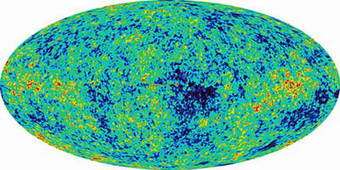
Image: Is this all there is? A map of microwave light emitted only 380,000 years after the Big Bang appears to define our universe more precisely than ever before. This all-sky image, produced by the orbiting Wilkinson Microwave Anisotropy Probe, shows a universe composed of 73 percent dark energy, 23 percent cold dark matter, and only 4 percent atoms. Courtesy WMAP Science Team, NASA
How does this horizon -- this spherical region that we can receive light from -- compare to the size of the entire universe?
Charlton: Well, you've defined the observable horizon. Now let's define "universe." I ask my students to do this. I think the best definition we've come up with is the universe is anywhere we could reach, given the ability to travel infinitely fast through space.
The distinction is a hard one for students to grasp. "What's beyond the observable universe?" I ask them. "What's out there? Is there no space and no time? Is there empty space? Or is there 'stuff' in space, like what we see within the observable universe?"
The definite correct answer is "there's stuff in space." We see to the place from which light has had time to reach us. To think that just beyond that point there's no more anything -- that doesn't make any sense.
Palma: So the physical size of the universe, according to this definition, would be infinite, or such a large number that it's essentially infinite.
Charlton: In which case the answer is that there's only one universe. Except ... there's inflation.
In the very early universe, things were different. Material was extremely dense, there was tremendous energy available, all sorts of weird kinds of particles could be created and physical forces didn't act the same as they do today. As time went on, the universe expanded and the energies available became smaller, and the forces started to act differently.
But the first transition was sudden, it wasn't a gradual thing. It was something like a phase transition, like when ice turns to water. And that leads to a phenomenon called inflation, where certain regions of space tap into the energy from this phase transition and expand exponentially, much faster than the speed of light.
Palma: Picture blowing up a balloon: You're adding air; you're giving it some energy; it's just expanding linearly. The idea is that there was a time very early on where the universe expanded suddenly, by this enormous factor in an incredibly short period of time. There was an instant where it jumped, and ever since then it's been expanding at a slower rate.
If you can picture this inflation happening once, why can't it happen multiple times? Why couldn't there have been lots of little pocket inflations in different places?
Charlton: And that would leave spaces in between all these balloons that could be stuck in the conditions that existed back when the physical forces were different.
It's a very different kind of space. We couldn't survive there, and we wouldn't see light from there. Almost by definition we couldn't get there, because it's too different.
So the real answer is: We don't know. There could be other universes with very different physical constants. But if there are, life will not exist there, stars will not exist there. Because it takes special conditions to make stars.
Palma: Stars and humans and other life forms in our universe are made out of carbon and oxygen and hydrogen. You can show mathematically that if the nuclear strong force (that holds together the protons and neutrons in an atom's nucleus) was just a little bit weaker, carbon and oxygen atoms wouldn't form at all. None of this would exist. It only takes a small change.
Charlton: As far as I know there's been only one good explanation of how these other universes could have similar physical constants, and that's if black holes spawn other universes. That's something that's talked about, that every star that dies in our universe that is massive enough to collapse infinitely, to just keep collapsing because nothing can stop the collapse, somehow that black hole breaks out into somewhere else -- another universe, that may exist in other dimensions than our usual three dimensions of space and one of time. When that happens there could be a memory of the parent universe, and that might mean similar physical constants.
You need a whole course to answer this question.
Palma: At Penn State, it's called Astro 120.
Soruce: Probing Question, Research/Penn State (By David Pacchioli)


