Innovative measurement technology: our planet is 'attractive' enough
July 21st, 2005 Innovative measurement technology: our planet is 'attractive' enough

The Earth's magnetic field is strong enough for some kinds of analyses – this opens up new opportunities for carrying out examinations under difficult conditions.

Where x-rays no longer manage to see, magnets allow us to look inside. Patients know what that means: they lay down in the "tube" surrounded by an enormous electromagnet, the so-called MRI scanner. Such large pieces of equipment artificially create strong magnetic fields which enable doctors to take the pictures inside the patient's body which they need for their diagnosis. Now scientists from the Research Centre Jülich, a Helmholtz Association institution, and the RWTH Aachen University of Technology have extended the spectrum of magnetic field scanning. Because they have discovered that the Earth's natural magnetic field is strong enough for some examinations. And this closes a gap. Because it makes measurement with magnetic fields outdoors and under difficult conditions possible for the very first time. Although the applications will not initially be used in the field of medicine, they will make chemical analyses possible, such as when examining oil directly at source.

20,000 times weaker

When measuring with magnets, researchers use a natural phenomenon, namely that nuclei spin like a top, a property appropriately called "spin". The spin can be focused in a magnetic field to generate typical signals, so-called nuclear magnetic resonance. And it is this that opens up a wide range of insights for scientists into the composition and structure of matter. As a rule, they need very strong artificially produced magnetic fields for such work.

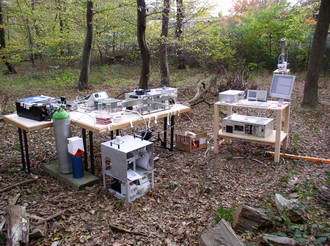
In experiments with the inert gas xenon, Helmholtz scientists were now able to show that under certain circumstances they can also use laser light to influence the spinning movement of the nuclei. In these cases, a weak magnetic field is already powerful enough for the analysis. Often, the Earth's natural magnetic field is even strong enough. By comparison, the Earth's magnetic field is around 20,000 times weaker than the field strengths used in these large pieces of equipment.

From inside Earth to solar wind

As Dr. Stephan Appelt from the Research Centre Jülich explains, a wide and diverse range of application options are conceivable. Besides chemical analyses outdoors and at hardly accessible places, geophysical examinations are also imaginable. "For example, we could survey the Earth's magnetic field with the highest precision," explains Appelt. "Furthermore, we could also look into the Earth, so to speak." That would make it possible to gain a better understanding of the earthquake risks along local fault lines, such as the San Andreas Fault in California or of volcanism. A third field of application would be in astrophysics. "Nuclear magnetic resonance in the Earth's magnetic field might also make it possible to measure the solar wind," believes Appelt. This wind is made up of particles ejected by the Sun and deviated by the Earth's magnetic field – the Northern Lights, "Aurora Borealis", are a side-effect of this.

Finally, another possible area of application is also the measurement of very weak magnetic fields inside patients. This would enable doctors to produce detailed pictures for the examination of diseased organs. "It's conceivable that contrast media could be used that contain xenon," explains Dr. Wolfgang Häsing from the Research Centre Jülich. "Patients could inhale these contrast media or they could be injected into them." All that would then be needed to carry out an MRI scan is a small additional magnetic field – the patient would be spared from the confines of the narrow tube. In fact, they would hardly notice the examination, because xenon is already used in medicine today, namely as an anaesthetic.

Source: Helmholtz-Gemeinschaft


print this article email this article download pdf blog this article bookmark this article     Digg this Stumble it share on Facebook share on Reddit add to delicious save to Yahoo! bookmarks
4.4/5 after 7 votes


July 21st, 2005 all stories
Physics /

Comments: 0
Rank: 4.4/5 after 7 votes

  • Stumble this up

  • Digg this

  • Share it:
  • share on Facebook
  • share on MySpace
  • share on Slashdot
  • rss-newsfeed
  • share on Google
  • share on Reddit
  • add to delicious
  • save to Yahoo! bookmarks
  • share on Windows Live
  • Add to Mixx!
Rating: 4.4/5 after 7 votes

  • Related Stories

  • Ulysses space mission to end
    created Jun 26, 2009 | popularity not rated yet | comments 0
  • Magnetic field on bright star Vega
    created Jun 23, 2009 | popularity not rated yet | comments 0
  • Sunspots revealed in striking detail by supercomputers
    created Jun 18, 2009 | popularity not rated yet | comments 0
  • Giant eruption reveals 'dead' star
    created Jun 16, 2009 | popularity not rated yet | comments 0
  • The Earth's magnetic field remains a charged mystery
    created Jun 15, 2009 | popularity not rated yet | comments 0

Tags


  • Physicists Demonstrate Quantum Memory with Matter Qubits
    Physicists Demonstrate Quantum Memory with Matter Qubits
    Physics / General Physics
    created Jul 03, 2009 | popularity 4.4 / 5 (17) | comments 1
  • 'Holey' Nanosheets for Wastewater Dye Removal
    Nanotechnology / Nanomaterials
    created Jul 01, 2009 | popularity 5 / 5 (5) | comments 1
  • Jellyfish Robot Swims Like its Biological Counterpart
    Jellyfish Robot Swims Like its Biological Counterpart
    Electronics / Robotics
    created Jun 26, 2009 | popularity 4.4 / 5 (8) | comments 1
  • Could Maxwell's Demon Exist in Nanoscale Systems?
    Could Maxwell's Demon Exist in Nanoscale Systems?
    Physics / General Physics
    created Jun 24, 2009 | popularity 4.4 / 5 (18) | comments 29
  • Living Safely with Robots, Beyond Asimov's Laws
    Living Safely with Robots, Beyond Asimov's Laws
    Electronics / Robotics
    created Jun 22, 2009 | popularity 4.6 / 5 (54) | comments 40
  • Other News

    Physical reality of string theory demonstrated

    Physics / General Physics

    created 6 hours ago | popularity 4.5 / 5 (22) | comments 15

    String theory has come under fire in recent years. Promises have been made that have not been lived up to. Leiden (The Netherlands) theoretical physicists have now for the first time used string theory to describe a physical ...


    Physicist takes a quantum leap

    Physics / General Physics

    created 2 hours ago | popularity not rated yet | comments 0

    (PhysOrg.com) -- A University of Queensland physicist is seeking answers to a persistent problem throughout human history: how do I compute things? None, however, have had the same impact as what we today know as simply the ...


    UQ researchers break the law -- of physics

    UQ researchers break the law -- of physics

    Physics / General Physics

    created 12 hours ago | popularity 4.6 / 5 (17) | comments 5

    (PhysOrg.com) -- Two UQ Science researchers have proved two famous physical laws that have been widely used for the past 25 years do not always work.


    Scientists create first electronic quantum processor

    Scientists create first electronic quantum processor

    Physics / General Physics

    created Jun 28, 2009 | popularity 4.8 / 5 (56) | comments 45

    A team led by Yale University researchers has created the first rudimentary solid-state quantum processor, taking another step toward the ultimate dream of building a quantum computer.


    Science journals

    How to Spot an Influential Paper Based on its Citations

    Physics / General Physics

    created Jul 04, 2009 | popularity 4 / 5 (11) | comments 6

    (PhysOrg.com) -- At first it may seem that the number of citations received by a published scientific paper is directly related to that paper's quality of content. The higher the quality, the more people read ...