Newly designed nanoparticle quantum dots simultaneously target and image prostate tumors
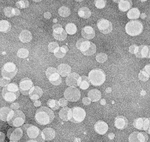
Emory University scientists have for the first time used a new class of luminescent "quantum dot" nanoparticles in living animals to simultaneously target and image cancerous tumors. The quantum dots were encapsulated in a highly protective polymer coating and attached to a monoclonal antibody that guided them to prostate tumor sites in living mice, where they were visible using a simple mercury lamp. The scientists believe the ability to both target and image cells in vivo represents a significant step in the quest to eventually use nanotechnology to target, image, and treat cancer, cardiovascular plaques, and neurodegenerative disease in humans. The findings were published on-line July 18 in the journal Nature Biotechnology and will appear in the journal's August 1 print edition.
The research team was led by Shuming Nie, PhD, a nanotechnology expert and a professor in the Coulter Department of Biomedical Engineering at Emory and the Georgia Institute of Technology and in Emory's Winship Cancer Institute, and by Lelund Chung, PhD, professor of urology in Emory University School of Medicine and the Winship Cancer Institute. Quantum dots are nanometer-sized luminescent semiconductor crystals that have unique chemical and physical properties due to their size and their highly compact structure. Quantum dots can be chemically linked (conjugated) to molecules such as antibodies, peptides, proteins or DNA and engineered to detect other molecules, such as those present on the surface of cancer cells.
The researchers injected human prostate cancer cells under the skin of mice to promote growth of solid prostate tumors. They then encapsulated quantum dots, made from cadmium selenide, within a highly protective coating called an ABC triblock copolymer, and over-coated the particle-polymer composite with poly (ethylene glycol). They injected the quantum dots into the circulatory system of the mice first to test "passive" targeting of the tumor. Tumors grow extra blood vessels in a process called angiogenesis. These angiogenic vessels are very porous, which allowed the quantum dots to leak out and accumulate at the tumor sites, where they could be detected by fluorescence imaging.
The scientists then conjugated the quantum dots to a highly specific monoclonal antibody targeted to a prostate-specific membrane antigen (PMSA) on the cell surface of the prostate tumor cells. When they injected the conjugated quantum dots into the circulatory system of the mice, the dots selectively accumulated at the site of the tumor through binding to the antigen target. The new triblock polymer coating protected the quantum dots from attack by enzymes and other biomolecules. The active method of tumor targeting using the monoclonal antibody was much faster and more efficient than was the passive method without the antibody.
"Although other research groups have used quantum dots to either target or image cells, we believe this is the first time in vivo targeting and imaging has been achieved simultaneously," said Xiaohu Gao, PhD a postdoctoral fellow in Dr. Nie's group.
In previous studies without using the ABC triblock polymer, Emory scientists and other researchers experienced a significant loss of fluorescence in quantum dots that were administered to live animals. "This polymer appears to lend a great deal of protection and stability to the quantum dot probes inside the animals," Dr. Gao said. "Also, cadmium and selenium ions are highly toxic, and this polymer acts like a plastic bag to protect the quantum dots from degradation and leakage."
"This is a new class of quantum dot conjugates designed specifically for complex in vivo applications," said Dr. Nie. "They are stable over a broad range of pH and salt conditions and maintain their stability even after treatment with hydrochloric acid."
Quantum dots are more brightly fluorescent than traditional dyes and fluorescent proteins often used for imaging, and because they emit different wavelengths over a broad range of the light spectrum from visible to infrared, depending on their size and chemical composition, it is possible to "tune" them to tag and detect multiple biomarkers simultaneously. They can be illuminated by a light source, such as a laser or mercury lamp. Different sized quantum dots can be combined to detect multiple targets in a process called "multiplexing." And quantum dots are more resistant to photobleaching or fading than are conventional dyes used in imaging.
"It has been a difficult task to achieve both targeting and imaging in living animal models," Dr. Nie said. "The larger surface area provided by quantum dots should allow the conjugation of multiple agents, and we envision the development of diagnostic and therapeutic dual-modality quantum dots." "We believe the unique properties of quantum dots will eventually allow us to use multiple colors and intensities to monitor multiple parameters at the same time for precise diagnosis and targeted treatment," Dr. Gao said. "We are developing quantum dots in the near-infrared spectrum, which should improve our ability for non-invasive and more sensitive imaging of deeper tissues."
The research was funded by the National Institutes of Health, the Georgia Cancer Coalition, the Coulter Translational Research Program at Georgia Tech and Emory University and the Department of Defense.
Source: Emory University Health Sciences Center


