Cassini Reveals Saturn's Eerie-Sounding Radio Emissions

July 25, 2005  Image depicting radio emissions at Saturn

Saturn's radio emissions could be mistaken for a Halloween sound track.
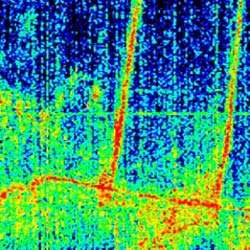
That's how two researchers describe their recent findings, published in the July 23 issue of the Geophysical Research Letters. Their paper is based on data from the Cassini spacecraft radio and plasma wave science instrument. The study investigates sounds that are not just eerie, but also descriptive of a phenomenon similar to Earth's northern lights.

All of the structures we observe in Saturn's radio spectrum are giving us clues about what might be going on in the source of the radio emissions above Saturn's auroras," said Dr. Bill Kurth, deputy principal investigator for the instrument. He is with the University of Iowa, Iowa City. Kurth made the discovery along with Principal Investigator Don Gurnett, a professor at the University. "We believe that the changing frequencies are related to tiny radio sources moving up and down along Saturn's magnetic field lines."

Samples of the resulting sounds can be heard at http://www.nasa.gov/cassini , http://saturn.jpl.nasa.gov and http://www-pw.physics.uiowa.edu/cassini/ .

The radio emissions, called Saturn kilometric radiation, are generated along with Saturn's auroras, or northern and southern lights. Because the Cassini instrument has higher resolution compared to a similar instrument on NASA's Voyager spacecraft, it has provided more detailed information on the spectrum and the variability of radio emissions. The high-resolution measurements allow scientists to convert the radio waves into audio recordings by shifting the frequencies down into the audio frequency range.

The terrestrial cousins of Saturn's radio emissions were first reported in 1979 by Gurnett, who used an instrument on the International Sun-Earth Explorer spacecraft in Earth orbit. Kurth said that despite their best efforts, scientists still haven't agreed on a theory to fully explain the phenomenon.

They will get another chance to solve the radio emission puzzle beginning in mid-2008 when Cassini will fly close to, or possibly even through, the source region at Saturn. Gurnett said, “It is amazing that the radio emissions from Earth and Saturn sound so similar.”

Other contributors to the paper include University of Iowa scientists George Hospodarsky and Baptiste Cecconi; Mike Kaiser (currently at Goddard Space Flight Center, Greenbelt, Md.); French scientists Philippe Louarn, Philippe Zarka and Alain Lecacheux; and Austrian scientists Helmut Rucker and Mohammed Boudjada.

Cassini, carrying 12 scientific instruments, on June 30, 2004, became the first spacecraft to orbit Saturn. It is conducting a four-year study of the planet, its rings and many moons. The spacecraft carried the Huygens probe, a six-instrument European Space Agency probe that landed on Titan, Saturn's largest moon, in January 2005.

The Cassini-Huygens mission is a cooperative project of NASA, the European Space Agency and the Italian Space Agency. The Jet Propulsion Laboratory, a division of the California Institute of Technology in Pasadena, manages the Cassini-Huygens mission for NASA's Science Mission Directorate, Washington. JPL designed, developed and assembled the Cassini orbiter. The radio and plasma wave science team is based at the University of Iowa, Iowa City.

Source: NASA


print this article email this article download pdf blog this article bookmark this article     Stumble it Digg this share on Facebook retweet share on Reddit add to delicious
Rate this story - 5 /5 (1 vote)


July 25, 2005 all stories

Comments: 0

5 /5 (1 vote)
  • Stumble this up

  • Digg this

  • share this

  • hide
  • Related Stories

  • Longest lightning storm on Saturn breaks Solar System record
    created Sep 15, 2009 | popularity not rated yet | comments 0
  • Cassini Spacecraft Tracks Raging Saturn Storm
    created Apr 29, 2008 | popularity not rated yet | comments 0
  • Saturn's Giant Sponge
    created Feb 06, 2008 | popularity not rated yet | comments 0
  • Planetary scientists close in on Saturn’s elusive rotation
    created Dec 12, 2007 | popularity not rated yet | comments 0
  • Scientists present new results from Huygens probe
    created Jun 04, 2007 | popularity not rated yet | comments 0


Other News

LCROSS Impact Data Indicates Water on Moon

LCROSS Impact Finds Water on the Moon

Space & Earth / Space Exploration

created 20 hours ago | popularity 4.9 / 5 (21) | comments 9

(PhysOrg.com) -- The argument that the moon is a dry, desolate place no longer holds water. Secrets the moon has been holding, for perhaps billions of years, are now being revealed to the delight of scientists ...


Wind power turbines in Dali, in China's southwestern Yunnan province

China tipped as global leader in green tech

Space & Earth / Environment

created 4 hours ago | popularity 4 / 5 (1) | comments 2

China can become the world's top exporter of "green technology" if it carries out crucial energy and ecological reforms, leading environmental campaigners said here Saturday.


Underwater robot probes depths for Istanbul quake clues

Space & Earth / Earth Sciences

created 4 hours ago | popularity 5 / 5 (2) | comments 0

A state-of-the-art underwater robot called BOB may hold the key to protecting millions of people around Turkey's biggest city against a massive earthquake scientists say is all but inevitable.


Mysterious X-rays from a Nearby Galaxy

Mysterious X-rays from a Nearby Galaxy

Space & Earth / Astronomy

created 20 hours ago | popularity 3.9 / 5 (8) | comments 9

(PhysOrg.com) -- The nucleus of an active galaxy, an AGN, contains a massive black hole that is vigorously accreting material. In the process it typically ejects jets of particles and radiates brightly at ...


Hawaii planning to replenish sand at Waikiki Beach

Space & Earth / Environment

created 5 hours ago | popularity not rated yet | comments 0

(AP) -- Hawaii officials are appealing to the state's tourism authority for funds to restore part of world-famous Waikiki Beach.