Detecting the Traces of Mystery Matter
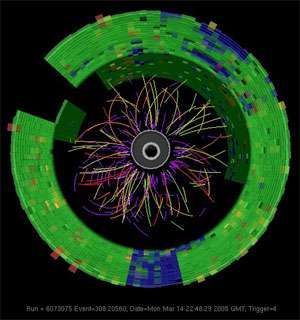
July 29, 2005 A splash of subatomic particle

Using high-speed collisions between gold atoms, scientists think they have re-created one of the most mysterious forms of matter in the universe -- quark-gluon plasma. This form of matter was present during the first microsecond of the Big Bang and may still exist at the cores of dense, distant stars.

Image: A splash of subatomic particles is created by the collision of gold atom nuclei traveling at nearly the speed of light in Brookhaven National Laboratory's Relativistic Heavy Ion Collider. (Brookhaven National Laboratory/STAR Collaboration/courtesy graph)


UC Davis physics professor Daniel Cebra is one of 543 collaborators on the research. His main role was building the electronic listening devices that collect information about the collisions, a job he compared to "troubleshooting 120,000 stereo systems."

Now, using those detectors, "we look for trends in what happened during the collision to learn what the quark-gluon plasma is like," he said.

"We have been trying to melt neutrons and protons, the building blocks of atomic nuclei, into their constituent quarks and gluons," Cebra said. "We needed a lot of heat, pressure and energy, all localized in a small space."

The scientists produced the right conditions with head-on collisions between the nuclei of gold atoms. The resulting quark-gluon plasma lasted an extremely short time -- less than 10-20 seconds, Cebra said. But the collision left tracings that the scientists could measure.

"Our work is like accident reconstruction," Cebra said. "We see fragments coming out of a collision, and we construct that information back to very small points."

Quark-gluon plasma was expected to behave like a gas, but the data shows a more liquid-like substance. The plasma is less compressible than expected, which means that it may be able to support the cores of very dense stars.

"If a neutron star gets large and dense enough, it may go through a quark phase, or it may just collapse into a black hole," Cebra said. "To support a quark star, the quark-gluon plasma would need rigidity. We now expect there to be quark stars, but they will be hard to study. If they exist, they're semi-infinitely far away."

The project is led by Brookhaven National Laboratory and Lawrence Berkeley National Laboratory, with collaborators at 52 institutions worldwide. The work was done in Brookhaven's Relativistic Heavy Ion Collider (RHIC).

Source: UC Davis


print this article email this article download pdf blog this article bookmark this article     Stumble it Digg this share on Facebook retweet share on Reddit add to delicious
Rate this story - 5 /5 (1 vote)

Rank Filter

Move the slider to adjust rank threshold, so that you can hide some of the comments.


Display comments: newest first

  • Absolute - Apr 29, 2009
    • Rank: not rated yet
    Recently, we have discovered a new process that can propose better outputs of Quark-Gluon Plasma than those of the RHIC. Mr.Tepparat Songkraw, a creator of this model, entitles his process as %u201CRelativistic Electron Repetition%u201D or %u201CRER%u201D. Its outputs are called Absolute Quark-Gluon Plasma model which is a part of Absolute Plasmon model.
    Its images can be illustrated as follows:

    http://www.absolutebase.com

July 29, 2005 all stories

Comments: 1

5 /5 (1 vote)
  • Stumble this up

  • Digg this

  • share this

  • hide
  • Related Stories

  • Simple Explanation for Mysterious Observations
    created Aug 18, 2009 | popularity not rated yet | comments 0
  • A supercharged metal-ion generator: Higher-quality coatings through 'runaway' self-sputtering
    created Jan 29, 2009 | popularity not rated yet | comments 0
  • Lavas from Hawaiian volcano contain fingerprint of planetary formation
    created Jun 19, 2008 | popularity not rated yet | comments 0
  • Low-cost EUV satellite shut down
    created Jun 02, 2008 | popularity not rated yet | comments 0
  • NASA satellite sees solar hurricane detach comet tail
    created Oct 01, 2007 | popularity not rated yet | comments 0


Other News

Do we need dark matter?

Do we need dark matter?

Physics / General Physics

created Nov 12, 2009 | popularity 4.1 / 5 (14) | comments 28

It's the biggest problem in physics: the matter we can see in the universe accounts for just five per cent of the observed gravity that holds galaxies together.


A line on string theory

A line on string theory

Physics / General Physics

created Nov 12, 2009 | popularity 4.7 / 5 (41) | comments 14

(PhysOrg.com) -- A Harvard theoretical physicist has discussed with scientists at the Large Hadron Collider in Switzerland the possibility that they may discover a theorized "stau" particle, with a lifetime ...


The LHC tunnel

Peckish bird briefly downs big atom smasher

Physics / General Physics

created Nov 09, 2009 | popularity 4.2 / 5 (13) | comments 20

A peckish bird briefly knocked out part of the world's biggest atom smasher by causing a chain reaction with a piece of bread, the European Organisation for Nuclear Research (CERN) said Monday.


Pushing light beyond its known limits

Pushing light beyond its known limits

Physics / Optics & Photonics

created Nov 12, 2009 | popularity 4.1 / 5 (14) | comments 6

Scientists at the University of Adelaide have made a breakthrough that could change the world's thinking on what light is capable of.


First Bose-Einstein condensation of strontium

First Bose-Einstein condensation of strontium

Physics / Quantum Physics

created Nov 09, 2009 | popularity 4.8 / 5 (10) | comments 5

In an international first, scientists from the Institute of Quantum Optics and Quantum Information (IQOQI, Austria) produced a Bose-Einstein condensate of the alkaline-earth element strontium, thus narrowly ...