How Butterflies Fly Thousands Of Miles Without Getting Lost Revealed By Researchers
August 1st, 2005 How Butterflies Fly Thousands Of Miles Without Getting Lost Revealed By Researchers

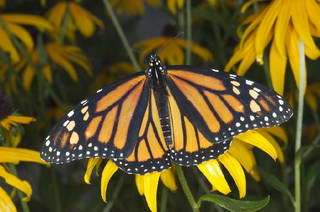
While "navigation" systems in automobiles are a fairly new (and still costly) innovation, monarch butterflies have managed for millennia to navigate their way for a distance of some 3000 miles (4800 kilometers) each fall from Canada to Mexico (and vice-versa in the spring) without losing their way.

The phenomenon of long-range bird migration is a well-known one, but not in the insect world. Also, among birds their migration route is a round-trip one, which they make more than once in their lifetimes, while for the monarch it is strictly a one-way trip for each butterfly. How do these creatures do it?

The mystery of the mechanisms involved in this remarkable phenomenon has been resolved by a team of scientists who did this by exploring the infinitesimal butterfly brain and eye tissues to uncover new insights into the biological machinery that directs this delicate creature on its lengthy flight path.

The research team, led by Prof. Steven Reppert of the University of Massachusetts Medical School, included Dr. Oren Froy, now of the Faculty of Agricultural, Food and Environmental Quality Sciences of the Hebrew University of Jerusalem. Others involved were from the Czech Academy of Sciences and the University of California, Irvine. Their latest findings were published in a recent issue of Neuron magazine, constituting a continuation of their earlier work, published in the journal Science.

While light in general is essential to the functioning of the “biological clock” in the butterfly brain – governing its metabolic cycles, including its “signal” to migrate -- the researchers discovered that it is specifically the ultraviolet band of light that is crucial to the creature’s orientation. The butterflies have special photoreceptors for ultraviolet (UV) light in their eyes which provide them with their sense of direction.

They proved that this ultraviolet “navigation” is crucial by placing butterflies in a “flight” simulator. When a UV light filter was used in the simulator, the butterflies lost their orientation

Further probing revealed a key wiring connection between the light-detecting navigation sensors in the butterfly’s eye and its brain clock Thus, it was shown that input from two interconnected systems – UV light detection in the eye and the biological clock in the brain -- together guide the butterflies “straight and true” to their destination at the appointed times in their two-month migration over thousands of miles/kilometers.

Source: Hebrew University of Jerusalem


print this article email this article download pdf blog this article bookmark this article     Digg this Stumble it share on Facebook share on Reddit add to delicious save to Yahoo! bookmarks
2/5 after 1 votes


August 1st, 2005 all stories
Other Sciences /

Comments: 0
Rank: 2/5 after 1 votes

  • Stumble this up

  • Digg this

  • Share it:
  • share on Facebook
  • share on MySpace
  • share on Slashdot
  • rss-newsfeed
  • share on Google
  • share on Reddit
  • add to delicious
  • save to Yahoo! bookmarks
  • share on Windows Live
  • Add to Mixx!
Rating: 2/5 after 1 votes


Tags


  • Physicists Demonstrate Quantum Memory with Matter Qubits
    Physicists Demonstrate Quantum Memory with Matter Qubits
    Physics / General Physics
    created Jul 03, 2009 | popularity 4.4 / 5 (16) | comments 1
  • 'Holey' Nanosheets for Wastewater Dye Removal
    Nanotechnology / Nanomaterials
    created Jul 01, 2009 | popularity 5 / 5 (5) | comments 1
  • Jellyfish Robot Swims Like its Biological Counterpart
    Jellyfish Robot Swims Like its Biological Counterpart
    Electronics / Robotics
    created Jun 26, 2009 | popularity 4.4 / 5 (7) | comments 1
  • Could Maxwell's Demon Exist in Nanoscale Systems?
    Could Maxwell's Demon Exist in Nanoscale Systems?
    Physics / General Physics
    created Jun 24, 2009 | popularity 4.4 / 5 (18) | comments 29
  • Living Safely with Robots, Beyond Asimov's Laws
    Living Safely with Robots, Beyond Asimov's Laws
    Electronics / Robotics
    created Jun 22, 2009 | popularity 4.6 / 5 (52) | comments 40
  • Other News

    Tourists enjoy a "Pineapple Tour" in Costa Rica

    Costa Rica tops happiness, 'green living' poll

    Other Sciences / Social Sciences

    created 18 hours ago | popularity 2 / 5 (2) | comments 0

    Costa Rica is the happiest place on earth, and one of the most environmentally friendly, according to a new survey by a British non-governmental group.


    Creation Museum president Ken A. Ham

    Paleontologists brought to tears, laughter by Creation Museum

    Other Sciences / Other

    created Jun 30, 2009 | popularity 4.4 / 5 (40) | comments 104

    For a group of paleontologists, a tour of the Creation Museum seemed like a great tongue-in-cheek way to cap off a serious conference.


    Mummified dinosaur skin yields up new secrets

    Mummified dinosaur skin yields up new secrets

    Other Sciences / Archaeology & Fossils

    created Jul 01, 2009 | popularity 4.8 / 5 (13) | comments 10

    (PhysOrg.com) -- Scientists from The University of Manchester have identified preserved organic molecules in the skin of a dinosaur that died around 66-million years ago.


    Liberal? Conservative? Stanford study says mental nudge can make voters flip-flop

    Liberal? Conservative? Stanford study says mental nudge can make voters flip-flop

    Other Sciences / Social Sciences

    created Jul 02, 2009 | popularity 3.8 / 5 (5) | comments 4

    (PhysOrg.com) -- No doubt you’ve worked hard for your success. But chances are you’ve also had some help and lucky breaks along the way.


    Probing Question: How do Ponzi Schemes work?

    Other Sciences / Economics

    created Jul 02, 2009 | popularity 5 / 5 (1) | comments 2

    Imagine the shock, the horror, and the sheer panic that would come with learning that the financial plan you’d sunk your life savings into was a sham, the financial experts you trusted were crooks, and all your money was ...