New Cassini Images Show "Northern Lights" Of Saturn
August 4, 2005 saturn

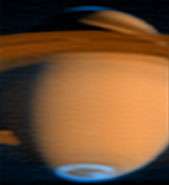
New images of Saturn obtained by a University of Colorado at Boulder-led team on June 21 using an instrument on the Cassini spacecraft show auroral emissions at its poles similar to Earth's Northern Lights.

Taken with the Ultraviolet Imaging Spectrograph aboard the Cassini orbiter, the two UV images, invisible to the human eye, are the first from the Cassini-Huygens mission to capture the entire "oval" of the auroral emissions at Saturn's south pole. They also show similar emissions at Saturn's north pole, according to CU-Boulder Professor Larry Esposito, principal investigator of the UVIS instrument built at CU-Boulder's Laboratory for Atmospheric and Space Physics, and Professor Wayne Pryor of Central Arizona College, a UVIS team member and former CU graduate student.

In the false-color images, blue represents aurora emissions from hydrogen gas excited by electron bombardment, while red-orange represents reflected sunlight. The images show that the aurora lights at the polar regions respond rapidly to changes in the solar wind, said the researchers. Previous images have been taken closer to the equator, making it difficult to see the polar regions.

Major changes in the emissions inside the Saturn south-pole aurora are evident by comparing the two images, which were taken about one hour apart, they said. The brightest spot in the left aurora fades, and a bright spot appears in the middle of the aurora in the second image.

Made by slowly scanning the UVIS instrument across the planet, the images also contain more than 2,000 wavelengths of spectral information within each picture element. Researchers will use the wavelength information to study Saturn's auroras, gases, and hazes and their changing distributions.

The UVIS observation team includes researchers from CU-Boulder, NASA's Jet Propulsion Laboratory, Central Arizona College and the University of Southern California.

The Cassini-Huygens mission is a cooperative project of NASA, the European Space Agency and the Italian Space Agency. The Jet Propulsion Laboratory, a division of the California Institute of Technology in Pasadena, manages the Cassini- Huygens mission for NASA's Space Science Mission Directorate in Washington, D.C.

More information on the Cassini-Huygens mission is available at the following Web sites: http://saturn.jpl.nasa.gov and http://www.nasa.gov/cassin i.


print this article email this article download pdf blog this article bookmark this article     Stumble it Digg this share on Facebook retweet share on Reddit add to delicious
Rate this story - 2 /5 (3 votes)


August 4, 2005 all stories

Comments: 0

2 /5 (3 votes)
  • Stumble this up

  • Digg this

  • share this

  • hide
  • Related Stories

  • Scientists solve 30-year-old aurora borealis mystery
    created Jul 24, 2008 | popularity not rated yet | comments 0
  • 'Broken Heart' Image the Last for NASA's Long-Lived Polar Mission
    created Apr 29, 2008 | popularity not rated yet | comments 0
  • A Giant Trilobite on the Sun
    created Sep 19, 2007 | popularity not rated yet | comments 0
  • Cassini Images Bizarre Hexagon on Saturn
    created Mar 27, 2007 | popularity not rated yet | comments 0
  • HEX2 a success: 4-rocket aurora experiment launches from Poker Flat
    created Feb 15, 2007 | popularity not rated yet | comments 0


Other News

Exoplanets Clue to Sun's Curious Chemistry

Exoplanets Clue to Sun's Curious Chemistry

Space & Earth / Astronomy

created 17 minutes ago | popularity not rated yet | comments 0

(PhysOrg.com) -- A ground-breaking census of 500 stars, 70 of which are known to host planets, has successfully linked the long-standing "lithium mystery" observed in the Sun to the presence of planetary systems. ...


A bubbling ball of gas

A bubbling ball of gas (w/ Video)

Space & Earth / Space Exploration

created 1hour ago | popularity 5 / 5 (1) | comments 0

The Sun is a bubbling mass. Packages of gas rise and sink, lending the sun its grainy surface structure, its granulation. Dark spots appear and disappear, clouds of matter dart up - and behind the whole thing ...


NOAA deploys new 'smart buoy' off Annapolis

Space & Earth / Environment

created 2 hours ago | popularity 5 / 5 (1) | comments 0

NOAA deployed the seventh in a series of "smart buoys" to monitor weather conditions and water quality in the Chesapeake Bay today. The buoy, located at the mouth of Severn River near Annapolis, Md., will be used by commercial ...


Rapid star formation spotted in 'stellar nurseries' of infant galaxies

Rapid star formation spotted in 'stellar nurseries' of infant galaxies

Space & Earth / Astronomy

created 8 hours ago | popularity 5 / 5 (2) | comments 0

The Universe's infant galaxies enjoyed rapid growth spurts forming stars like our sun at a rate of up to 50 stars a year, according to scientists at Durham University.


Reducing greenhouse gases may not be enough to slow climate change

Space & Earth / Environment

created 7 hours ago | popularity 2.3 / 5 (3) | comments 3

Georgia Tech City and Regional Planning Professor Brian Stone publishes a paper in the December edition of Environmental Science and Technology that suggests policymakers need to address the influence of global deforestation ...