Mars Reconnaissance Orbiter to Launch Aug. 11
Today morning's launch of the Mars Reconnaissance Orbiter (MRO) has been postponed by at least one day. At present, liftoff is scheduled for no earlier than 7:50 a.m. on August 11.
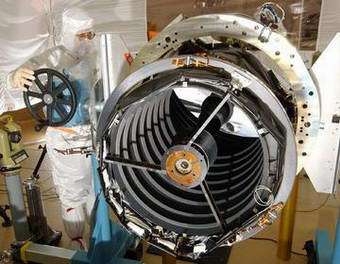
Image: The High Resolution Imaging Science Experiment (HiRISE) camera is examined by a worker from Ball Aerospace & Technologies Corp. Scheduled to launch Aug. 11 aboard an Atlas V rocket from Launch Complex 41 at Cape Canaveral Air Force Station in Florida, HiRISE is designed to take high-resolution images of the surface of Mars from orbit provide unprecedented image quality, resolution and coverage at sub-meter scales. The Mars Reconnaissance Orbiter will search for evidence of water, study the climate record, and identify landing sites for future missions.
The mission will lift off from Launch Complex 41, Cape Canaveral Air Force Station, and is the first government launch of Lockheed Martin's Atlas V launch vehicle. The orbiter will study Mars to understand the planet's water riddles and to advance the exploration of the mysterious red planet.
NASA's Mars Reconnaissance Orbiter is ready for a morning launch on Thursday, Aug. 11. The spacecraft will arrive at Mars in March 2006 for a mission to understand the planet's water riddles and to advance the exploration of the mysterious red planet.
The mission's first launch opportunity window is 4:50 to 6:35 a.m. PDT, Thursday. If the launch is postponed, additional launch windows open daily at different times each morning through August. For trips from Earth to Mars, the planets move into good position for only a short period every 26 months. The best launch position is when Earth is about to overtake Mars in their concentric racing lanes around the Sun.
"The teams preparing this orbiter and its launch vehicle have done excellent work and kept to schedule. We have a big spacecraft loaded with advanced instruments for inspecting Mars in greater detail than any previous orbiter, and we have the first Atlas V launch vehicle to carry an interplanetary mission. A very potent and exciting combination," said NASA's Mars Exploration Program Director Doug McCuistion.
The mission will lift off from Launch Complex 41, Cape Canaveral Air Force Station, Fla. It is the first government launch of Lockheed Martin's Atlas V launch vehicle. "We're ready to fly, counting down through final procedures," said Chuck Dovale, director for expendable-launch-vehicle launches at NASA Kennedy Space Center, Fla.
When the Mars Reconnaissance Orbiter arrives in March, it begins a half-year "aerobraking" process. The spacecraft will gradually adjust the shape of its orbit by using friction from carefully calculated dips into the top of the Martian atmosphere. The mission?s primary science phase starts in November 2006.
"Mars Reconnaissance Orbiter will give us several times more data about Mars than all previous missions combined," said James Graf, project manager for the mission at NASA's Jet Propulsion Laboratory, Pasadena Calif.
Researchers will use the data to study the history and distribution of Martian water. Learning more about what has happened to the water will focus searches for possible past or present Martian life. Observations by the orbiter will also support future Mars missions by examining potential landing sites and providing a communications relay between the Martian surface and Earth.
The craft can transmit about 10 times as much data per minute as any previous Mars spacecraft. This will serve both to convey detailed observations of the Martian surface, subsurface and atmosphere by the instruments on the orbiter and enable data relay from other landers on the Martian surface to Earth. NASA plans to launch the Phoenix Mars Scout in 2007 to land on the far northern Martian surface. NASA is also developing an advanced rover, the Mars Science Laboratory, for launch in 2009.
The mission is managed by JPL, a division of the California Institute of Technology, Pasadena, Calif., for the NASA Science Mission Directorate. Lockheed Martin Space Systems, Denver, built the spacecraft and is the prime contractor for the project.
NASA's Launch Services Program at the Kennedy Space Center is responsible for government engineering oversight of the Atlas V, spacecraft/launch vehicle integration and launch day countdown management.
Source: NASA


