World's smallest autonomous submarine
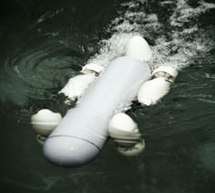
A new era of oceanic discovery, with potential applications ranging from shipwreck recovery, to mineral exploration, to search and rescue missions may be possible with the development of the world’s smallest autonomous underwater vehicle at The Australian National University. The Serafina is 40 centimetres long, with five propellers and a plastic hull crammed with rechargeable batteries and circuitry. The craft is able to travel at a relatively fast underwater speed of one metre per second — equivalent to fast walking pace — but can also hover, tilt and right itself if overturned.
Most importantly, the team have managed to refine the design so Serafina can be produced relatively cheaply — starting at around A$1,000 per basic unit. This raises the potential for large numbers of Serafinas to be deployed, travelling together in swarm formation, like a school of fish.
“Small and versatile submersibles, such as Serafina, are an important leap towards making underwater exploration affordable and effective,” the leader of the development team, Dr Uwe Zimmer said.
“Underwater exploration and travel is usually extremely expensive and therefore limited either to the military or to specialised missions. The deep sea is one of the world’s last unexplored frontiers.
“Now that we have developed the world’s smallest autonomous underwater vehicle at a reasonable cost, it provides a promising platform to develop a fleet, or swarm of underwater Serafinas, which could provide valuable new data about our seas and what lies beneath them.”
The Serafina has been designed to be autonomous. It can be programmed in advance, and will be sufficiently strong to be dropped from the side of a ship – eliminating the need for cranes and launching systems that typically limit the usage of underwater exploration vehicles to fine weather.
The Serafina has been developed in the Department of Systems Engineering in the ANU Research School of Information Sciences and Engineering, in a collaboration between staff and students, led by Dr Zimmer.
The team aim to develop the Serafina to be able to travel to a depth of between 3000 and 5000 metres, and to be flexible enough to carry a range of sensors useful in undersea exploration and oceanic monitoring.
There has been considerable interest from shipping and salvage companies in locating sunken cargo and ships but there are potentially many other applications, including checking underwater cables, searches for downed aircraft, searches for undersea mineral deposits and monitoring of currents and temperatures in the ocean.
For more detail on the project, including photographs and video footage go to: syseng.anu.edu.au/Projects/Serafina/


