Look out: Asteroid's near-miss may be home run for scientists
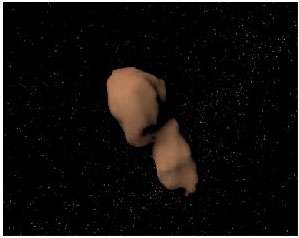
August 16th, 2005 Asteroid 4179 Toutatis

A University of Michigan-led research team has discovered that for the first time in history, scientists will be able to observe how the Earth's gravity will disrupt a massive asteroid's spin.

Scientists predict a near-miss when Asteroid 99942 Apophis passes Earth in 2029. An asteroid flies this close to the planet only once every 1,300 years. The chance to study it will help scientists deal with the object should it threaten collision with Earth.

Only about three Earth diameters will separate Apophis and Earth when the 400-meter asteroid hurtles by Earth's gravity, which will twist the object into a complex wobbling rotation. Such an occurrence has never been witnessed but could yield important clues to the interior of the sphere, according to a paper entitled, "Abrupt alteration of the spin state of asteroid 99942 Apophis (2004 MN4) during its 2029 Earth flyby," accepted for publication in the journal Icarus.

The team of scientists is led by U-M's Daniel Scheeres, associate professor of aerospace engineering, and includes U-M's Peter Washabaugh, associate professor of aerospace engineering.

Apophis is one of more than 600 known potentially hazardous asteroids and one of several that scientists hope to study more closely. In Apophis' case, additional measurements are necessary because the 2029 flyby could be followed by frequent close approaches thereafter, or even a collision.

Scheeres said not only is it the closest asteroid flyby ever predicted in advance, but it could provide a birds-eye view of the asteroid's "belly."

"In some sense it's like a space science mission 'for free' in that something scientifically interesting will happen, it will be observable from Earth, and it can be predicted far in advance," Scheeres said.

If NASA places measuring equipment on the asteroid's surface, scientists could for the first time study an asteroid's interior, similar to how geologists study earthquakes to gain understanding of the Earth's core, Scheeres said. Because the torque caused by the Earth's gravitational pull will cause surface and interior disruption to Apophis, scientists have a unique opportunity to observe its otherwise inaccessible mechanical properties, Scheeres said. Throwing the asteroid off balance could also affect its orbit and how close it comes to Earth in future years.

"Monitoring of this event telescopically and with devices placed on the asteroid's surface could reveal the nature of its interior, and provide us insight into how to deal with it should it ever threaten collision," Scheeres said.

The asteroid will be visible in the night sky of Europe, Africa and Western Asia.

The asteroid was discovered late last year and initially scientists gave it a 1-in-300 chance of hitting the Earth on April 13, 2029. Subsequent analysis of new and archived pre-discovery images showed that Apophis won't collide with Earth that day, but that later in 2035, 2036, and 2037 there remains a 1-in-6,250 chance that the asteroid could hit Earth, Scheeres said. Conversely, that's a 99.98 percent chance that the asteroid will miss Earth.

The asteroid is relatively small, about the length of three football fields. If it hit it wouldn't create wide-scale damage to the Earth, but would cause major damage at the impact site, Scheeres said.

The team of scientists also includes Lance Benner and Steve Ostro of NASA's Jet Propulsion Laboratory, Alessandro Rossi of ISTI-CNR, Italy, and Francesco Marzari of the University of Padova, Italy.

Source: University of Michigan


print this article email this article download pdf blog this article bookmark this article     Digg this Stumble it share on Facebook share on Reddit add to delicious save to Yahoo! bookmarks
4.6/5 after 5 votes


August 16th, 2005 all stories
Space & Earth /

Comments: 0
Rank: 4.6/5 after 5 votes

  • Stumble this up

  • Digg this

  • Share it:
  • share on Facebook
  • share on MySpace
  • share on Slashdot
  • rss-newsfeed
  • share on Google
  • share on Reddit
  • add to delicious
  • save to Yahoo! bookmarks
  • share on Windows Live
  • Add to Mixx!
Rating: 4.6/5 after 5 votes

  • Related Stories

  • Engage YORP drive: Light Gives Asteroids Spin
    created Mar 07, 2007 | popularity not rated yet | comments 0
  • First detailed pictures of asteroid reveal bizarre system
    created Oct 12, 2006 | popularity not rated yet | comments 0
  • Floating pile of rubble a pristine record of solar system's history
    created Jun 01, 2006 | popularity not rated yet | comments 0
  • Mars data published in Science this week
    created Jul 02, 2009 | popularity not rated yet | comments 0
  • Asteroid Attack 4 Billion Years Ago May Have Accelerated Life on Earth
    created May 20, 2009 | popularity not rated yet | comments 0

Tags


  • Physicists Demonstrate Quantum Memory with Matter Qubits
    Physicists Demonstrate Quantum Memory with Matter Qubits
    Physics / General Physics
    created Jul 03, 2009 | popularity 4.4 / 5 (17) | comments 1
  • 'Holey' Nanosheets for Wastewater Dye Removal
    Nanotechnology / Nanomaterials
    created Jul 01, 2009 | popularity 5 / 5 (5) | comments 1
  • Jellyfish Robot Swims Like its Biological Counterpart
    Jellyfish Robot Swims Like its Biological Counterpart
    Electronics / Robotics
    created Jun 26, 2009 | popularity 4.4 / 5 (8) | comments 1
  • Could Maxwell's Demon Exist in Nanoscale Systems?
    Could Maxwell's Demon Exist in Nanoscale Systems?
    Physics / General Physics
    created Jun 24, 2009 | popularity 4.4 / 5 (18) | comments 29
  • Living Safely with Robots, Beyond Asimov's Laws
    Living Safely with Robots, Beyond Asimov's Laws
    Electronics / Robotics
    created Jun 22, 2009 | popularity 4.6 / 5 (54) | comments 40
  • Other News

    China environmental phenomena monitored from space

    Space & Earth / Earth Sciences

    created 2 hours ago | popularity not rated yet | comments 0

    China is in a very seismically active area and has had many catastrophic earthquakes during its history. A joint European-Chinese team is using satellite radar data to monitor ground deformation across major continental faults ...


    California to require sun-blocking car windows

    Space & Earth / Environment

    created 4 hours ago | popularity 2 / 5 (4) | comments 6

    New cars sold in California must include windshields that block or absorb the sun's rays beginning in 2012, the state's Air Resources Board recently ruled.


    Steam billows from the cooling towers at a nuclear power generating station in Byron

    Tropical zone expanding due to climate change: study

    Space & Earth / Earth Sciences

    created 7 hours ago | popularity 3.6 / 5 (7) | comments 3

    Climate change is rapidly expanding the size of the world's tropical zone, threatening to bring disease and drought to heavily populated areas, an Australian study has found.


    Scientists: Silent tremors may foretell next Big One

    Space & Earth / Earth Sciences

    created 4 hours ago | popularity 5 / 5 (1) | comments 0

    The seismometer is snugged in its hole and tamped over with dirt. Now it's time for the stomp test.


    The least sea ice in 800 years

    The least sea ice in 800 years

    Space & Earth / Earth Sciences

    created Jul 01, 2009 | popularity 4.1 / 5 (65) | comments 61

    New research, which reconstructs the extent of ice in the sea between Greenland and Svalbard from the 13th century to the present indicates that there has never been so little sea ice as there is now. The ...