New Way of 'Seeing': A 'Neutron Microscope'
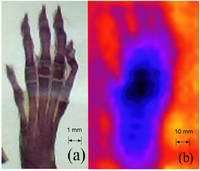
July 30, 2004 The neutron micrograph at right (b) of a rat's foot uses false color to show differences in the number of neutrons penetrating t

A prototype microscope that uses neutrons instead of light to "see" magnified images has been demonstrated at the National Institute of Standards and Technology (NIST). Neutron microscopes might eventually offer certain advantages over optical, X-ray and electron imaging techniques such as better contrast for biological samples.

Described in the July 19 issue of Applied Physics Letters,* the imaging process involves hitting a sample with an intense neutron beam. The neutrons that pass through—whose pattern reflects the sample’s internal structure—are directed into a row of 100 dimpled aluminum plates. Each dimpled plate acts like a weak focusing lens for neutrons, diverting the neutrons’ path slightly at each interface. The image then is projected onto a detector. Adelphi Technology Inc. of San Carlos, Calif., designed and demonstrated the microscope with the help of NIST scientists, who routinely use multiple lenses to focus neutron beams for other research.

In principle, neutrons could provide better image resolution than visible light because they have shorter wavelengths—as short as 1 nanometer (nm) compared to 400-700 nm. In this demonstration at NIST’s Center for Neutron Research, the microscope produced a resolution of only 0.5 millimeters and a magnification of about 10. However, Adelphi hopes to substantially improve image resolution through research to reduce lens aberrations. The company also hopes to build a compact, laboratory-scale neutron source.

Moreover, neutrons offer some unique advantages. Unlike other imaging methods, neutrons interact strongly with hydrogen, an important component of biological samples composed mostly of hydrocarbons and water. And neutrons easily penetrate samples, thereby reducing artifacts produced with other techniques requiring thin slices, staining or fixing.

Stanford University also participated in the research, which was supported in part by the U.S. Department of Energy.

Source: NIST


print this article email this article download pdf blog this article bookmark this article     Stumble it Digg this share on Facebook retweet share on Reddit add to delicious
Rate this story - 3.7 /5 (3 votes)


July 30, 2004 all stories

Comments: 0

3.7 /5 (3 votes)
  • Stumble this up

  • Digg this

  • share this

  • hide
  • Related Stories


Other News

Stars Fueled by Dark Matter Could Hold Secrets to the Universe

Stars Fueled by Dark Matter Could Hold Secrets to the Universe

Physics / General Physics

created Nov 03, 2009 | popularity 4.5 / 5 (50) | comments 41

(PhysOrg.com) -- The first stars in the universe may have been very different from the stars we see today, yet they may hold clues to understanding some of the mysterious features of the universe. These "dark ...


Second Law of Thermodynamics May Explain Economic Evolution

Second Law of Thermodynamics May Explain Economic Evolution

Physics / General Physics

created Nov 02, 2009 | popularity 4.3 / 5 (30) | comments 28

(PhysOrg.com) -- Terms such as the "invisible hand," laissez-faire policy, and free-market principles suggest that economic growth and decline in capitalist societies seem to be somehow self-regulated. Now, ...


High-performance plasmas may make reliable, efficient fusion power a reality

High-performance plasmas may make reliable, efficient fusion power a reality

Physics / Plasma Physics

created Nov 02, 2009 | popularity 4.7 / 5 (39) | comments 31

In the quest to produce nuclear fusion energy, researchers from the DIII-D National Fusion Facility have recently confirmed long-standing theoretical predictions that performance, efficiency and reliability ...


'Teapot effect' solved

Solving Teapot Effect

Physics / General Physics

created Nov 02, 2009 | popularity 4.9 / 5 (11) | comments 10

(PhysOrg.com) -- A team of scientists from France have worked out why teapots dribble at low flow rates, and how to stop them. The effect is called the "teapot effect", and solving it could finally put an ...


Laser accelerated protons to the highest energies so far

Researchers use trident laser to accelerate protons to record energies

Physics / General Physics

created Nov 02, 2009 | popularity 4.7 / 5 (6) | comments 10

An international team of physicists at Los Alamos National Laboratory has succeeded in using intense laser light to accelerate protons to energies never before achieved. Using this technique, scientists can ...