NASA Study Shows Water Could Create Gullies on Mars
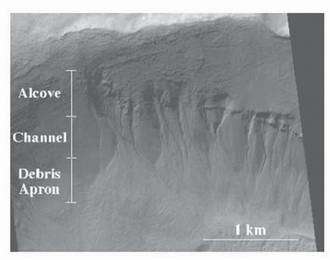
NASA scientists say liquid water formed recent gullies on Mars.
A NASA-led team will present its Mars gully findings at the American Astronomical Society's Division for Planetary Sciences annual meeting in Cambridge, England, Sept. 5, 2005.
Image: Portion of MOC image M17-00423 showing the alcove, channel, and debris apron structures of recent gullies on Mars. Scale bar is 1km.
"The gullies may be sites of near-surface water on present-day Mars and should be considered as prime astrobiological target sites for future exploration," ventured National Research Council scientist Jennifer Heldmann, principal author of the study who works at NASA Ames Research Center in California's Silicon Valley.
"The gully sites may also be of prime importance for human exploration of Mars because they may represent locations of relatively near surface liquid water, which can be accessed by crews drilling on the red planet," she added.
"If liquid water pops out onto Mars' surface, it can create short gullies about 550-yards (500-meters) long," Heldmann said. "We used a computer to simulate the flow of liquid water within gully channels," Heldmann explained.
"Our model indicates that these fluvially-carved gullies were formed in the low temperature and low pressure conditions of present-day Mars by the action of relatively pure liquid water," said Heldmann.
The science team found that the maximum length of gullies simulated in the computer models were comparable to the martian gullies studied. "We find that the short length of the gully features implies they did form under conditions similar to those on present-day Mars, with simultaneous freezing and rapid evaporation of nearly pure liquid water," Heldmann said.
In addition, images taken by the Mars Global Surveyor spacecraft show 'geologically young' small-scale features on the red planet that resemble terrestrial water-carved gullies, according to scientists.
"The young geologic age of these gullies is often thought to be a paradox, because liquid water is unstable at the martian surface," Heldmann said. At present martian air pressure and temperature, water will boil and freeze at very rapid rates, the scientists reported.
Team scientists noticed that images of some of Mars' gullies show that they taper off into very small debris fields – or no debris fields at all – suggesting that water rushing through the gullies rapidly froze and/or evaporated.
"In the martian case, fluid well above the boiling point (which is a very low temperature at Mars' low atmospheric pressure and air temperature) is suddenly exposed to the atmosphere," said Heldmann. "The difference between the vapor and ambient pressures relative to the ambient pressure is large, and flash boiling can occur, leading to a violent loss of fluid."
Scientists believe that ice probably would not accumulate in the gullies, because of the rapid evaporation of water and relatively high flow velocities, but in some cases, some ice could be carried downstream. The researchers studied computer simulations of both scenarios.
"We tested our model using known flow parameters and environmental conditions of perennial saline springs in the Mars analog environment of the Canadian High Arctic," Heldmann noted.
In addition to Heldmann, Chris McKay, also of NASA Ames; Brian Toon, Michael Mellon and John Pitlick, of the University of Colorado, Boulder; Wayne Pollard, of McGill University, Montreal, Canada; and Dale Andersen, of the SETI Institute, Mountain View, Calif., are study co-authors.
Source: NASA


