Spitzer Turns Two

August 26th, 2005 Spitzer Turns Two

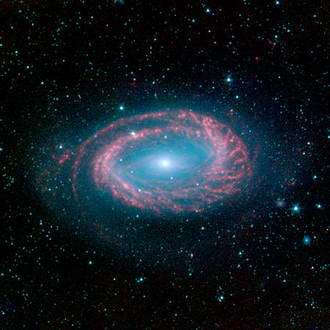
Two years ago today, NASA's Spitzer Space Telescope blasted into the same dark skies it now better understands. In just two years, the observatory's infrared eyes have uncovered a hidden universe teeming with warm stellar embryos, chaotic planet-forming disks and majestic galaxies, including the delightfully odd galaxy called NGC 4725 shown here.

This peculiar galaxy is thought to have only one spiral arm. Most spiral galaxies have two or more arms. Astronomers refer to NGC 4725 as a ringed barred spiral galaxy because a prominent ring of stars encircles a bar of stars at its center (the bar is seen here as a horizontal ridge with faint red features).

Our own Milky Way galaxy sports multiple arms and a proportionally smaller bar and ring.

In this false-color Spitzer picture, the galaxy's arm is highlighted in red, while its center and outlying halo are blue. Red represents warm dust clouds illuminated by newborn stars, while blue indicates older, cooler stellar populations. The red spokes seen projecting outward from the arm are clumps of stellar matter that may have been pushed together by instable magnetic fields.

NGC 4725 is located 41 million light-years away in the constellation Coma Berenices.

This picture is composed of four images taken by Spitzer's infrared array camera at 3.6 (blue), 4.5 (green), 5.8 (red), and 8.0 (red) microns. The contribution from starlight (measured at 3.6 microns) has been subtracted from the 5.8- and 8-micron images to enhance the visibility of the dust features.

Copyright 2005 by Space Daily, Distributed United Press International


print this article email this article download pdf blog this article bookmark this article     Digg this Stumble it share on Facebook share on Reddit add to delicious save to Yahoo! bookmarks
2/5 after 1 votes


August 26th, 2005 all stories
Space & Earth /

Comments: 0
Rank: 2/5 after 1 votes

  • Stumble this up

  • Digg this

  • Share it:
  • share on Facebook
  • share on MySpace
  • share on Slashdot
  • rss-newsfeed
  • share on Google
  • share on Reddit
  • add to delicious
  • save to Yahoo! bookmarks
  • share on Windows Live
  • Add to Mixx!
Rating: 2/5 after 1 votes

  • Related Stories

  • A Galaxy Collision in Action
    created 5 hours ago | popularity not rated yet | comments 0
  • Ultracool stars take 'wild rides' around, outside the Milky Way
    created Jun 09, 2009 | popularity not rated yet | comments 0
  • Galaxy Evolution Explorer Mission Celebrates Sixth Anniversary
    created Apr 28, 2009 | popularity not rated yet | comments 0
  • Hubble celebrates 19th anniversary with fountain of youth
    created Apr 21, 2009 | popularity not rated yet | comments 0
  • New understanding of the origin of galaxies
    created Jan 21, 2009 | popularity not rated yet | comments 0

Tags


  • Transform a ball into a rock -- or make it invisible -- using transformation optics
    Transform a ball into a rock -- or make it invisible -- using transformation optics
    Physics / General Physics
    created 10 hours ago | popularity 3.7 / 5 (3) | comments 0
  • Could a quantum motor do work?
    Physics / General Physics
    created Jul 07, 2009 | popularity 4 / 5 (12) | comments 0
  • Physicists Demonstrate Quantum Memory with Matter Qubits
    Physicists Demonstrate Quantum Memory with Matter Qubits
    Physics / General Physics
    created Jul 03, 2009 | popularity 4.3 / 5 (21) | comments 1
  • 'Holey' Nanosheets for Wastewater Dye Removal
    Nanotechnology / Nanomaterials
    created Jul 01, 2009 | popularity 5 / 5 (5) | comments 1
  • Jellyfish Robot Swims Like its Biological Counterpart
    Jellyfish Robot Swims Like its Biological Counterpart
    Electronics / Robotics
    created Jun 26, 2009 | popularity 4.4 / 5 (9) | comments 1
  • Other News

    Living fossils hold record of 'supermassive' kick

    Living fossils hold record of 'supermassive' kick

    Space & Earth / Astronomy

    created 3 hours ago | popularity 4.5 / 5 (2) | comments 1

    The tight cluster of stars surrounding a supermassive black hole after it has been violently kicked out of a galaxy represents a new kind of astronomical object and a fossil record of the kick.


    Methane-eating microbes can use iron and manganese oxides to 'breathe'

    Methane-eating microbes can use iron and manganese oxides to 'breathe'

    Space & Earth / Earth Sciences

    created 6 hours ago | popularity 4.7 / 5 (3) | comments 0

    Iron and manganese compounds, in addition to sulfate, may play an important role in converting methane to carbon dioxide and eventually carbonates in the Earth's oceans, according to a team of researchers ...


    Tremors on southern San Andreas Fault may mean increased quake risk

    Tremors on southern San Andreas Fault may mean increased quake risk

    Space & Earth / Earth Sciences

    created 5 hours ago | popularity not rated yet | comments 0

    (PhysOrg.com) -- Increases in mysterious underground tremors observed in several active earthquake fault zones around the world could signal a build-up of stress at locked segments of the faults and presumably ...


    A Galaxy Collision in Action

    A Galaxy Collision in Action

    Space & Earth / Astronomy

    created 5 hours ago | popularity 4.8 / 5 (4) | comments 1

    This beautiful image gives a new look at Stephan's Quintet, a compact group of galaxies discovered about 130 years ago and located about 280 million light years from Earth. The curved, light blue ridge running ...


    Aerial view of a flooded area in Bolivia in 2007

    'El Nino' arrives in Pacific for a months-long stay

    Space & Earth / Earth Sciences

    created 6 hours ago | popularity 3 / 5 (1) | comments 0

    US scientists on Thursday said that the El Nino warming trend of the Pacific Ocean waters has returned, bringing with it almost certain changes in weather patterns around the world.